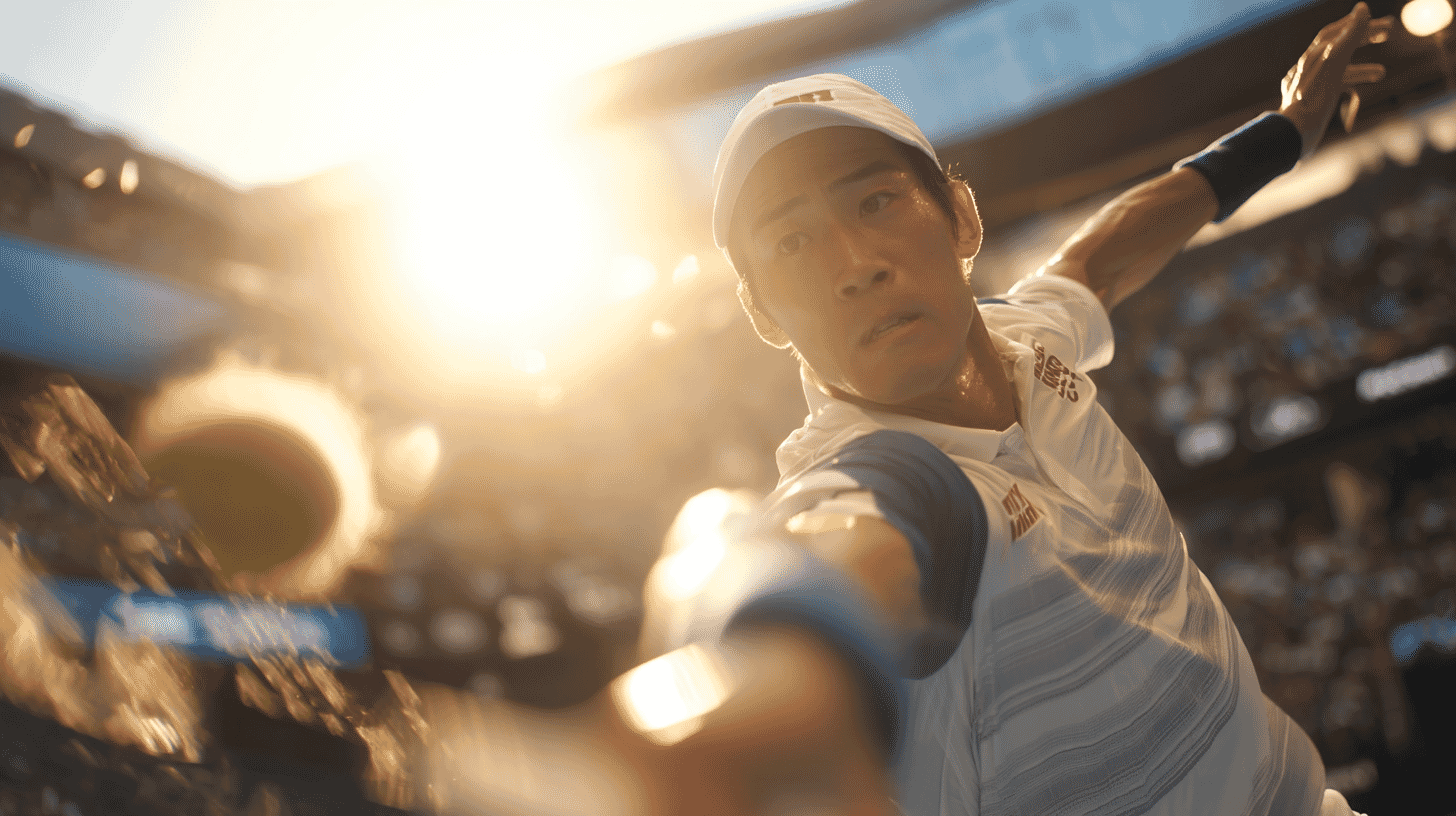
January 12, 2025, John Cain Arena in Melbourne. Kei Nishikori walked onto an Australian Open main-draw court for the first time in four years. Across the net was Thiago Monteiro of Brazil, ranked 106th, through from qualifying. Nishikori lost the first two sets, faced two match points, and by any reasonable reading was beaten. What followed was 4-6, 6-7(4), 7-5, 6-2, 6-3, a four-hour-six-minute comeback.
A Ticket Numbered 48
Nishikori was in the draw because of a protected ranking, the mechanism that lets a player sidelined by injury for six months or more enter a limited number of events using the ranking he held before the layoff. His number was 48. It appeared next to his name when the Australian Open entry list was published on December 6, 2024.
This was his 11th appearance at the tournament, dating back to his debut in 2009, and his first time in the main draw since 2021. His best results here are quarterfinals in 2012, 2015, 2016, and 2019, which makes Melbourne the Slam where he has been most consistently dangerous.
He had hip surgery in January 2022 and needed close to a year and a half to return. Ankle trouble kept him off tour again after that. The number 48 was, in its way, a measure of how long he had been gone.
Five Days in Hong Kong Moved Him 32 Places
He did not arrive in Melbourne relying purely on the exemption, though.
His 2025 season opened at the Hong Kong Open, an ATP 250 that began on New Year's Eve. Playing on a wild card, Nishikori beat former world No. 10 Denis Shapovalov (56) 6-2, 6-3, then came from a set down to take out third seed Karen Khachanov (19) 4-6, 6-3, 7-5, and beat Cameron Norrie (49) 6-3, 3-6, 6-2 in the quarterfinals. Three former top-ten players in three matches.
Shang Juncheng (50) retired ill in the semifinal, sending Nishikori into his first tour final since Brisbane in January 2019. He lost it to Alexandre Muller (67) 6-2, 1-6, 3-6, leaving a 13th career title still out of reach. But the January 6 rankings moved him up 32 places to 74th, back inside the top 100 for the first time in roughly two years and seven months and second among Japanese men.
A player who entered on a protected ranking had, by the time the tournament started, climbed back to that level on merit. The first round in Melbourne sat on top of that momentum.
Four Hours, Six Minutes, Two Match Points
The Monteiro match itself offered little comfort.
Nishikori lost the first set 4-6 and the second on a 4-7 tiebreak. Early in the third he generated seven break points on Monteiro's serve and converted none of them. Then, at 4-5, 30-40, after a double fault at 30-30, came the first match point against him.
He saved it. He saved the second one after deuce. From there the match turned: the third set went his way 7-5, the fourth 6-2, the fifth 6-3. It was the 37th five-setter of his career and his 29th win in one.
It was also his first win at the Australian Open since his 2019 quarterfinal run. Afterwards Nishikori was blunt about how it had gone, saying his opponent had deserved to win on the balance of play.
The Second Round
Three days later he met 12th seed Tommy Paul of the United States.
Nishikori took the first set 7-6(3), and to that point the match was even. After that it collapsed: 0-6, 3-6, 1-6. The four hours and six minutes spent in the first round showed up on the scoreboard.
A second-round exit, then. But getting back into a main draw, winning a match, and playing a second round were all things that had been out of reach since 2022.
The Climb to No. 4, and the Decade After
At the 2014 US Open, Nishikori became the first Japanese man to reach a Grand Slam singles final. In March 2015 he hit a career-high world No. 4. He finished with 12 ATP singles titles and four Masters 1000 finals. At the 2016 Rio Olympics he beat Nadal in the bronze medal match, Japan's first Olympic tennis medal in 96 years. He rewrote what Asian men's tennis was assumed to be capable of.
The back half of his career was a negotiation with his own body. Right wrist, right elbow, hip. From 2019 onward the pattern was withdrawal and return, and hip surgery in January 2022 took him out for a long stretch. He won his comeback event on the Challenger circuit, then hurt his left knee the following month and disappeared again.
Playing at the top into your late thirties is no longer unusual. Roger Federer went until 41, Rafael Nadal until 38. What a player past his physical peak carries is accumulated reading of opponents, match management, and an unwillingness to fall off the cliff. The first round in Melbourne was two hours of exactly that, plus two more.
May 2026: The Announcement
Sixteen months after that match, the story reached its end point.
On May 1, 2026, Nishikori announced on social media that he would retire at the end of the 2026 season. He was 36, in his 19th year as a professional. "Honestly, part of me still wants to keep standing on court," he wrote. "But when I look back at all of it, I can say with my head up that I gave it everything."
He finished with 451 tour-level wins, and his record in matches that went to a deciding set was 72.4 percent, among the best in the sport's history. The four hours and six minutes against Monteiro were not an exception but a sample of that number.
His ranking had fallen to 464th by April 20, 2026, and to 558th by May 4. A stress fracture in his back troubled him through 2025, and after losing at a Challenger event in Yokohama that November he said plainly that he could not see what came next. His last match before an open-ended rest was a second-round loss at the Savannah Challenger in the United States, an event he had not played in 16 years. It was a year of departures across the men's game: Stan Wawrinka, Milos Raonic, Gael Monfils, David Goffin, and Roberto Bautista Agut all announced retirements in 2026.
Read from there, the 2025 first round takes on a different colour. It was not the start of a resurgence. It was the old Nishikori surfacing once more, late.
What the Four Hours Left Behind
He never won a Grand Slam. He never reached No. 1. What he did was install, in Japanese men's tennis, the assumption that the top ten is a reachable target. Yoshihito Nishioka and Shintaro Mochizuki began their careers inside that assumption.
The four hours and six minutes of January 12, 2025 did not turn into a deep run. But on that day in Melbourne, a player two sets down saved two match points and won. The scoreline is what goes into the record. It is not all that was left.
Are there athletes in your country who fought their way back after injury and long absences? How do fans where you live tend to treat the final years of a career like that? We would like to hear about it in the comments.
References
- https://www.ausopen.com/
- https://www.atptour.com/en/players/kei-nishikori/n552/overview
- https://news.tennis365.net/news/today/202501/150892.html
- https://tennis.jp/news/archives/345993
- https://news.tennis365.net/news/today/202605/157366.html
- https://news.tennis365.net/news/today/202605/157322.html - Tennis365 on the retirement announcement



Global Discussion
15 comments