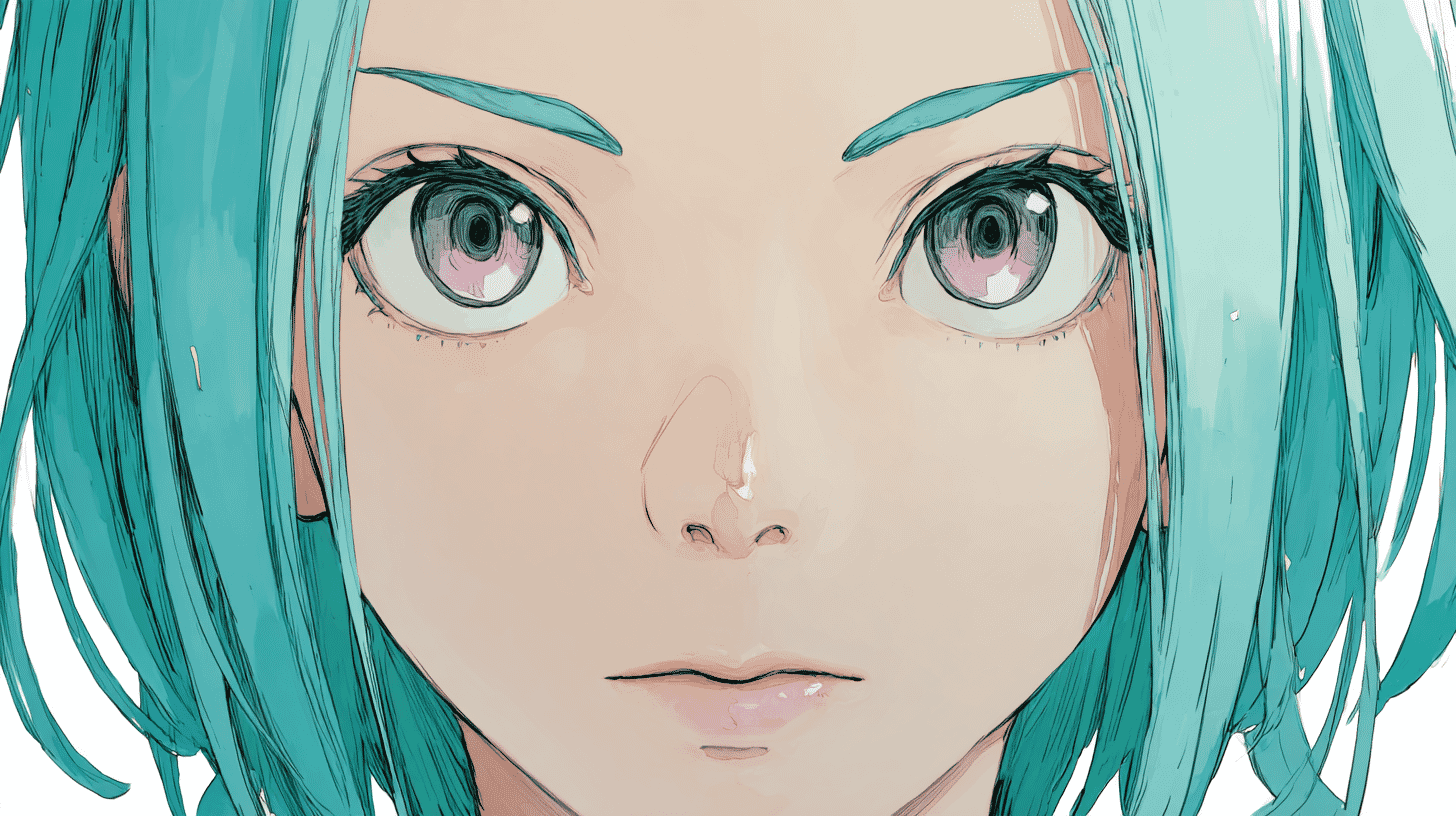
🤖🏄 Robots. Surfing. In the sky. Yes, really. In 2005, studio BONES made a 50-episode anime about giant mechs riding trapar waves on surfboards. It sounds ridiculous, and many viewers dropped it within the first 10 episodes. But 20 years later, the creators still call it their masterpiece. Here are five reasons why Eureka Seven deserves a second look in 2026.
The YouTube Comment That Started This
On YouTube, under the fourth opening theme "sakura" from Eureka Seven's final arc, there was this comment:
"I haven't watched a single episode, but the fact that I can tell just from this song that it's the final stretch, that's what makes it a masterpiece."
I laughed. And I thought: this is exactly the person who needs to watch it. So let me make the case for Eureka Seven.
First aired in 2005, 50 episodes, produced by studio BONES. It's a sci-fi mecha anime where robots surf through the sky on energy waves, which, written out like that, sounds like it makes no sense. In 2025, it celebrated its 20th anniversary and continues to be passed down among fans like a cherished secret.
And yet, Eureka Seven's reputation in the broader anime community is... not great.
The Honest Truth: Yes, It Has Problems
Before making the case for Eureka Seven, let's acknowledge what everyone says about it:
- The first 20 episodes are rough. The protagonist Renton is an annoying kid. Holland, the team leader, punches him for no good reason. The crew of Gekkostate treats him like garbage. Many viewers quit before the story finds its footing.
- 50 episodes is a LOT. In today's era of 12-episode seasons, committing to 50 straight episodes with no seasonal breaks is a big ask. There's even a soccer episode in the middle that baffles fans worldwide.
- The world-building is dense. Scub Coral, Compac Drive, trapar, the Limit of Questions: the show throws mountains of original terminology at you with minimal explanation. At one point, it casually drops the concept that the universe will tear apart if the total mass of intelligent life exceeds a certain threshold.
- Every sequel is disappointing. The movie Pocket Full of Rainbows turned allies into villains. The TV sequel AO repositioned Renton as something close to a final boss. The Hi-Evolution film trilogy was so poorly received that fans called it "footage made for pachinko machines." The sequels systematically undermined the original's beautiful ending.
All fair points. But here's the other side.
"Underrated" or Just "Not Popular"?
CBR called Eureka Seven "one of the most underrated mecha anime of the past 20 years." On fan forums, someone offered a sharper take: "It's not underrated. It's just not popular. That's a different thing."
The case for the defense:
- One of the greatest romances in anime history. Fans consistently say you should watch it not for the mechs or the trapar waves, but for Renton and Eureka's love story. Built over 50 episodes, their relationship feels earned and genuine in a way few anime romances achieve.
- It's not really a mecha show. One IMDb reviewer wrote that classifying it as mecha "is a crime." Most people who finish it realize it's a character drama wearing a robot suit.
- The length IS the point. Those "painful" early episodes and the "excessive" runtime are actually what make the payoff so powerful. The emotional gut-punches in episodes 26 and 48 only work because of 25 and 47 episodes of buildup.
- Unmatched style and music. Opening themes like "DAYS," "Shōnen Heart," "Taiyō no Mannaka e," and "sakura." Ending theme "Himitsu Kichi" (Secret Base). Every episode subtitle is named after a Western rock or electronic song. The show's subcultural aesthetic hasn't aged a day in 20 years.
So here are five specific reasons to watch it now, in 2026.
Reason 1: Everyone's First Time
For the 20th anniversary in 2025, series composer Dai Sato shared this:
"We were 35 years old at the time. It was my first time as series composer, Kyoda-san's first time directing a TV series, and Yoshida-san's first time doing character design. It was a challenge where we threw everything we had into the work. That was Eureka Seven."
Director. Series composer. Character designer. All three key staff members were doing it for the first time. This audacious lineup completed an original 50-episode, four-season anime, and looking at their subsequent careers makes this "debut" even more remarkable.
Dai Sato (Series Composer) had already written for Cowboy Bebop, Ghost in the Shell: Stand Alone Complex, and Samurai Champloo, but always as a contributing writer, never as the person overseeing the whole narrative. Eureka Seven won him the Tokyo Anime Award for screenplay in 2006. He went on to lead Ergo Proxy, Eden of the East, and Space Dandy, and has handled series composition for Pokémon since 2023. Even so, his 20th anniversary comment called Eureka Seven "my debut as series composer, and my defining work."
Tomoki Kyoda (Director) entered the anime industry after being blown away by Evangelion, served as assistant director on RahXephon at BONES, then took on Eureka Seven as his first TV series. He later contributed to Space Battleship Yamato 2199 and served as storyboard director on Expelled from Paradise. But his defining work remained Eureka Seven: he has spent 20 years with the franchise, from the movie Pocket Full of Rainbows through the entire Hi-Evolution trilogy.
Kenichi Yoshida (Character Design) worked at Studio Ghibli on Only Yesterday, Porco Rosso, and Princess Mononoke before going independent. Eureka Seven was his first character design credit, and it won the Tokyo Anime Award for character design. He later designed characters for Yoshiyuki Tomino's Gundam: Reconguista in G and Mitsuo Iso's The Orbital Children (Netflix). His X profile lists just three works: "Animator. King Gainer, Eureka Seven, G-Reco." Eureka Seven sits right in the middle.
All three built solid careers afterward, and none of them treats Eureka Seven as a stepping stone or a youthful mistake. Knowing that the rough opening arc, the wandering middle and the explosive back half all came from three people emptying the tank on their first big job changes how the show reads.
Reason 2: Miyano Before He Was Famous, and the Night Koshimizu Leveled Up
Moondog, the lowest-ranking member of Gekkostate, was voiced by Mamoru Miyano, 21 when the show went on the air. In his 20th anniversary comment, he recalled:
"I had very few anime roles at the time. I'm deeply grateful for the new experiences this show gave me."
When the Hi-Evolution trilogy concluded, he added:
"I was just starting out as a voice actor, still completely green. Moondog gave me so much, range as a performer, courage as an actor, and things I'd carry with me for my entire career."
This is the same Miyano who would go on to voice Light Yagami in Death Note, Setsuna F. Seiei in Gundam 00, Tokiya in Uta no Prince-sama, and dub Rooster in Top Gun: Maverick. Moondog, a pretty blond boy who inexplicably slips into a rural dialect when he gets emotional, was fumbling to find his place in Gekkostate in exactly the same way Miyano was fumbling to find his place in the industry.
And Miyano wasn't the only one. The moment Ami Koshimizu transformed as a performer is captured in this show.
Koshimizu was 19 at the time, having debuted with Ashita no Nadja and building her résumé with School Rumble. In Eureka Seven, she played Anemone, a capricious, half-mad girl who serves as the protagonists' rival. For most of the series, she functions as an antagonist.
Then episode 48, "Ballet Mécanique," changes everything.
Anemone's inner world is laid bare for the first time, culminating in her reunion with Dominic. Koshimizu's performance completely steals the show from the lead couple, Renton and Eureka. Through delicate inner monologue, she reveals the "ordinary girl" hiding beneath the villain, and destroys every viewer's composure. Forty-eight episodes of "hateable character" are flipped in a single episode. That scene doesn't work without that performance.
How big was the impact? The second Hi-Evolution film is titled simply ANEMONE. A supporting character was promoted to movie protagonist. Renton's voice actress Yuko Sanpei acknowledged it at the premiere: she joked about having her lead role "completely hijacked" by Anemone and Dominic in episode 48, adding that the film proved "how beloved they are by the fans."
Koshimizu herself has said: "I debuted as a voice actress at 16. Without Eureka Seven, without Anemone, the voice actress I am today simply wouldn't exist." She went on to play Kallen in Code Geass, Holo in Spice and Wolf, and Ryuko in Kill la Kill. The exact moment she leveled up as a performer? It's right there in episode 48.
Reason 3: The Macross Dream Team Built an Air War Without Macross
The staff credits for Eureka Seven read like an animation history textbook.
Main mechanical design: Shoji Kawamori, the man who created Macross's Valkyrie. Conceptual design: Kazutaka Miyatake, the legend who built Macross's world and the person who first used the phrase "Itano Circus" in a 1982 magazine interview. Special effects director: Yasushi Muraki, who joined at character designer Kenichi Yoshida's invitation.
That last name matters. Animator Ichiro Itano developed the "Itano Circus," the technique where swarms of missiles trace complex trajectories while the camera whips through space at high speed. Only three animators were recognized by Itano himself as having mastered the technique: Hideaki Anno, Masami Goto, and Yasushi Muraki.
Muraki served as special effects director across all 50 episodes of Eureka Seven, crafting breathtaking aerial combat for a weekly broadcast schedule. The creators of Macross built a full-commitment air war in an original show that wasn't Macross.
Most people think "Itano Circus = lots of missiles." Itano himself has repeatedly said otherwise: "The core is the camerawork." Whether it's one missile or a hundred, what matters is how a high-speed camera captures high-speed objects, and what lens effects and deformation get applied to that.
Muraki has a distinct style within this tradition. Where Itano draws missile trajectories with exhaust trails, Muraki tends to express the Itano Circus through lasers and beams. That's exactly why Eureka Seven's aerial battles use laser fire and LFO maneuvers rather than Macross-style missile barrages.
In other words, Eureka Seven proved that the Itano Circus survives the removal of its most recognizable signature. Robots surfing through the sky, lasers flying, cameras racing to keep up. Strip out the smoke trails and the speed and depth are still there.
Reason 4: A Ghibli-Trained Designer Fought Against Cookie-Cutter Characters
Character designer Kenichi Yoshida has a clear artistic mission. Since the 1980s, anime character design has increasingly prioritized 3D consistency, making sure characters look correct from any angle. The unintended result was homogenization: the loss of drawings that might not be ideal for animation but possess a unique, captivating quality. Yoshida has consciously worked to restore that, giving drawn characters the kind of screen presence live-action actors bring to film.
In 2026, as AI-generated character designs accelerate the trend toward visual uniformity, this philosophy resonates even more strongly than it did in 2005. The reason Eureka Seven's characters still radiate distinctive charm after 20 years isn't an accident. It's the product of a deliberate stance.
Reason 5: The "Eureka Generation" Is Now Running the Industry
Dai Sato also revealed in his anniversary comments:
"Over the past 20 years, especially recently, I keep meeting people at work, in the music industry and the anime industry, who tell me 'I watched Eureka Seven' or 'I loved Eureka Seven.'"
The teenagers who watched Eureka Seven in 2005 are now in their late 30s and 40s, working as creators themselves. The same dynamic Evangelion had on later anime is happening here, with one difference: where Eva's influence shows up as visual or directorial homage, Eureka Seven's sits at the level of creative posture, in "boy meets girl," in fusing music with subculture, in spending 50 episodes to portray human beings honestly. It incubated quietly and is only now surfacing.
Watch It. At Least Through Episode 26.
Every flaw is real. The early episodes are painful. 50 episodes is long. The world-building is confusing. The sequels? Skip them.
But episodes 26 ("Morning Glory") and 48 ("Ballet Mécanique") remain. In a 2021 fan vote, 48 came first, 26 second, and the finale "Star Song" third. What they deliver is the kind of emotional authenticity only 50 episodes of buildup can produce, and in an era of 12-episode seasons that has become genuinely hard to find.
To the person who heard the fourth opening theme and could tell it was the final stretch: your instinct was right. That's exactly why you should start from episode 1. By episode 26, you'll cry.
What's the longest anime you've ever committed to, and was it worth the ride? We'd love to hear from you, wherever you are in the world.
References
- Eureka Seven 20th Anniversary Official Site
- Comic Natalie, Eureka Seven 20th Anniversary Cast Comments (April 2025)
- Comic Natalie, Eureka Seven 20th Anniversary Staff Comments (November 2025)
- CBR, Eureka Seven Is One of the Most Underrated Mecha Anime
- Movie Natalie, ANEMONE Premiere Stage Greeting (2018)
- MANTANWEB, Ami Koshimizu on Anemone (November 2021)




Global Discussion
0 comments