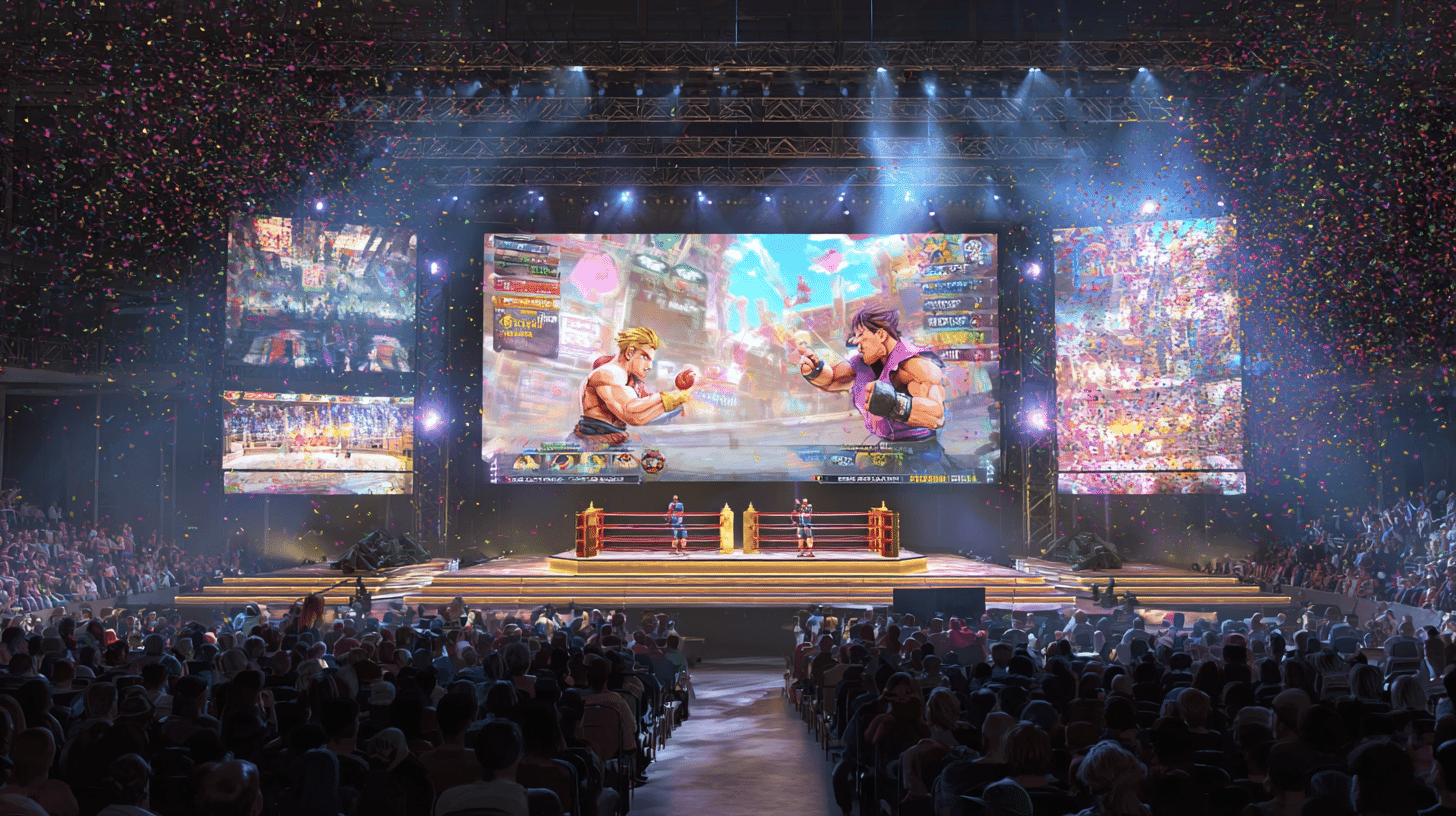
EVO Japan 2026 just rewrote two pieces of fighting game history at once. Over three days at Tokyo Big Sight, the event drew 34,000 attendees, the largest crowd in its history under Levtech's title sponsorship, and the Street Fighter 6 bracket pulled in 7,168 entrants, earning a Guinness World Record™ for the largest tournament for a single fighting video game ever held. The previous record was held by EVO 2023 in Las Vegas, with 7,083. ZETA DIVISION's Yamaguchi beat Punk in the grand final to become the first Japanese player ever to win the SF6 division at EVO Japan. Japan didn't just host the world's biggest fighting game event of all time, it took home the trophy too. Meanwhile, in the same hall, a 154-entrant tournament for a broken 20-year-old arcade game called Hokuto no Ken pulled 10,000 concurrent stream viewers and quietly reminded everyone that scale isn't the only metric the FGC cares about.
EVO Japan 2026 at Tokyo Big Sight: A Three-Day Snapshot
EVO Japan 2026 presented by Levtech ran May 1–3, 2026 at Tokyo Big Sight (East Halls 1–3), the country's largest convention center, located on Tokyo's man-made island in Koto Ward. (For Western readers: Tokyo Big Sight is roughly Japan's equivalent of the Las Vegas Convention Center, it also hosts Comiket, the world's largest doujin event.)
Across three days, the event recorded:
- 34,000 cumulative attendees, the highest in EVO Japan history under the current sponsorship arrangement
- 9,717 total entries across 12 main tournament titles
- Players from 71 countries and territories
- A total prize pool of ¥30 million (approximately US$194,000)
The floor wasn't just brackets and matches. Side tournaments run by community organizers, exhibitor booths, broadcast studios, and main-stage segments turned the venue into a multi-layered FGC festival, with competitors, spectators, stream viewers, publishers, and partner companies all sharing the same hall.
The Guinness World Record: 7,168 SF6 Entrants Beat EVO 2023's 7,083
The day's headline moment came when Guinness World Records officially certified the Street Fighter 6 bracket as the "Largest tournament for a single fighting video game" in history. The award was presented just before Top 8 began, with EVO General Manager Rick Thiher, EVO Japan Operations Chair Yasuaki Matsuda, Tournament Director Hiroaki Inaba, and Street Fighter 6 Tournament Manager Fusuke Toyota representing the team on stage.
The previous record, also held by Street Fighter 6, was set at EVO 2023 in Las Vegas with 7,083 entrants. EVO Japan 2026 topped that by 85 players, finalizing at 7,168.
A detail worth dwelling on: that 7,168 figure is larger than the combined total of all eleven other titles at the event. Tekken 8 came second with 851 entrants. Guilty Gear Strive third with 692. The gap reflects how singular Street Fighter 6's pull is in Japan, where the game's grassroots scene is unusually deep.
Thiher commented, "We knew Evo Japan was going to be record-breaking, but we are honored to be recognized by Guinness World Records." Two-time EVO champion Ryan Hart, inducted into the EVO Hall of Fame the same weekend, added that watching fighting games scale up over thirty-plus years culminate in this moment was deeply moving.
Yamaguchi's Win: A Decade of Mentorship Paid Off in Real Time
The Street Fighter 6 division was won by Eisuke "Yamaguchi" Yamaguchi of ZETA DIVISION, playing Mai Shiranui. He defeated EVO 2024 champion Victor "Punk" Woodley (Cammy) 3–1 in the grand final, claiming ¥4 million (approximately US$25,800) along with qualification spots for Capcom Cup 13 and the 2026 Esports World Cup in Riyadh.
Here's the part that turned hardcore FGC viewers misty: Yamaguchi and Higuchi (third place, Guile) are both alumni of the Shinobism program, a long-running mentorship initiative founded by former EVO champion Momochi and his wife, professional player Chocoblanka. Roughly a decade ago, both players were unknown teenagers brought into Momochi's house-team to learn the game from the inside. Seeing two of his students place first and third at the largest fighting game tournament in history is the kind of full-circle moment that doesn't happen by accident, it's the visible payoff of one of the FGC's most deliberate long-term player development structures.
Yamaguchi posted on X (translated): "This is the greatest possible repayment to everyone who has stuck with Street Fighter and fighting games all these years." A clip from Momochi's stream, showing him and Chocoblanka watching the grand final tense and wordless, then erupting at the final hit, made the rounds across FGC social media.
The full Top 8:
| Place | Player | Character | Country | Notes |
|---|---|---|---|---|
| 1 | Yamaguchi | Mai | Japan | ZETA DIVISION, Shinobism alum |
| 2 | Punk | Cammy | USA | EVO 2024 champion |
| 3 | Higuchi | Guile | Japan | Shinobism alum |
| 4 | Hope | A.K.I. (Modern) | Taiwan | |
| 5–8 | Shuto, naooonn, NuckleDu, takepi | , | mixed |
Yamaguchi's run was nearly flawless through the winners' side. His toughest test came in the upper-bracket semis against Hope's Modern A.K.I., he survived a five-game set 3–2, before clearing his Shinobism teammate Higuchi 3–1 in the upper-bracket final.
Upsets and the MenaRD "Kemonomichi Hangover"
There were genuine upsets in the SF6 bracket. Capcom Cup 12 champion Sahara was sent to losers by Yamaguchi himself, then eliminated by yukaro. Fan favorite blaz lost to naooonn and was finished off by Punk on the way down.
But putting MenaRD's early loss in the "upset" bucket is inaccurate, and the context here is more interesting than the standard "Western media missed the story" narrative would suggest. The story was actually well-documented in English. The gap was somewhere else entirely.
Two days before EVO Japan opened, on April 29, 2026, MenaRD was at Club Citta in Kawasaki for "Kemonomichi FT10 / Evo Legends Live", a legendary first-to-10 series against Daigo Umehara. MenaRD on Blanka, Umehara on Akuma. MenaRD won 10–6. "The Bull beats the Beast", a Japanese-FGC-history-making set, the first time anyone has taken down Umehara in a long-format match like this in the SF6 era. The match itself originated in February 2025, when MenaRD publicly challenged Umehara on X with a post praising Daigo as "the greatest player ever at long sets" and asking what they could do if they each spent months preparing for a single set. A year and a half in the making.
Crucially, the buildup was extensively covered in English long before EVO Japan. The official Kemonomichi site published a three-part English translation ("On the Road" Vols. 1–3) of Daigo's reflections on FT10 mindset, including Tokido's character study of MenaRD and Daigo's admission that his initial reaction to the challenge was skepticism, "a flex from a player adding to his trophy collection", before MenaRD's sincerity flipped his view. DashFight ran a detailed piece in late March covering the negotiation history (MenaRD wanted a later date), the rule structure (character lock, color lock, stage rotation every five games), and Daigo's evolving view of MenaRD's seriousness. EventHubs had been tracking the storyline from MenaRD's original Feb 2025 challenge tweet onward. Core-A Gaming, the most-watched documentary channel in English-language FGC media, produced "Daigo's Road to MenaRD" as a video essay walking through Daigo's FT10 history (Shen, Infiltration, Tokido). And the "prep-time Daigo" meme, Daigo as the FGC's Batman, undefeatable given enough preparation, has been firmly embedded in English-language SF discourse for years.
One nuance the English coverage couldn't quite capture, though, surfaces only on Daigo's own stream. The English write-ups generally framed Daigo's resistance to MenaRD's later-date proposal as "balance patches could disrupt prep", leaving whose prep ambiguous. On stream, Daigo was specific: the prep he was protecting wasn't his own, it was MenaRD's. Paraphrasing his explanation: "I'm not really winning tournaments anymore, so balance patches barely affect me. But you're still active in the competitive scene, if a patch hits, it's going to seriously disrupt your tournament prep. That's why we should do this now, not later." A 45-year-old legend pushing back on a date proposal out of consideration for the competitive schedule of the opponent who's there to dethrone him. That's the kind of small character beat that doesn't quite cross language barriers, and once you know it's there, the entire match gains another layer of weight.
So the gap here wasn't Japan versus the West. It was hardcore FGC followers versus casual SF6 viewers. For anyone tracking the FGC press in either language, MenaRD's early loss at EVO Japan was a fully expected outcome. He had publicly stated that other tournaments could be sacrificed for this set, and that quote was already circulating in English. His month of preparation was almost exclusively for the Akuma matchup. Walking into a 7,000-player bracket with that level of focused-but-narrow prep, an early exit to a Japanese player named "Kobashiri" in the early rounds was structurally baked in. He won what he came to win. Losing the rest was the price.
There's also a strategic argument worth restating: MenaRD won EVO Japan 2025 and EVO Las Vegas 2025 back-to-back. Choosing Kemonomichi over a clean EVO Japan run wasn't an accident, it was a conscious trade of ranking points and prize money for a place in fighting game history. Beating Daigo in a long set is something you can do exactly once. He chose the once.
Even with that, a 7,000+ player bracket creates real top-tier risk. Sahara's and blaz's losses were genuine upsets. International commenters increasingly framed the bracket carnage as proof that Japan's mid-tier ladder is now ahead of the global average baseline, not just at the very top.
And Then There's Hokuto no Ken, the FGC's Beloved Broken Masterpiece
EVO Japan 2026 had one more tournament that absolutely deserves its own section. The arcade version of Fist of the North Star, Hokuto no Ken (2005, SEGA, developed by Arc System Works on the ATOMISWAVE board). Entry count: 154, roughly 1/45th the size of the SF6 bracket. And yet the EVO Japan official YouTube broadcast pulled 10,000 concurrent viewers for its grand finals, a viewership-to-entrant ratio that's frankly absurd, and a number SF6 broadcasters would happily kill for.
For readers outside Japan: Hokuto no Ken is the FGC's most celebrated "beloved kusoge" (literally "shit game"), meaning a game everyone admits is structurally broken and yet has, after 20 years of obsessive play, become competitively unmissable.
Some history. When the game launched in 2005, the consensus was that the character Toki was so overpowered the game was unbalanced beyond repair. Two decades of community research arrived at a much funnier conclusion: every single character is broken. The game is, in the language of its source material, well and truly post-apocalyptic.
The competitive vocabulary alone tells the story. There's "Basket", an infinite combo that exploits a quirk where characters bounce dramatically once a hit-count threshold is reached. There's "Traveling", a glitched high-speed dash to the corner. There are instant-death combos, Shin's invincibility bug, Rei's slide bug, the famous time-stop glitch. None of these terms exist in normal fighting game discourse.
The official EVO Japan rules read, in part: "Shin's invincibility bug, Rei's slide bug, time-stop, and any other bugs that obstruct the progression of the game are prohibited. Use of these will result in disqualification." Which is to say: the truly broken stuff has to be banned, or no tournament happens at all. And what's left after all those bans is still an instant-kill combo arms race. Twenty years in, the community has perfected a meta-game whose central question is: "Within this disaster, which broken things should I choose?"
The 2026 winner was K.I (Yuda / Rei), defeating Yuttori (Raoh / Toki) in grand finals. The detail worth highlighting: K.I also won the Hokuto no Ken division at the 2008 edition of Tougeki, the legendary Japanese arcade-game super-tournament. He has been competitively playing this same broken game for roughly 30 years. Eighteen years after his first major title in it, he won it again. In his post-victory interview, K.I said he plans to "buy four more Hokuto no Ken arcade boards and donate them to game centers around Japan", on top of the four boards he already owns. Pure FGC love.
For international FGC observers, Hokuto no Ken has become a kind of shorthand for the depth of Japan's fighting game culture. In the very same hall where SF6 was setting a Guinness record with 7,168 entrants, 154 people were sitting at 20-year-old ATOMISWAVE boards trading instant-kill combos for the love of it. That coexistence is what EVO Japan actually is. A purely commercial esports event would have cut Hokuto no Ken years ago. EVO Japan keeps it. That decision is the most authentic answer to "what does this scene value?" you'll get all year.
The Relationship to EVO Las Vegas: Japan as the Season-Opening Major
EVO 2026 ran June 26–28 at the Las Vegas Convention Center. Ahead of it, commentators including Dot Esports wondered whether Las Vegas would take the record back. It did not: Street Fighter 6 drew 2,416 entrants there, nowhere near EVO Japan's 7,168, and the Guinness mark still belongs to Tokyo. MenaRD won the title, beating RIDDLE ORDER's Shigematsu in a Blanka mirror after a bracket reset, going back-to-back and taking his fourth EVO championship. Yamaguchi did not reach the final bracket.
The EVO brand now operates as a global circuit, Japan in May, Las Vegas in June, France in October, with Singapore added from 2027, and EVO Japan has cemented its role as the season-opening major that everyone watches first.
What Reddit's r/FGC and r/StreetFighter Talked About
Threads on r/FGC and r/StreetFighter in the days after the event clustered around seven main conversations:
1. Japan's mono-title concentration is unusual. Western FGC scenes spread across SF6, Tekken 8, Mortal Kombat, Guilty Gear, Smash, and increasingly 2XKO. Japan, by contrast, channels overwhelming numbers into Street Fighter, to the point that one game outdraws eleven others combined at the country's biggest event. This is a structural difference between the regions, not a transient one.
2. The Shinobism payoff is something Western FGC mostly lacks. US-based posters specifically pointed out that there is no equivalent in North America to a decade-long mentorship program with two veteran pros effectively running a stable of young talent.
3. MenaRD's choice was framed as career-defining, not as an upset. r/FGC and r/StreetFighter regulars had been tracking the Kemonomichi storyline since MenaRD's original challenge tweet in February 2025. The English translation of MenaRD's "other tournaments can be sacrificed for this set" stance had been quoted in coverage for weeks. So when MenaRD went out early at EVO Japan, the dominant Reddit reading wasn't "wow, upset", it was "respect, he chose the once." The discussion centered on the trade itself: choosing the FT10 over a possible third consecutive EVO title. The popular framing was that this is what professional decision-making at MenaRD's level actually looks like, legacy over ranking points, history over prize money. "Prep-time Daigo" references showed up in roughly half the threads.
4. Punk's run was the American FGC's emotional anchor. With MenaRD checked out by design, Sahara, and blaz all out early, Punk's losers' bracket gauntlet, beating blaz, Shuto, and Higuchi to reach grand finals, was praised even by his harshest critics. (His backstage proposal to his now-fiancée mid-event got a lot of attention too, though some posters debated whether the bathroom-area location quite stuck the landing.)
5. Tekken 8's Arslan Ash finishing 9th was the other big upset. The multiple-time EVO Tekken champion experimented with Zafina and paid for it. Across Tekken Twitter and r/Tekken, the consensus was: never bring a new character to EVO Japan. He answered in June by winning Tekken 8 at EVO 2026, his eighth EVO title.
6. Hokuto no Ken became the FGC's wholesome moment of the weekend. International r/FGC threads reframed the game as the strongest signal that Japan's scene cares about something other than commercial scale. "Only Japan would still be running a 154-entrant ATOMISWAVE bracket and pulling 10K viewers for it" was the dominant sentiment, and it was meant as the highest compliment. There's a kind of respect-beyond-nostalgia building around games like this in international FGC discourse.
7. Is "biggest" the right thing to celebrate? A small but vocal section of the FGC questioned whether sheer participant numbers should be the headline statistic. The counterpoint, fairly: EVO Japan ran the bracket clean and finished on time. That itself is a flex.
What's Next: Capcom Cup 13, EWC 2026, and Ingrid Drops May 28
EVO Japan 2026 was the first qualifier for Capcom Cup 13. Yamaguchi and Punk both punched their tickets to that and to EWC 2026 in Riyadh this July. The next big SF6 stops were Combo Breaker 2026 (May 22–24, Chicago) and EVO 2026 in Las Vegas in late June.
Capcom also released the final character of Street Fighter 6's Year 3 DLC, Ingrid, on May 28, 2026. Three years post-launch, with the meta shifting again, the game's competitive shelf life shows no signs of cooling.
How is it in your country?
How big are offline fighting game tournaments where you live? Is your local FGC organized around a single dominant title, or spread across many? Are there any mentorship programs producing top players in your region the way Shinobism has in Japan? Does any event near you come even close to the scale of 7,000+ entries for a single game? And, this is the one we're most curious about, does your country have its own Hokuto no Ken? A small, broken, ancient game that a die-hard community refuses to let die? Share your scene with us. We'd genuinely like to hear it.



Global Discussion
15 comments