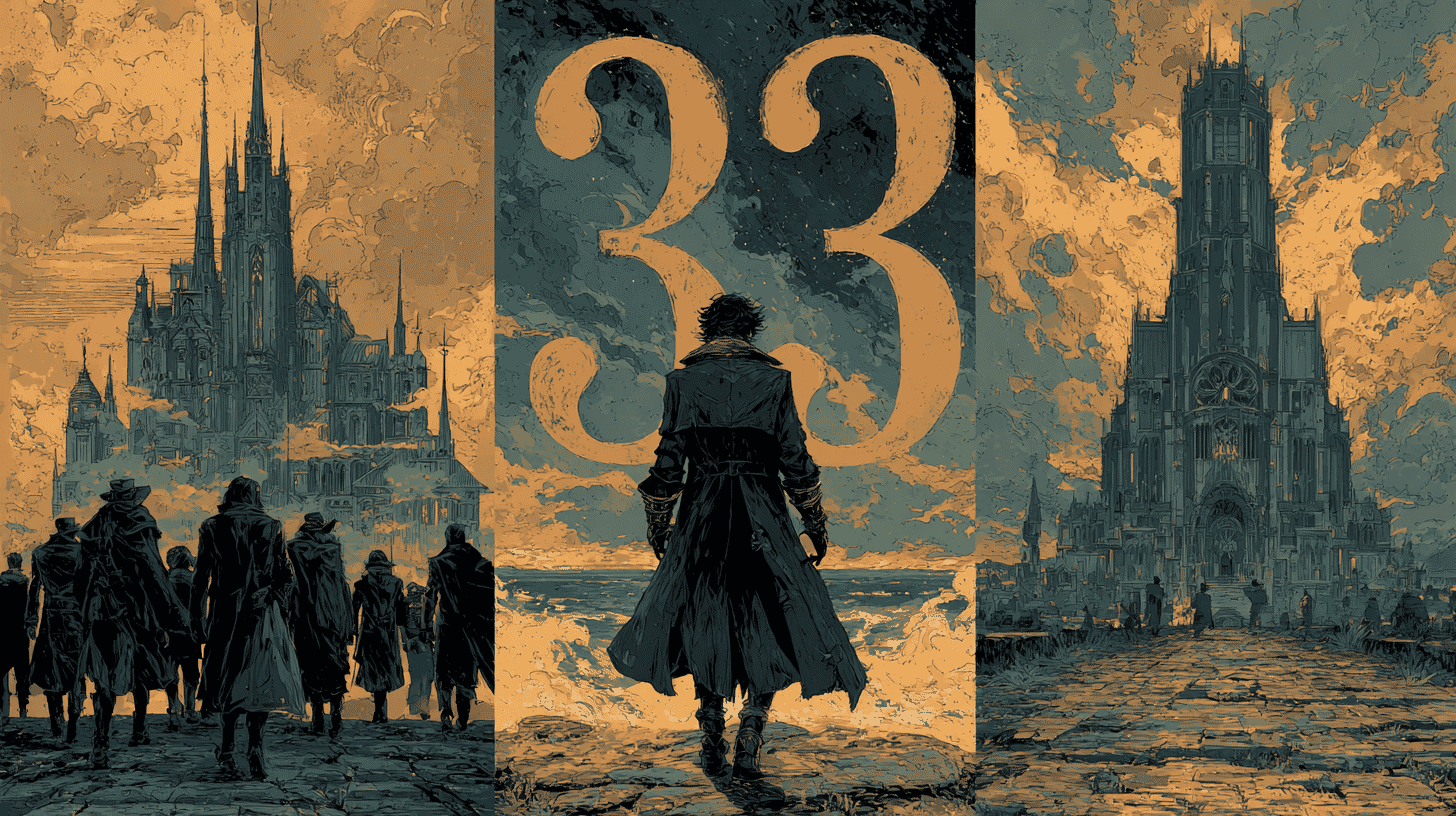
A French team of 30 people just made the game Japan was supposed to make.
On April 17, 2026 (London time), at the BAFTA Game Awards 2026, Clair Obscur: Expedition 33 won Best Game. With that victory, following wins at the Golden Joystick Awards, The Game Awards, D.I.C.E. Awards, and Game Developers Choice Awards, the game completed a clean sweep of all five major Game of the Year awards. It is only the second title in history to achieve this, after Baldur's Gate 3 in 2023.
But this article isn't a celebration. Not entirely.
Because this game was made by a French developer who grew up obsessing over Final Fantasy VIII, IX, and X, Persona 5, SEKIRO, Devil May Cry, and Lost Odyssey, and built the JRPG he personally wanted to play. In a genre Japanese studios built and dominated for decades, a masterpiece has arrived not from Japan but from France, one so good that it stirs Japanese players' hearts too.
It stings. Genuinely stings.
And rather than looking away from that sting, we think seriously engaging with the question "Why couldn't a Japanese studio make this?" is the greatest respect we can pay to Sandfall's work.
The Second-Ever 5-GOTY Sweep, A Moment in Gaming History
Let's establish the facts first.
Clair Obscur: Expedition 33, released on April 24, 2025, is the debut title from French indie studio Sandfall Interactive. It's a turn-based RPG that fuses action elements, parrying, dodging, aimed shots, with traditional JRPG combat, set in a Belle Époque-flavored world reminiscent of early 20th-century Paris, rendered in painterly Unreal Engine 5 visuals. The game scored 93 on Metacritic, sold over 3 million copies in its first month, and swept the 2025 award circuit.
The "5 major GOTYs" refer to the Game of the Year (or equivalent) categories at:
- The Game Awards (TGA)
- Golden Joystick Awards (GJA)
- D.I.C.E. Awards
- Game Developers Choice Awards (GDC)
- BAFTA Game Awards
These five are voted on by different bodies, media, fans, developers, the British Academy, which makes a full sweep extraordinarily difficult. Three previous titles came within one award of the feat; remarkably, two were Japanese. The Legend of Zelda: Breath of the Wild (2017) lost the BAFTA to What Remains of Edith Finch. God of War (2018) lost the Golden Joystick to Fortnite. Elden Ring (2022) lost the BAFTA to Vampire Survivors.
Expedition 33 is only the second title ever to take all five. Per ResetEra's tracking, its total GOTY wins across outlets and ceremonies have passed 513, approaching Elden Ring's all-time record.
This Is a JRPG, Made by a Frenchman
Here's the key fact that matters most. Creative director Guillaume Broche has explicitly positioned the game as a love letter to the JRPG genre.
In an interview with Denfaminicogamer, Broche said: "Final Fantasy VIII, IX, and X were the games that struck my generation. It's no exaggeration to say I discovered the joy of video games through FF VIII. Even just hearing the Balamb Garden music from the opening makes me want to cry, that's how deep my attachment runs." He's also a devoted player of the Persona and Atelier series.
Every significant design decision in Expedition 33 traces back to Japanese influences. The satisfying "click" of navigating the menu UI comes from Persona 5. The dynamic cinematic camera during battle cutscenes, same source. The fluid animation work during turn-based combat was inspired by Devil May Cry. The anime-adjacent effects style comes from Broche's lifelong love of Japanese animation. In pre-release interviews, Broche revealed that the two seeds for the entire project were Final Fantasy VIII and SEKIRO.
In other words, Expedition 33 isn't surface-level homage. It's a French developer in his thirties synthesizing, as his own creative DNA, everything he absorbed from Japanese games, anime, and manga, producing a JRPG that a Frenchman made, as a Frenchman, and it works.
What's especially interesting is Broche's stated philosophy: he never considered bringing in Japanese designers or commissioning Japanese composers. "We're French, so we make it French." That stance is exactly what allowed Belle Époque Paris, Art Nouveau aesthetics, Impressionist color theory, chanson, and electro-swing to coexist seamlessly with JRPG systems.
How Did 30 People Pull This Off?
The other fact that stunned the industry is the team size.
Sandfall Interactive's core team is under 30 people, roughly 25 in Montpellier and 5 in Paris, with this being the first commercial title for most of them. Counting outsourced animation, QA, and motion capture, total contributors number in the hundreds, but the creative nucleus, design, direction, writing, sat with that 30-person team.
By modern AAA standards, this is absurd. Square Enix's major titles employ hundreds of developers. CD Projekt Red's Cyberpunk 2077 had over 500. Even Kojima Productions has "ballooned" past 200 since the pandemic, by Hideo Kojima's own admission.
And Kojima himself made the following comment about Sandfall: "They only have like 33 team members and a dog. That's my ideal when I create something with a team. Creation has now become much bigger. It's kind of a war between how efficient you could [be] with the small team, but you have to make it so grand."
Coming from Kojima, this reads almost like an unintentional confession of the structural problem haunting Japan's AAA industry.
Why Couldn't a Japanese Studio Make This?
This is the heart of the matter. Broche openly loves JRPGs. His aesthetic was formed by the golden age of Japanese role-playing games. So why couldn't a Japanese creator with the same sensibilities make Expedition 33 inside a Japanese company?
The answer has several overlapping threads.
First, the IP-dependency trap. According to Toyo Keizai, Square Enix reported a record-breaking ~22 billion yen (about $139 million) in content write-downs for fiscal year ending March 2024. The company canceled multiple HD titles in development and took an additional ~16.8 billion yen impairment on continuing projects. CEO Takashi Kiryu publicly acknowledged that "lack of title diversity" and "lack of marketing" were core weaknesses. Over-reliance on Final Fantasy and Dragon Quest has hollowed out the capacity to nurture new IPs. If a Broche-like FF superfan walked into a major Japanese publisher today and pitched "the FF I want to play," the answer would likely be: "We don't have bandwidth for non-FF new IP right now."
Second, an overcorrection on rising budgets. Bandai Namco's online RPG Blue Protocol, which spent over eight years in development, ended service just 18 months after launch. Toyo Keizai calls this the "100-million-dollar development budget era," and Japanese publishers are now paralyzed by the failure risk of large titles. The response has been to consolidate around "cannot-fail, hundreds-of-people, hundreds-of-millions-of-yen" projects, rather than "can-fail-cheap, 30-people, smaller-budget" ones. Sandfall succeeded by compressing experience density while keeping budget modest. That "make it small" philosophy has almost disappeared from major Japanese studios.
Third, a broken "fan-to-creator" pipeline. Broche grew up as a consumer of FF, Atelier, and Persona, and transitioned directly into being a producer of the JRPG he wanted. This was exactly the strength of 1980s–90s Japanese game development. Yuji Horii (Dragon Quest) was a passionate gamer. Katsura Hashino (Persona 3) was a passionate gamer. But modern Japanese mega-publishers have narrowed the room for an enthusiastic fan to pitch "the thing I want to play" and get it greenlit. That kind of person showed up in France instead.
Fourth, the "Japanese-ness" tax. Ironically, Japanese creators can be over-constrained by "Japanese RPG-ness." In a dialogue with Broche, Final Fantasy XV director Hajime Tabata observed that Japanese RPGs tend to require enemies to have legitimate reasons to fight, former enemies to team up against greater threats, and similar culturally specific narrative conventions. These are strengths, but they can also become templates. A French developer like Broche had the freedom to break those templates: borrow FF combat grammar, set the story in Belle Époque Paris, and build the narrative around a distinctly European meditation on mortality.
Japanese Creators Themselves Have Admitted: "It Stings"
What's striking is that Japanese game industry figures aren't hiding the sting. They're voicing it openly.
Hiroshi Kobayashi, CEO of Binary Haze Interactive (makers of Ender Lilies and Ender Magnolia), has publicly described himself as a fan who put 60+ hours into Expedition 33. During a developer roundtable with Sandfall, he said: "Watching them achieve this art direction in a 3D game, I felt genuinely frustrated, in the sense of, we should have done this." For a working game director to say "it stings" on the record is significant.
Then came the industry verdict. Famitsu's 2025 year-end poll, which asks 191 Japanese developers, voice actors, and industry figures to vote for their personal Game of the Year, picked Expedition 33 as #1. The voter list includes Hideki Kamiya (Devil May Cry, Bayonetta), Akira Yamaoka (Silent Hill), Takayuki Nakayama (Street Fighter 6), and Katsuhiro Harada (Tekken), people sitting at the very center of Japanese game development. They collectively declared: the best game of 2025 was made in France.
The influence is flowing into current projects, too. In an AUTOMATON interview, the Monster Hunter Stories 3 development team explicitly said they "studied Metaphor and Expedition 33" and are "genuinely committing to RPG-first design." A French game is now shaping the next generation of Japanese development.
The Silver Lining: This Isn't Bad News for Japan
Having established the sting, let's flip the lens.
Expedition 33's triumph isn't a defeat for Japanese game development. It functions more as a mirror, reflecting what Japan has been on the verge of forgetting.
First, it proves to the world that turn-based RPGs are not obsolete. At a moment when Japanese studios were drifting toward action pivots under the assumption that "turn-based is dead," Expedition 33, alongside Atlus's Metaphor: ReFantazio and HoYoverse's Honkai: Star Rail, decisively rebuts that. Done right, turn-based design can still reach the very top of global gaming.
Second, it shows that a ~30-person team can win worldwide. For the Japanese indie scene, think Ender Lilies, The Exit 8, and many others, this is a huge tailwind.
Third, Sandfall deeply respects Japanese culture. Broche repeatedly says he loves JRPGs, and publicly acknowledges FromSoftware's Hidetaka Miyazaki and Atlus's Katsura Hashino as design influences. Expedition 33 isn't a rejection of Japanese game culture. It's a genuine love letter.
And Sega is the Japanese publisher for the PS5 physical edition. A Japanese company is part of delivering this French masterpiece to the world, which, honestly, is a good look.
How Is This Being Framed Where You Live?
The one thing we can say for certain: Expedition 33's success proves that "JRPG-style design can compete globally." Whether Japan's industry treats this as a tailwind or a headwind is up to Japan now. Square Enix is deep in a restructuring cycle and pursuing strategic focus. Atlus is steadily growing its global footprint. Sega, Capcom, and Bandai Namco have the resources to respond, if they choose to.
Here's what we're genuinely curious about: how is the "JRPG from France" phenomenon being framed where you live? Is Expedition 33 being celebrated as "JRPG-style design is now universal"? Or is it being used as a cudgel against Japanese studios, "Japan's gaming industry is behind the times"?
If you played the game, what hooked you hardest? And has your country's game industry ever produced a comparable masterpiece as a love letter to a foreign culture's aesthetic?
We'd love to hear about it in the comments.
References
- Clair Obscur: Expedition 33 wins BAFTA Best Game, completing 5-GOTY sweep - AUTOMATON
- Denfaminicogamer interview with Sandfall Interactive on JRPG respect and turn-based RPG potential
- Hajime Tabata (FF XV director) and Guillaume Broche in dialogue on East-West RPG differences
- Clair Obscur: Expedition 33 follows Baldur's Gate 3 to become the second game ever to win all five major GOTY awards - GamesRadar+
- Hideo Kojima says Clair Obscur team size is ideal - VGC
- Famitsu asks 191 Japanese developers their Game of the Year, Expedition 33 wins - GamesRadar+
- Square Enix absorbs record 22 billion yen write-down - Toyo Keizai
- The "$100 million development budget era" and Japanese publishers' survival strategy - Toyo Keizai
- Inside the development journey of Clair Obscur: Expedition 33 - Unreal Engine




Global Discussion
14 comments