🛂 A Japanese passport opens 188 countries and territories without a visa. Only about one in six Japanese people owns one. Both are 2026 figures, and together they describe a country whose diplomats built something its citizens barely use.
Singapore 192, Japan 188, and a gap of four
Henley & Partners released the 20th-anniversary edition of its Passport Index on July 21, 2026. The London firm ranks 199 passports by how many of 227 destinations their holders can enter without arranging a visa beforehand, drawing on Timatic data from the International Air Transport Association.
Singapore kept first place with 192. Japan came second with 188, sharing the position with South Korea and the United Arab Emirates. Sweden followed at 187, then a block of eleven European countries at 186. The United Kingdom rose to sixth with 184 after gaining visa-free entry to China and Malawi. The United States sits tenth with 180, and is now one of the very few top-ranked passports whose holders still need a visa for China.
So the distance between Japan and the top of the list is four destinations. For anyone actually booking a flight, that gap is close to meaningless. What it does show is how compressed the top of the ranking has become: dozens of passports now cluster inside a narrow band, and small diplomatic shifts move countries several places.
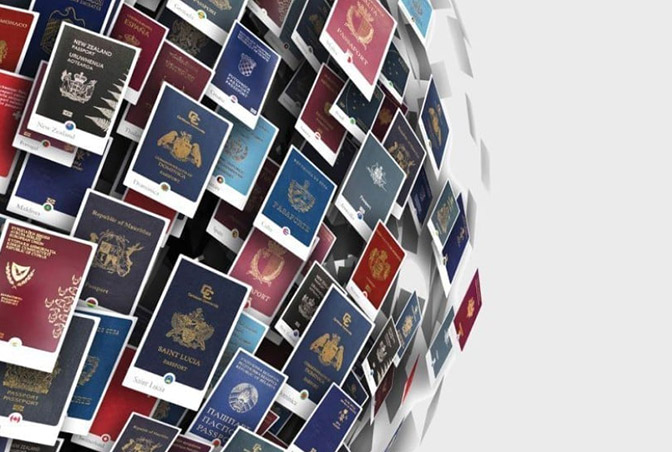
[ref src="https://cdn.henleyglobal.com/storage/app/media/NEWSROOM/HPI-2026_July-News_PR.jpg" alt="Key visual for the 20th-anniversary edition of the Henley Passport Index" origin="Source: Henley & Partners"]
Where the 188 actually comes from
The number is not a count of treaties Japan has signed. It bundles three different things: mutual visa-waiver arrangements, one-sided decisions by foreign governments to let Japanese citizens in, and visa-on-arrival counters that hand over a stamp at the border.
The traffic is also lopsided. Japan waives short-stay visas for 74 countries and territories, according to the Foreign Ministry list dated September 1, 2025. Japanese travellers are let in visa-free by more than twice that many places. Countries open their doors to Japan more readily than Japan opens its own.
China shows how conditional some of those entries are. Beijing restarted its unilateral waiver for Japanese passport holders on November 30, 2024, permitting stays of up to 30 days, and has extended it through December 31, 2026. There is no reciprocity: Chinese nationals still need a visa to enter Japan, and China is not on the Foreign Ministry's list of 74. Nor is it permanent. The waiver has an expiry date, and Beijing can let it lapse whenever the relationship sours.
Christian Kaelin, who created the index, argues that passport strength is essentially a reading of diplomatic capital. The strongest travel documents, in his framing, belong to countries that other governments want as partners for trade, investment or security. By that logic Japan's 188 is a scorecard on decades of bilateral work, not a reward for anything its travellers did.
Visa-free does not mean paperwork-free
The word "visa-free" is doing a lot of work in these rankings. Japanese travellers already file online authorisations before flying to the United States, Canada, the UK, Australia, New Zealand and Israel; the Foreign Ministry's travel safety site lists all six. None of those count as visas, so none of them cost Japan a point in the index.
Europe is next in line, although nobody can say when. The EU's ETIAS authorisation costs 20 euros and lasts three years, and the official target for the past year was a launch in the final quarter of 2026. In July 2026 that target came off the EU's own pages, which now say only that the system is not running, that no applications are being taken, and that a date will be announced several months ahead. Reports in early July indicated the agency building it had concluded that a 2026 start was no longer feasible. For the moment, a passport is still all a Japanese traveller needs for the Schengen area.
Japan is building the same kind of gate in the opposite direction. Its JESTA pre-screening system was written into the immigration law revision enacted in May 2026, and the government is aiming to switch it on during fiscal 2028. The pattern is global: the visa is disappearing and a form is taking its place.
Twenty years that rearranged the map
The anniversary data is where the ranking gets genuinely interesting. In 2006 the average passport reached 58 destinations. Today it reaches 108. Travel freedom has roughly doubled for almost everyone.
Almost. Bolivia is the only passport on the index to have gone backwards over two decades, down six destinations. Every other country gained.
The rearrangement at the top is sharper. In 2006 the strongest passports belonged to the United States, Denmark and Finland, each with 130 destinations. The US ranked first and the UK third; today they sit tenth and sixth. Singapore was eighth and is now first. The UAE has added 153 destinations since 2006, the largest gain the index has recorded, climbing from 35 destinations to joint second alongside Japan. Japan itself gained 60 over the same period, and South Korea 73, according to CNN's reading of the anniversary data.
Meanwhile the floor has not risen with the ceiling. Afghanistan remains last with 22 destinations. The distance between the best and worst passport has widened from 118 destinations in 2006 to 170 now, the largest gap in the index's history.
The strongest passport almost nobody carries
Here is the part that stings in Japan. At the end of 2025 the country held about 22.82 million valid passports, of which roughly 21.93 million were ordinary passports held by residents. Measured against the total population, that works out to about 17.8 percent. Up from 16.8 percent a year earlier, and still far below the 23.8 percent of 2019.
Issuance fell too: roughly 3.62 million passports in 2025, down 5.3 percent year on year. Travellers under 30 accounted for 44.6 percent of them, which suggests the often-repeated story about young Japanese losing interest in the world is at least partly wrong. It is the older half of the country that stopped renewing.
Cost is the obvious culprit. The yen touched about 163.8 to the dollar on July 24, 2026, and had recovered to around 157 by early August, still weaker than it has been in decades, and a week in Seoul now prices like a week in Hawaii used to.
The government has responded on the one lever it controls. From applications received on July 1, 2026, a ten-year passport costs 8,900 yen online, about 57 dollars, down from 15,900 yen or roughly 101 dollars. At a counter it is 9,300 yen, about 59 dollars, instead of 16,300 yen or about 104 dollars. Five-year passports for under-18s dropped to 4,400 yen online and 4,800 yen at a counter, while the five-year option for adults was scrapped. The same day, the departure tax tripled from 1,000 yen to 3,000 yen, about 19 dollars, which is roughly why the discount exists. Passport offices are now busy enough that issuance is taking around a month rather than the usual two weeks.
Whether a 7,000-yen saving persuades anyone to fly when the airfare has doubled is another question. For now Japan holds one of the world's most useful travel documents and leaves it in a drawer.
Which brings the obvious question back to you. Where does your passport land on this year's list, and more to the point, when did you last actually use it?
References
- https://www.henleyglobal.com/newsroom/press-releases/henley-passport-index-20th-anniversary
- https://www.cnn.com/2026/07/21/travel/most-powerful-passports-july-2026
- https://www.travelvoice.jp/20260724-160220
- https://www.mofa.go.jp/mofaj/toko/visa/tanki/novisa.html
- https://www.shanghai.cn.emb-japan.go.jp/itpr_ja/00_000866.html
- https://www.government.nl/themes/migration-and-travel/holidays-and-travels/etias
- https://www.travelvoice.jp/20260224-159307
- https://news.allabout.co.jp/articles/o/113310/
- https://www.watch.impress.co.jp/docs/news/2120510.html



Global Discussion
0 comments