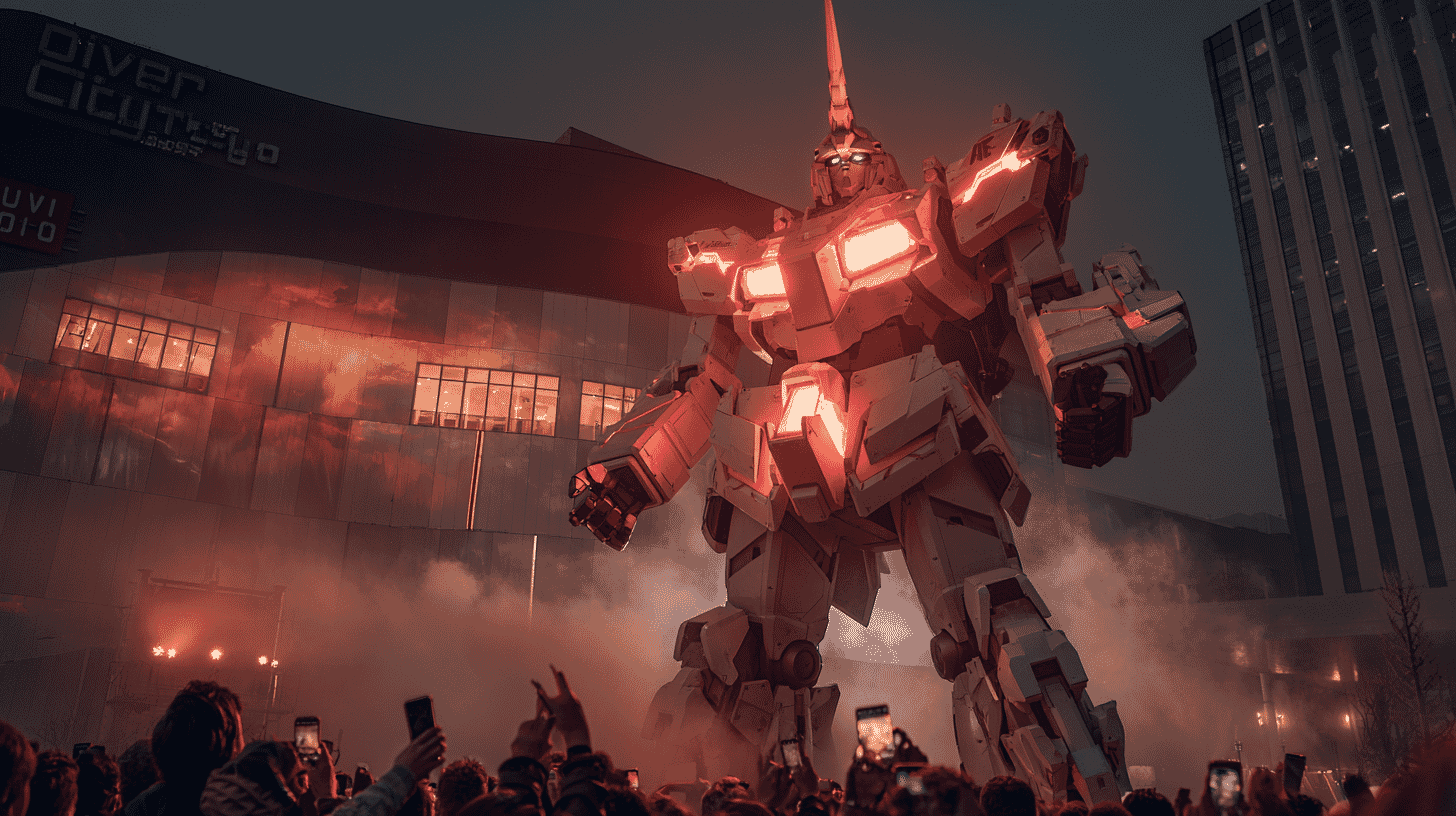
🤖 Tokyo is about to lose one of its most-photographed landmarks.
The 19.7-meter Unicorn Gundam that has watched over the Odaiba waterfront since September 2017 will be dismantled at the end of August 2026. When the panels finally come down, Tokyo will be without a life-sized Gundam for the first time since 2009, save for a roughly six-month gap in 2017 between the removal of the original RX-78 statue and the Unicorn taking its place.
For a free outdoor sculpture that anyone could walk up to at any hour, it was a strange kind of celebrity. Anime tourists planned trips around it. Office workers took their lunch breaks beside it. International influencers shot it at sunset. And every night, a fully grown 49-ton mecha unfolded panels across its chest and arms in front of crowds who had often arrived hours early to get a spot.
That ritual is ending.
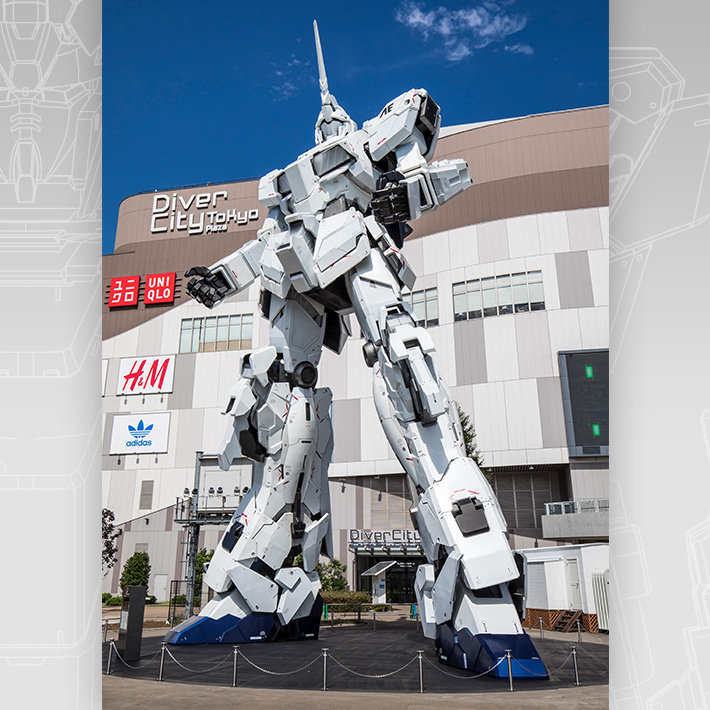
Source: Official Unicorn Gundam Statue website
What Bandai Namco actually announced
The news landed on May 15 during "Gundam Conference SPRING 2026," a livestreamed event Bandai Namco uses to dump anniversary news on fans. Buried among trailers and collaboration announcements was the line nobody wanted: the life-sized Unicorn Gundam at DiverCity Tokyo Plaza will close its exhibition at the end of August 2026, after exactly eight years and eleven months.
The official statement is restrained. New "finale version" decals will be applied to the statue for its last months. Unspecified events are planned. Details will appear on the official site as they're confirmed. The phrasing avoids any explanation of why, no mention of structural fatigue, no mention of the venue's plans, no mention of what (if anything) replaces it on that plaza.
In Japanese internet culture this kind of restrained press release usually means the decision was made some time ago and the parties involved would rather not elaborate.
What "Odaiba Gundam" has meant for 17 years
The first life-sized Gundam went up in the Odaiba area in 2009: an 18-meter, roughly 35-tonne recreation of the RX-78-2 from the original 1979 series, installed at Shiokaze Park from July 11 to August 31 as the centrepiece of the "GREEN TOKYO Gundam Project" marking the show's 30th anniversary. It was always a limited run, and it drew around 4.15 million visitors in those 52 days. The statue then travelled to the Shizuoka Hobby Fair from July 2010 to March 2011 before being installed at DiverCity Tokyo Plaza's Festival Plaza on April 19, 2012, where it stood until March 5, 2017. Long before Instagram became the standard reference, it was already one of Tokyo's most-photographed spots.
After six Gundam-less months, the current Unicorn Gundam took over the same role in front of the newly relocated DiverCity Tokyo Plaza in September 2017. It was bigger (19.7 meters vs 18 for the RX-78), heavier (about 49 tons), and equipped with something the RX-78 didn't have: a working transformation. Twice daily by day and again at night, the statue would extend its horn, unfold panels along its torso and limbs, and shift from "Unicorn Mode" into the red-glowing "Destroy Mode" from the 2010 anime series Mobile Suit Gundam UC. The night version was paired with a projection-mapping show called WALL-G, scored to the Cage theme by composer Hiroyuki Sawano.
What made it work, more than the engineering, was the math of access. The plaza is open. There's no ticket. You can walk under the statue, eat a takoyaki from the food court, sit on a bench, and watch a 49-ton robot rearrange itself above your head. Foreign visitors who had grown up on Pokémon or Naruto and only vaguely knew Gundam still walked away from a transformation with their phones out. The statue was, in functional terms, Tokyo's most generous piece of public art.
The statue itself, briefly
Mechanical design oversight came from Hajime Katoki, the artist who designed most of the Universal Century-era Gundam variants people actually buy as Gunpla. Construction was handled by Nomura Kogeisha, a Japanese exhibition-fabrication firm. The body is built primarily of glass-fiber reinforced plastic across roughly 230 panels, mounted on a steel armature. There are about 50 dedicated lighting points, and the transformation runs on a mix of hydraulic and electric mechanisms designed to mimic, within physical limits, the way the suit moves on screen.
It was never going to be a forever object. The original RX-78 wasn't either. But the engineering held up better than most temporary installations ever do.
A farewell with broken parts
There is one detail in the closing that the press releases don't talk about, and it stings if you've been paying attention to the official notices page.
On June 9, 2025, the statue's transformation broke. A mechanism failed. Officially, the suit was "fixed in Destroy Mode," frozen with its panels open, horn split and red psycho-frame exposed, and stayed that way for months. A partial repair brought back most of the transformation later, but with the shoulder mechanism still not fully working. The official site still carries the apology notice.
So the Unicorn Gundam will end its run not at peak performance but in a half-restored state, never quite the show it was for its first seven years. Visitors who arrived for the goodbye and then noticed the shoulders not opening in sync will be watching something that was already being let go.
It's the kind of ending a Universal Century-era Gundam character would actually recognize.
What's next, "Gundam Landmark Project"
Almost in the same breath as the closure announcement, Bandai Namco mentioned a vague initiative called the Gundam Landmark Project: a planned facility somewhere in Japan, built for fans worldwide, with no timeline and no location attached. Read generously, it's a real commitment to having a flagship Gundam destination in Japan. Read skeptically, it's a placeholder while the company figures out where the money lives.
The context around it is unflattering for Tokyo. The 18-meter moving Gundam in Yokohama, the most technically ambitious life-sized Gundam ever built with a walking gait and 24 degrees of freedom, was shut down at the end of March 2024, with parts later moved to the Expo 2025 Osaka site. The standing 24.8-meter Nu Gundam at LaLaport Fukuoka continues to operate. The Freedom Gundam at the Bandai Namco Shanghai store also continues to operate.
When Odaiba's Unicorn comes down at the end of August, Tokyo will be the only major Gundam city in the world without a life-sized statue, for the first time since 2009.
That gap may not last long. The series is heading into its 50th anniversary in 2029, and a "Road to 50" prologue video premiered at the same conference. A "Gundam-Con" event is planned for January. The remaster of the original 1979 series is in the works. Reading the broader announcements, the Unicorn retirement looks less like a clean ending and more like clearing space for something the company wants to position as a bigger reveal.
What that "something" is, and whether it's on a plaza in Odaiba, or somewhere else entirely, isn't being said yet.
A landmark, dimmer than it was
There's a category of Japanese landmark that's hard to explain to people who haven't been: free, slightly absurd, slightly serious, more meaningful than its premise should allow. The Tetsujin 28-go statue in Kobe. The Gundam at Odaiba. The walking Gundam at Yokohama before it left. These are pop-culture monuments that the cities they live in have, eventually, started to treat as actual landmarks rather than gimmicks. They show up in tourism campaigns. They show up in maps. They show up in the muscle memory of people who grew up nearby.
What's striking about the Odaiba Gundam's quiet retirement is how much it's leaning into that frame. The press release uses the word "親しまれてきた", "beloved" or "grown familiar with," literally something like "intimate with the public." The statue's lights will go out at the end of August. A finale paint job will go on first. Then, presumably, scaffolding.
In your city, is there a public artwork people would actually miss if it disappeared? One that's free, slightly silly, and somehow ended up mattering more than anyone planned? Tell us what it is, we'd genuinely like to know what your version of the Odaiba Gundam looks like.
Update (June 2026)
The closing date has since been fixed at Monday, August 31, 2026. From June 20 through August 31, Bandai Namco Filmworks is running a special decoration on the statue designed by mechanical designer Hajime Katoki. A Gundam Stamp Rally 2026 also started in June.
References
- https://www.unicorn-gundam-statue.jp/1065/
- https://www.oricon.co.jp/news/2455004/full/
- https://www.itmedia.co.jp/news/articles/2605/15/news120.html
- https://www.animenewsnetwork.com/news/2026-05-15/gundam-franchise-unveils-50th-anniversary-short-gundam-con-event-next-january/.237394
- https://soranews24.com/2026/05/15/tokyos-life-size-gundam-anime-mecha-statue-will-be-removed-this-summer/
- https://www.dexerto.com/entertainment/japans-iconic-life-sized-gundam-is-being-removed-after-9-years-3365189/
- https://coki.jp/article/column/78200/







Global Discussion
0 comments