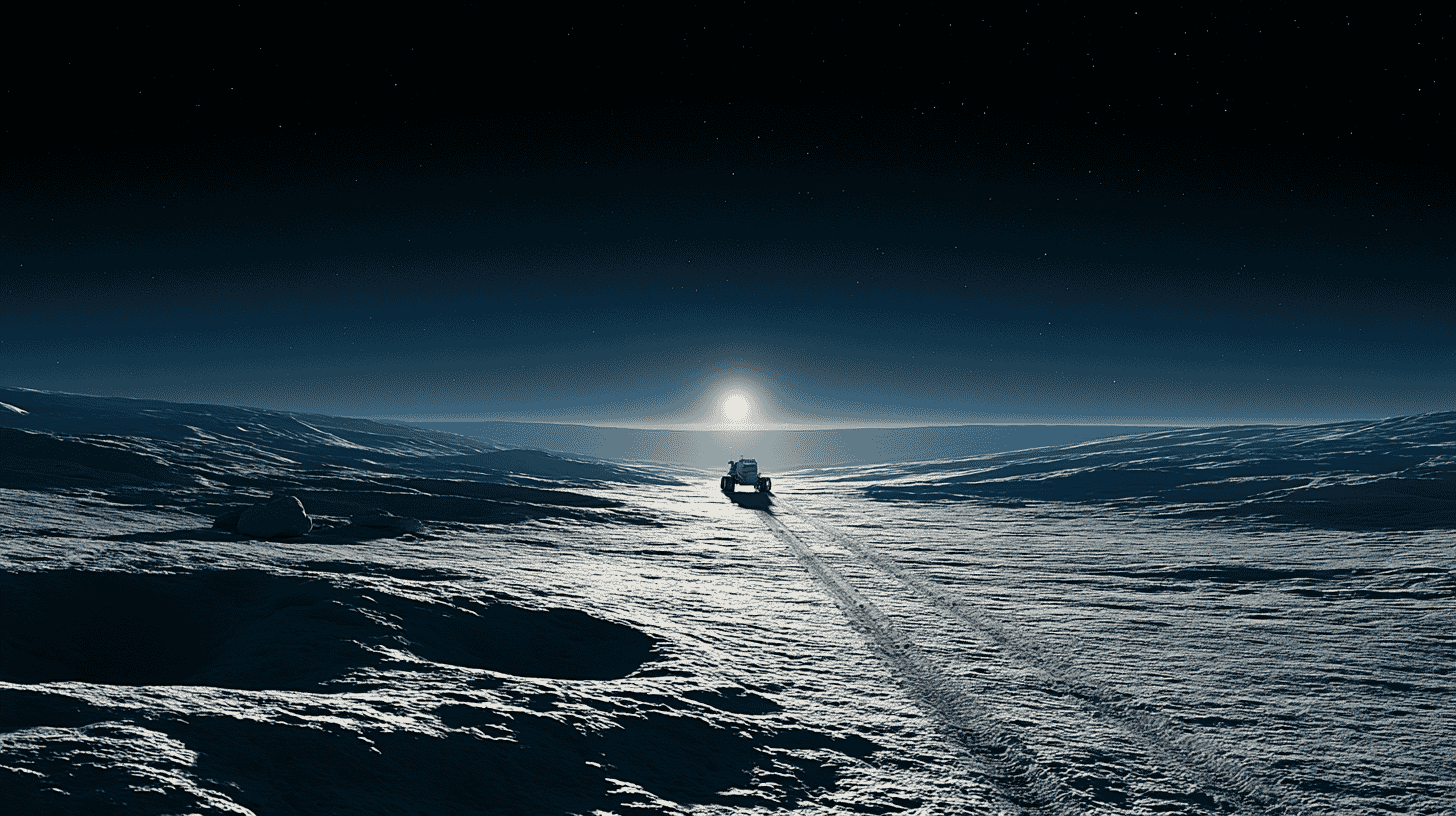
🌑 Before a rover ever rolls across the Moon, someone has to know exactly how far it can safely go. A Japanese studio better known for making video games has built a way to find out, without anyone leaving Earth. "REAL MOON Studio" recreates a 240-by-240-kilometer slice of the lunar south pole in enough detail that engineers can drive a virtual rover, frame a virtual camera shot, and lay out a virtual base, all before a single real mission launches.
A game studio quietly recreated the Moon's south pole
On May 26, 2026, a Tokyo software company called Historia announced REAL MOON Studio, a "digital twin" of the lunar environment. (A digital twin is a virtual copy of something real, accurate enough to test and experiment on in place of the original.)
Historia is not a space contractor. It is a developer that specializes in Unreal Engine, the graphics technology behind countless video games and, increasingly, film visual effects and architectural visualization. The company has spent years building simulation environments for industries like automotive: the kind of virtual worlds used to test self-driving systems.
REAL MOON Studio grew out of that expertise. Since 2024, Historia has worked with JAXA, Japan's space agency, on a joint study to rebuild the lunar surface inside Unreal Engine 5. The research was presented at a 2025 Japanese space-science conference under a telling title: the development of a lunar simulator aimed at successors to LUPEX, the planned Japan-India rover mission to hunt for water ice at the Moon's south pole.
In December 2025, the project surfaced publicly in an unusual form: a free game on Steam called REAL MOON, which let anyone walk and drive across the recreated surface. REAL MOON Studio is the professional version of that same technology: not entertainment, but a working tool for planning real missions.
Built from measurements, not imagination
What separates a digital twin from a nice-looking 3D model is fidelity. REAL MOON Studio is assembled from actual observation data and published research rather than artistic guesswork.
The terrain comes from DEM data, digital elevation models: precise height maps measured by orbiting spacecraft. On top of that, Historia layered realistic crater and boulder distributions, meshing a 240-by-240-kilometer expanse of the south polar region into navigable 3D ground. The south pole is the current focus, but the company says other regions can be modeled the same way.
Note: sources disagree on the size. Historia's press release gives 240 by 240 kilometers; the announcement on the company's own site says 420 by 420. This article uses the press-release figure.
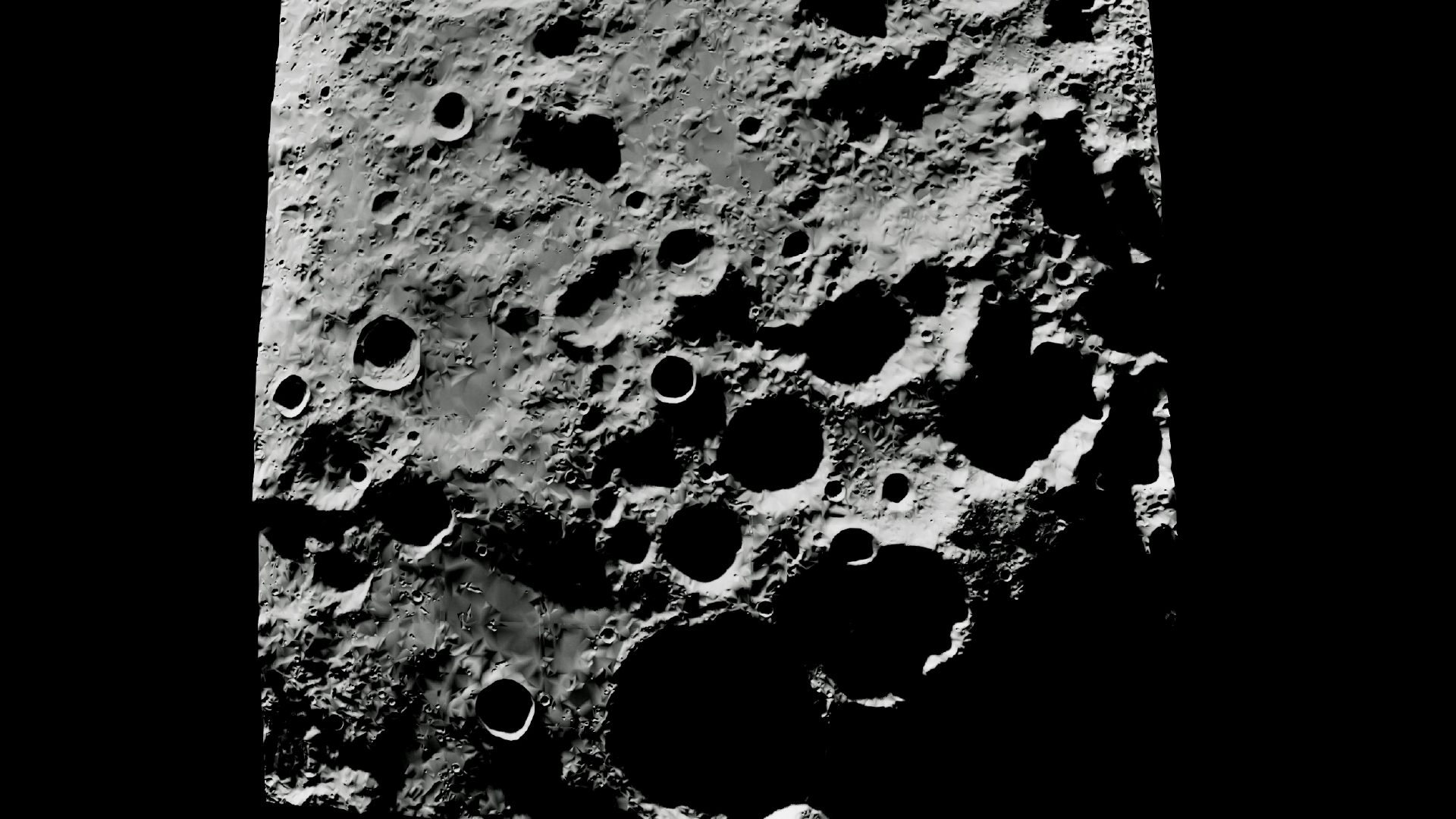
Source: Historia Inc. press release
Lighting matters just as much as the ground. At the lunar south pole, the Sun barely clears the horizon, throwing long, knife-edged shadows that crawl across the surface over the course of a day, and those shadows are exactly what cameras and solar panels have to contend with. To get this right, Historia used a UE5 plugin called MaxQ, built on NASA's SPICE Toolkit, the standard system for calculating the positions of planets, moons and spacecraft. The result reproduces the real movement of the Sun and Earth, and even the correct star field overhead.
Because the rendering is physically based, the studio can output stills and video that look like photographs rather than game graphics. It goes a step further: users can dial in real camera settings such as ISO, aperture and shutter speed, so a team can preview what an actual rover or lander camera would capture, and check sensor performance, long before the hardware reaches the Moon.
Rehearsing a mission before it happens
The most practical part of REAL MOON Studio is what it does with all that terrain.
It connects to standard robotics and physics tools including ROS, MATLAB and AGX Dynamics, so engineers can run a virtual rover across the surface and watch its camera feeds, sensor readings and orientation in real time. Slopes are color-coded, which turns route planning from guesswork into something closer to reading a trail map.
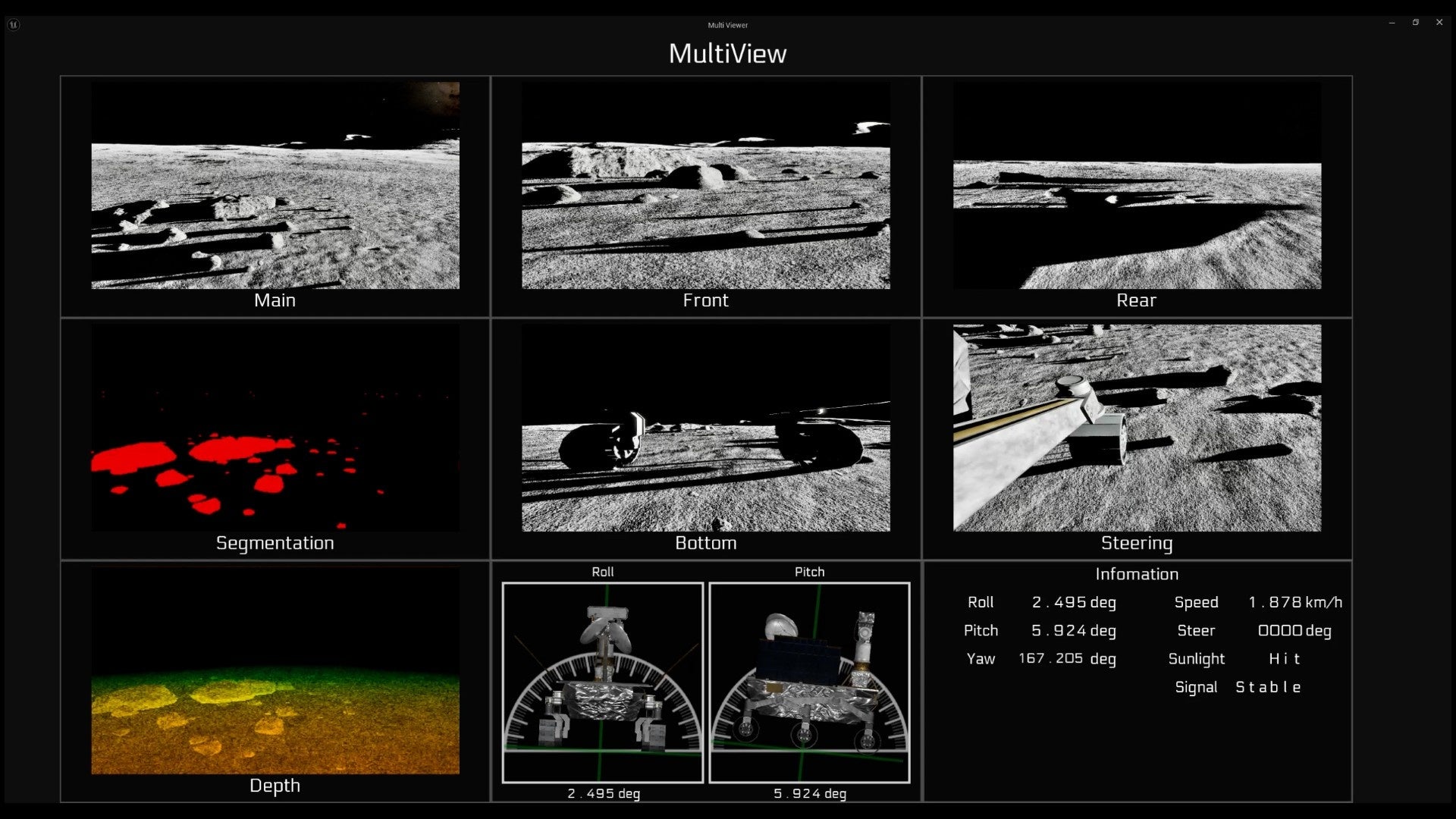
Source: Historia Inc. press release
There is also automatic pathfinding. Give the software a start and end point and it generates a driving route across the real terrain. If the rover meets an obstacle, the operator can order a detour and the system instantly produces a new path around it. Routes can be driven in real time, recorded and replayed.
The tool reaches beyond rovers, too. The same terrain can be used to place buildings and visualize a future lunar base, with measurement tools to keep the scale honest. And because Historia bundled in its own annotation software, the simulator can churn out labeled training data such as segmentation maps, depth information and metadata, for the AI systems that will one day help spacecraft navigate on their own.
Why everyone suddenly wants a digital Moon
REAL MOON Studio is arriving at a very particular moment. The Moon's south pole has become the most contested patch of real estate in the Solar System.
NASA's Artemis program is steering its crewed landings toward the south polar region, where permanently shadowed craters are believed to hold water ice, a resource that could one day be split into drinking water, breathable oxygen and rocket fuel. A string of robotic missions is scouting the same ground, among them several planned landings by the Japanese company ispace. As this article was published, its U.S. arm was targeting 2030 for a landing under NASA's CLPS program, on the Draper-led CP-12 task order.
Update: In July 2026 NASA terminated the CP-12 task order with Draper, citing delays tied to the lander redesign. ispace said its contract with Draper to supply the lander would be canceled as well. The company's next lunar landing mission is still planned for 2028. (Added July 27, 2026)
China, working with Russia, is building toward the International Lunar Research Station, a base also centered on the south pole, with a basic version targeted for around 2035. Its Chang'e-7 mission is set to survey the polar environment; the spacecraft was delivered to the Wenchang launch site on Hainan in April 2026 for a launch planned in the second half of the year. More than a dozen countries have signed on to the station.
Here is the catch: the south pole is genuinely hard to land on and drive across. The terrain is steep and broken, and the low Sun angle creates shadows that confuse cameras and hide hazards. Sending hardware there is enormously expensive, and you generally get one attempt. That is precisely where a high-fidelity digital twin earns its keep: a place to make the mistakes, test the routes and break the virtual rover thousands of times before the real one ever leaves the launch pad.
Japan's quieter contribution to the Moon race
When people picture the global return to the Moon, they tend to picture hardware: rockets, landers, rovers. Japan has those too: ispace's commercial landers, JAXA's pinpoint SLIM lander, the LUPEX rover being developed with India.
But REAL MOON Studio points to a different kind of contribution: the software layer. A simulator does not fly anywhere, yet it shapes nearly every decision a mission makes: where to land, which way to drive, how to set the cameras, where to build.
There is something fitting about a video-game studio occupying that role. The skills that make a convincing game world, namely terrain, lighting, physics and real-time rendering, turn out to be the same skills needed to rehearse a Moon landing. Historia's path from autonomous-driving simulators to a Steam game to a JAXA-backed mission tool is a small example of a bigger pattern: game-engine technology steadily migrating into serious science and engineering.
REAL MOON Studio goes on public display at SPEXA, an international space-business expo in Tokyo, from May 27 to 29, 2026. Whether or not it ends up guiding a specific mission, it captures a shift in how exploration works. The first journey to a new world now happens, again and again, inside a computer.
For most of the space age, agencies rehearsed Moon missions in deserts and volcanic fields that merely resembled the lunar surface. Now a real slice of the south pole lives inside a game engine, ready to be driven across as often as you like. Does that feel like genuine progress to you, or does rehearsing exploration in software quietly drain some of its risk and romance? And where you live, are video-game technologies turning up in places you would not expect?






Global Discussion
0 comments