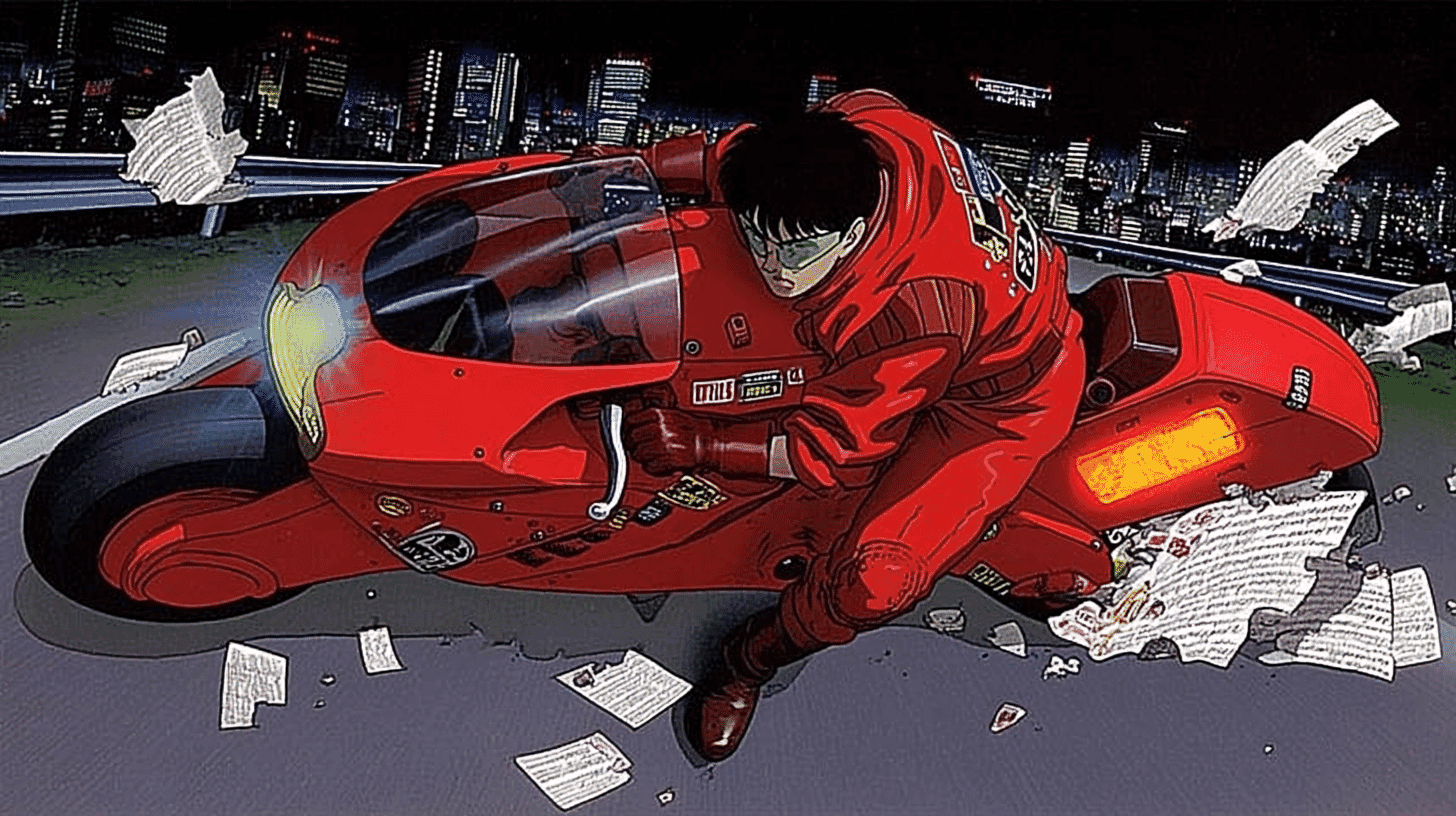
The genius who split manga history into "before Otomo" and "after Otomo" hasn't picked up his pen in over 30 years since completing his masterpiece. Why did Katsuhiro Otomo, the man who shook the world with AKIRA, stop drawing manga? A fascinating YouTube deep dive explores this question head-on, unpacking his revolutionary art, the hidden tributes inside AKIRA, and the three reasons he walked away from the medium he transformed.
About This Article
We came across a fascinating YouTube analysis titled "The Genius Who Split Manga History in Two with AKIRA, Why He Put Down His Pen for 30 Years After Finishing" (in Japanese) and wanted to share its insights with international readers. The video meticulously examines what Katsuhiro Otomo changed, what he created, and why he stopped drawing manga, all backed by thorough research and careful storytelling. Below, we summarize the video's key points while adding context for readers unfamiliar with Otomo's place in manga history.
"Before Otomo, After Otomo": A Revolution in Manga Expression
The video opens by explaining just how radically Otomo transformed manga.
Until the 1970s, Japanese manga was dominated by the "symbolic" visual language established by Osamu Tezuka, oversized eyes, exaggerated outlines, and emotional shorthand like sweat drops and tear marks. Readers instinctively decoded these symbols to understand the story.
Otomo overturned this entire foundation, the video explains. He drew realistic East Asian faces with uniform, thin lines, downturned eyes, low noses, angular cheekbones. Everything from tire reflections to distant skylines was rendered in lines of identical weight, with light and shadow expressed solely through the contrast of black and white planes. Every single piece of debris in an explosion was drawn with accurate perspective, and cinematic camera work inspired by French bande dessinée, particularly Moebius, was woven into his panel layouts.
These innovations profoundly influenced later generations of manga artists including Naoki Urasawa, Yoshiyuki Sadamoto, and Masashi Kishimoto, the video notes. However, since manga techniques cannot be copyrighted, Otomo's innovations were quickly absorbed by the entire industry, making the originator's contributions paradoxically invisible, a remarkably sharp observation.
Our Perspective: The Secret of Otomo's "Movement" Lies in Weight Shifting
Stepping away from the video's content for a moment, we'd like to add our own perspective.
The usual explanations for the extraordinary sense of movement in Otomo's manga are his meticulous speed lines and precise perspective. But there's a unique quality of "living motion" in his work that these elements alone can't account for. We believe the key lies in his depiction of weight shifting mid-motion.
When a person runs, punches, or jumps, their center of gravity is constantly moving. While many manga artists draw the "completed pose", the moment a punch lands, the instant of touchdown, Otomo captures the moment just before: the unstable instant when the body's weight is still in transit. The weight transferring from heel to toe, the torso leaning forward on the verge of the next movement.
By drawing this "in-between" moment, Otomo forces the reader's brain to automatically fill in the motion before and after, creating a sense of temporal flow in what should be a static panel. Where speed lines symbolically represent "velocity," the depiction of weight shifting anchors "motion itself" onto the page. This is why Otomo's art possesses a photorealistic quality yet feels utterly different from a photograph, it comes from this fundamentally physical, kinesthetic approach.
The Hidden Tribute to Mitsuteru Yokoyama Inside AKIRA
The video then dives into AKIRA's narrative structure.
AKIRA began serialization in Weekly Young Magazine in 1982 and was originally planned to last about 10 episodes, the video explains. It ultimately ballooned into an 8-year epic spanning 120 chapters and over 2,000 pages.
What's particularly fascinating is the wholesale tribute to Mitsuteru Yokoyama's Tetsujin 28-go (Gigantor) hidden within the work. According to the video, the protagonist Shotaro Kaneda, his rival Tetsuo, Colonel Shikishima, and Akira himself, referred to as "Number 28", all take their names directly from characters in Tetsujin 28-go.
But it goes beyond mere name-borrowing. The video's analysis shows that AKIRA inherits the central theme of Tetsujin 28-go, "power can become justice or evil depending on who wields it", and transplants it into a modern context. Tetsuo, driven by inferiority toward Kaneda, spirals his psychic powers out of control, founds the Great Tokyo Empire, yet ultimately cannot withstand the overwhelming power and loses his human form. This anguished arc forms the emotional core of the story.
The video also highlights AKIRA's deliberate "temporal structure." The story is set 37 years after the 1945 destruction of Tokyo, beginning in 1982, and depicts events another 37 years later in 2019 (the manga shows 2020 Tokyo Olympic redevelopment and the iconic graffiti reading "Just cancel it"). Destruction and rebirth repeating in 37-year cycles, this is no coincidence but an intentionally engineered circular structure, the video argues. Considering that the real 2020 Tokyo Olympics were indeed "postponed" due to COVID-19, Otomo's prescience is nothing short of chilling.
Three Reasons the Genius Put Down His Pen
This is the heart of the video. Why did Katsuhiro Otomo stop drawing manga?
Eight grueling years of serialization that far exceeded his original plan. Then the experience of directing the animated film adaptation of AKIRA, halting the serialization to lead a team of 1,300 staff with a budget of 1 billion yen (roughly $6.3 million). The video argues that these two monumental experiences became the turning point, leading Otomo away from manga for three interconnected reasons.
Reason 1: The allure of the unexpected through collaboration
Manga is fundamentally a solitary endeavor. But through the process of making a film with 1,300 people, Otomo discovered the joy of collaborative creation, how other people's involvement introduces ideas he would never have conceived, expanding his own imagination, the video explains. For a genius who had spent decades immersed in solitary creation, the realization that a team could reach places he couldn't alone must have been a revelation.
Reason 2: Choosing to surpass his own limits
The video describes Otomo's legendary spatial awareness, the ability to mentally rotate a helicopter and draw it accurately from any angle. A superhuman talent for a manga artist. Yet after the experience of making a film with 1,300 people, he came to see the solitary work of drawing manga at a desk as "a quiet, narrow place," feeling he had hit its limits. A person at the pinnacle of talent, looking beyond that pinnacle and choosing animated filmmaking as the vehicle to get there, that's how the video frames it.
Reason 3: Freedom existed because the industry was "in the shadows"
The video's third reason centers on the industrialization of the anime and manga industry. As manga and anime became massive commercial enterprises, it became harder to take creative risks. Otomo felt that the freedom he once enjoyed, precisely because the industry was a niche, "in the shadows", had been taken away, and he chose to distance himself.
This analysis aligns with Otomo's own words. At his 2013 Medal with Purple Ribbon ceremony, he stated: "Back in the day, it was a fringe thing, so we could do whatever we wanted. Now it's all corporate projects. New people, people who want to do something different, they can't get in." The video's analysis is carefully grounded in Otomo's own public statements, a testament to the creator's thorough research.
Only Available on Paper: The Dilemma of a Genius's Aesthetic
In its final section, the video addresses the current state of Otomo's works.
None of Katsuhiro Otomo's works have been digitized for e-books. This isn't a publisher decision or a technical limitation, it's Otomo's own explicit choice, the video explains. "I draw with the assumption it'll be printed on paper, so I won't allow digitization." This aesthetic is consistent with anecdotes about him refusing to publish paperback editions, calling the physical size of a book "a right I earned", and even refusing to print a barcode on the cover of AKIRA.
In 2007, he pulled all works except AKIRA out of print. The "Otomo Complete Works" series that began in 2022 includes Domu but not AKIRA itself. Paper copies have become expensive, putting them out of easy reach for younger readers.
In an era where digital is mainstream, the video sounds an alarm: Otomo's works aren't being "passed down", rather, "people who were there at the time are still talking about them, and when that generation is gone, the works may truly disappear." No anime reruns, no remakes, no free digital previews, no lines becoming internet memes. If the generation that experienced Otomo firsthand fades away, the works of the genius who changed manga history could genuinely vanish.
A "More Than a Manga Artist" Recognized by the World
And yet, the world has not forgotten Katsuhiro Otomo.
In 2013, he received Japan's Medal with Purple Ribbon, the first in the feature-length animation field since Isao Takahata, 15 years prior. In 2015, he became the first Japanese recipient of the Grand Prix at the Angoulême International Comics Festival in France, the highest honor awarded to an individual creator. He was made an Officier of France's Order of Arts and Letters in 2014.
These accolades demonstrate that Otomo is recognized as a cultural figure who transcends the category of "manga artist." He continues to draw, the video concludes, but his work is now directed at film frames rather than manga pages.
Reflections After Watching
The value of this video lies in its structural rather than sentimental analysis of Otomo's achievements and absence. Rather than resorting to easy answers like burnout or loss of motivation, it carefully builds its case around three axes: the awakening to collaborative creation, the recognition of a medium's limits, and the structural transformation of the industry. For anyone interested in Katsuhiro Otomo, this video is well worth watching.
To contemplate why Otomo put down his pen is to contemplate the nature of creation itself. A genius who completely rewrote a medium, reached its pinnacle, and then, still seeking what lay beyond, moved on to another arena. Not compromise, not escape, but the relentless pursuit of "what I find most interesting."
The words Otomo spoke at his Medal with Purple Ribbon ceremony, "I'm not done yet", may not have been a justification for leaving manga behind, but rather a declaration of an unquenchable thirst for creation.
References
- The Genius Who Split Manga History in Two with AKIRA, Why He Put Down His Pen for 30 Years (YouTube, in Japanese)
- Katsuhiro Otomo Medal with Purple Ribbon Press Conference (ORICON NEWS, 2013)
- Katsuhiro Otomo - Wikipedia
AKIRA can still only be read on paper. Do you support this genius's aesthetic? Or do you believe that without digitization, his work will be forgotten?





Global Discussion
13 comments