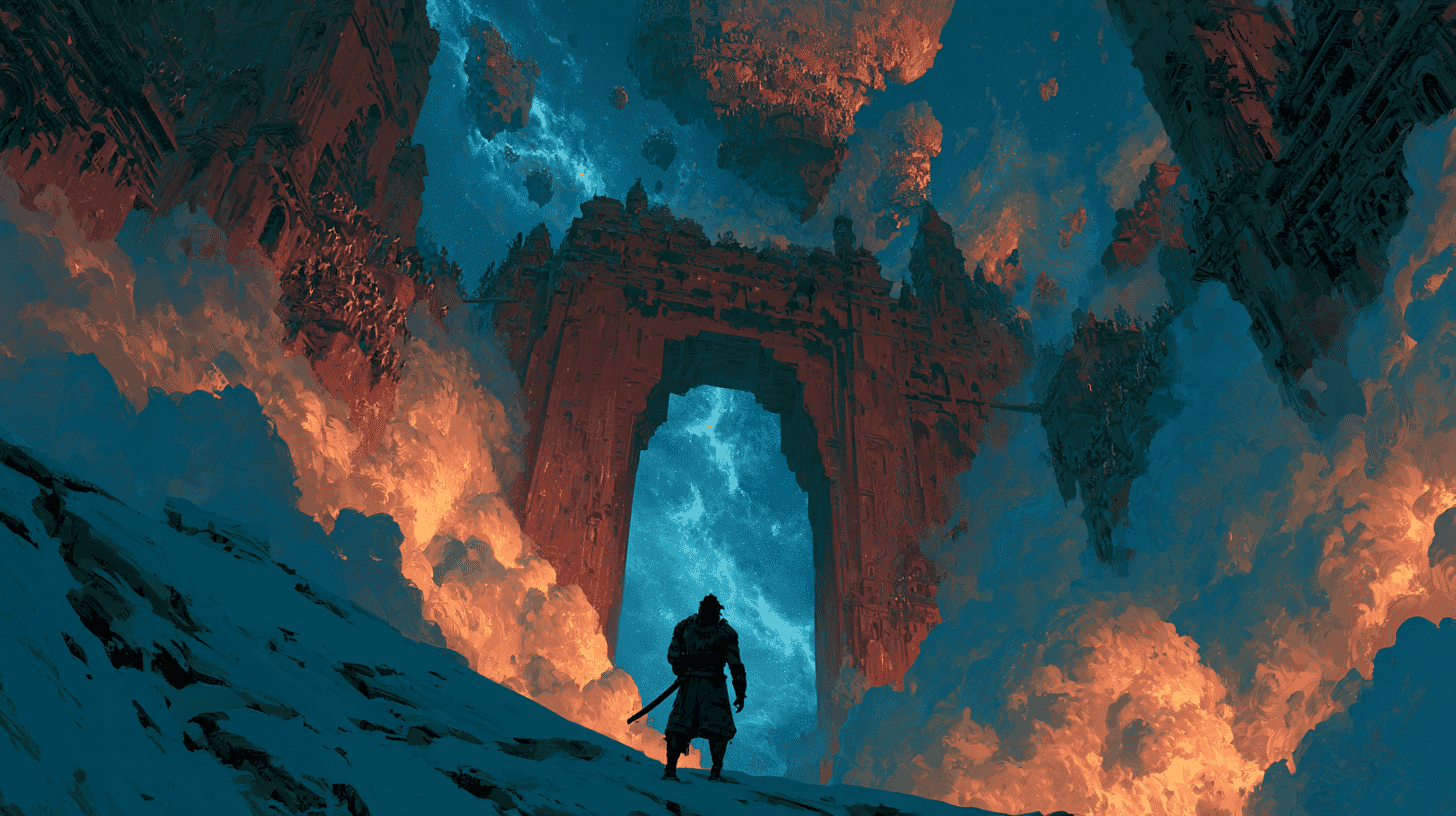
🎬 What happens when India's biggest live-action blockbuster gets reborn as an animated epic, and the studio behind Evangelion signs on to help draw it?
That is the question hanging over Baahubali: The Eternal War, a two-part animated spin-off of the record-breaking Indian franchise. The project pulls together studios from India, the UK, France, and Japan, and the Japanese piece comes from Studio Khara, the company Hideaki Anno built. To understand why that matters, it helps to look at the people whose names are now attached to it.
A blockbuster heads into the afterlife
The original Baahubali films, directed by S.S. Rajamouli (who later made the global hit RRR), are the highest-grossing Indian franchise of all time. The Eternal War picks up where the live-action story left off. After Prince Amarendra Baahubali is killed, his soul travels into the afterlife and is swept into a cosmic war between the Devas (gods) and the Asuras (demons), playing out across fourteen realms drawn from Vedic cosmology.
Prabhas and Ramya Krishnan, the live-action stars, return to voice Baahubali and Sivagami. Rajamouli serves as presenter and co-producer, and Oscar-winning composer M.M. Keeravani, who wrote "Naatu Naatu" for RRR and scored the original films, handles the music. The screenplay is by Scott Mosier, co-director of The Grinch. Part 1 is aiming for a worldwide release in late 2027, and a Japanese release date has not been announced.
The budget is the headline number back home: a reported 1.2 billion rupees, or 120 crore, roughly $13.5 million, for Part 1 alone, which producers describe as the most expensive animated feature in Indian history. The look is unusual too: a "painterly" 3D style the team describes as concept art set in motion, closer in spirit to Spider-Man: Into the Spider-Verse or Arcane than to Pixar or conventional anime.
The indie director who pitched it
The film's overall director is Ishan Shukla, and his path to a project this size is its own story. Shukla studied at BITS Pilani and then at a media school in Singapore, where he spent years in the advertising and animation industry. His 2016 short Schirkoa won Best of Show at SIGGRAPH Asia and qualified for the Oscars. He went on to direct an episode, "The Bandits of Golak," for season two of Disney's Star Wars: Visions, and then made the indie feature Schirkoa: In Lies We Trust, an Indo-French production built entirely in Unreal Engine that won an award at the Rotterdam film festival.
It was that combination of buzz that brought him to the attention of Rajamouli and producer Shobu Yarlagadda, who asked him to do something in the Baahubali universe. Shukla has said the afterlife premise was his own idea, written as a love letter to his twelve-year-old self and the Indian comic books he grew up on. He describes himself as an indie filmmaker used to tiny budgets who suddenly has a blockbuster's resources, with the producers letting him steer. His larger goal is to get Indian audiences to take animation seriously, in a market where animated features are still rare.
Where Japan comes in
Studio Khara is handling part of the animation, with the anime-focused company Slow Curve managing the planning and production of that segment and connecting the Japanese and overseas teams. Khara is best known abroad for the Rebuild of Evangelion films and, more recently, for Mobile Suit Gundam GQuuuuuuX. But the more interesting detail is who is doing the work.
The Khara segment is directed by Akira Honma, a veteran animator who came up at Madhouse and sits on the board of Japan's animator association. He is the kind of name fans of craft recognize even if the general public does not, known for sequences in titles like Black Lagoon and Dennou Coil. Character design for the segment comes from Noriko Ito.
The marquee name, though, is Mahiro Maeda, who joins as main staff. Maeda is one of the most internationally seasoned figures in Japanese animation. He worked on Macross and Hayao Miyazaki's Nausicaä while still in university, spent years on the films of the legendary studio Gainax, then co-founded Gonzo, where he directed the series Gankutsuou. His résumé reaches well beyond Japan: he directed the "Second Renaissance" segments of The Animatrix, animated part of the anime sequence in Quentin Tarantino's Kill Bill, and was brought in by George Miller to do concept art and design for Mad Max: Fury Road. He joined Khara in 2012 and worked as a director on Shin Evangelion, designed the creature in Shin Godzilla, and contributed to Gundam GQuuuuuuX.
It is no coincidence that the people Khara is sending are the ones who have spent decades moving between Japanese and Western projects. That history is much of why the studio fits a film trying to fuse an Indian mythological epic with the language of anime.
Why it's worth watching
For India, the film is a bet that animation can carry a franchise as culturally heavy as Baahubali, and that audiences there will show up for it. For Japan, it is another sign that its studios are increasingly working inside international productions rather than just exporting finished shows. The film was selected for the Work in Progress section at France's Annecy festival, the biggest event in the animation calendar, where the team showed off footage and talked through the cross-border setup.
Whether the blend works is the open question. Rajamouli's RRR already had a devoted following in Japan, so there is an audience primed for the crossover, but a four-country production with three distinct visual styles is a hard thing to make feel like one film.
Cross-border co-productions on this scale are still rare in anime. Would you watch an Indian myth reimagined by the people who made Evangelion, and does your country's film industry team up across borders like this?
References
- https://natalie.mu/comic/news/677798
- https://animeanime.jp/article/2026/06/25/100402.html
- https://av.watch.impress.co.jp/docs/news/2120295.html
- https://variety.com/2026/film/global/annecy-baahubali-ishan-shukla-shobu-yarlagadda-1236790105/
- https://scroll.in/reel/1088354/an-afterlife-for-amarendra-baahubali-in-the-eternal-war-and-a-huge-leg-up-for-an-indie-director
- https://www.khara.co.jp/mahiromaeda/
- https://www.hollywoodreporterindia.com/features/interviews/exclusive-ishan-shukla-on-prabhas-starring-animated-epic-baahubali-the-eternal-war-and-working-with-ss-rajamouli








Global Discussion
4 comments