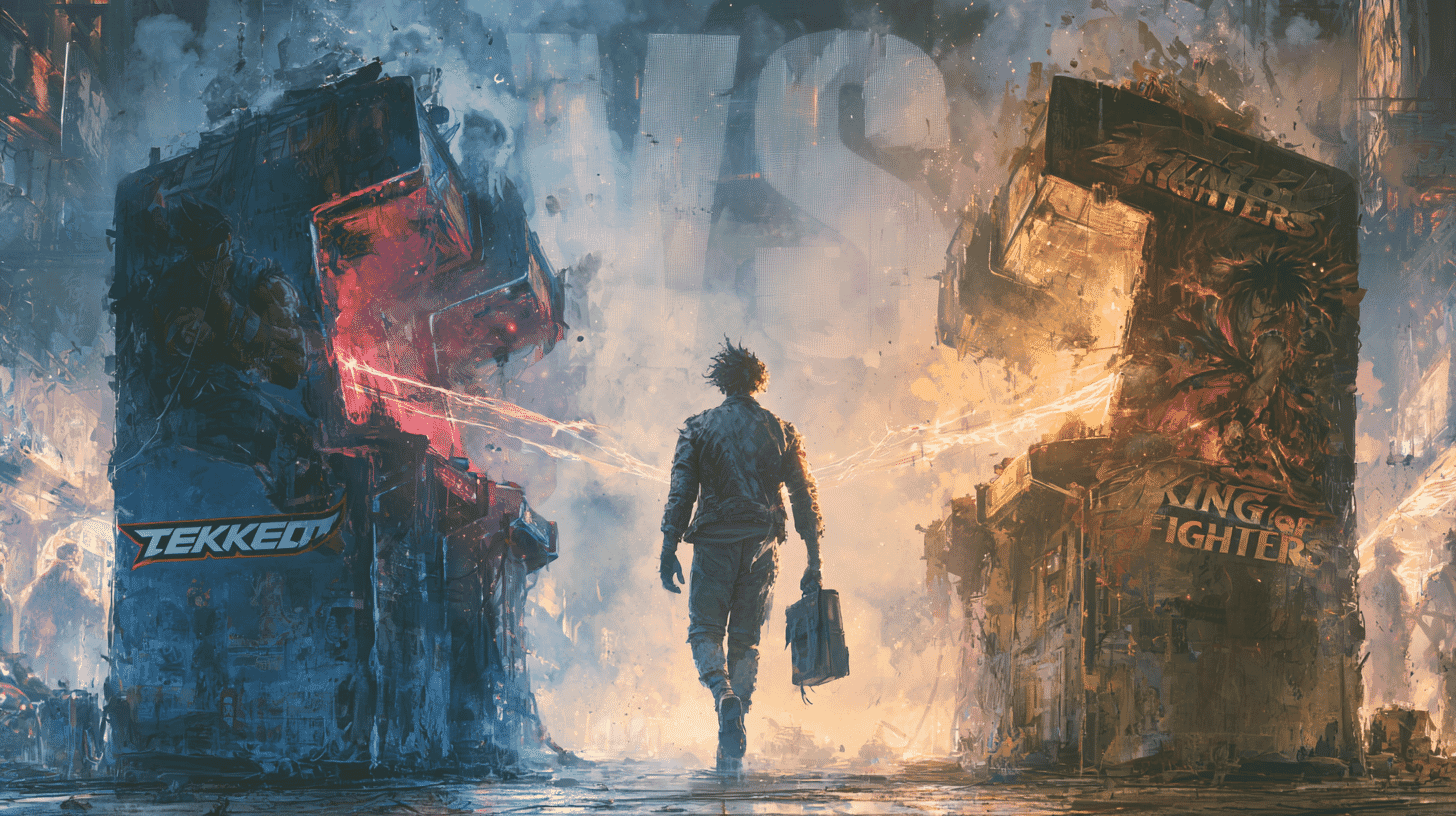
🎮 The fighting game world just got a plot twist no one saw coming. Katsuhiro Harada, 31 years at Namco and then Bandai Namco and long the hair-gelled face of Tekken, has rejoined the industry four months after walking out, and he has done it under the umbrella of his oldest rival, SNK. Welcome to "VS Studio SNK."
What just happened
On May 13, 2026, SNK and Katsuhiro Harada jointly announced the formation of VS Studio SNK Co., Ltd. (commonly called "VS Studio"), a brand-new game development studio established on May 1 and headquartered in Shinagawa, Tokyo. Harada serves as Representative Director and CEO. Joining him as Chief Creative Officer is Yuichi Yonemori, a longtime Tekken collaborator who directed Tekken Tag Tournament 1 and 2 among others.
The studio is described as an "independent studio under the SNK group." SNK put money in through a capital increase and is folding the company into the group as a consolidated subsidiary; the stake is undisclosed, but both sides have been explicit that this is not a wholly owned subsidiary. SNK is also supporting the build-out of the development environment, with staff exchanges and secondments under consideration. The point person on SNK's side is Yasuyuki Oda, head of SNK Japan Studio and the chief producer behind Fatal Fury: City of the Wolves.
For context: Harada left Bandai Namco at the end of 2025 after 31 years, going back to the days when the company was just "Namco." In his farewell statement, he cited Tekken's 30-year milestone, the deaths and retirements of friends and mentors, and a growing awareness of "the time I have left as a developer." Where he would land stayed a mystery until now. On May 1, the day the company was legally founded, he was on stage at EVO Japan 2026 in Tokyo collecting a lifetime achievement award for game creators and introducing himself, to laughter, as "Harada, currently unemployed."
What "VS" actually means (it's not just "versus")
Harada explained that "VS" carries multiple meanings layered on top of each other:
- Versus: the obvious fighting-game read
- Video game Soft: a reference to the old "VS Development Division" at 1990s-era Namco, which Harada and Yonemori both came from. That division's name was actually short for Video Game Software, but everyone called it "Versus" anyway
- Vanguard Spirit: the pioneer mindset
- Visionary Standard and Volition Shift: innovation-and-challenge framings Harada has used in his press messaging
- Visual Studio: yes, the Microsoft IDE. A wink to developers
In other words: a fighting-game name on the surface, with a deeper "let's get back to what we did in the 90s" core.
The 90s nostalgia is the actual mission statement
Reading between the lines of Harada's interviews, the studio is openly trying to recapture something specific: the energy of 1990s arcade-era development teams, when a small group of obsessed people could make a hit. Across the interviews he gave around the launch, Harada kept returning to the same idea. Organizations get heavy over time. Responsibilities accumulate regardless of one's wishes. He wanted to "set down the current load and pick a new one I choose myself."
The studio's tagline, "Beyond tradition, crafted to perfection," sounds corporate, but Harada's actual words around it are not. He talked about wanting "people whose internal fire hasn't gone out, even if they're over 50." He emphasized that gaming journalists who never stopped being curious about games might actually make great developers. He's hiring veterans and newcomers alike, with passion weighted above resume.
That ethos lines up with what former colleague Yonemori said: he joined because the picture of "working with old friends in a blank-canvas environment, the way we used to" was simply too good to pass up.
The Tekken-vs-SNK reunion is loaded with history
For readers outside the fighting game community, here's why this pairing makes longtime fans do a double-take.
In the 1990s, Bandai Namco's Tekken and SNK's King of Fighters were direct rivals, with different design philosophies, different arcade cabinets, different fanbases. Tekken pushed 3D-polygonal realism; King of Fighters doubled down on dense 2D sprite work and team-based tag battles. The two companies competed for arcade space, for tournament prestige, and for the loyalty of a generation of players.
Harada and Oda, the two people now sitting on opposite sides of the VS Studio collaboration, are the same generation, both of them shaped by that rivalry era. Harada has said that running into Samurai Shodown in an arcade in 1993 was a genuine shock to him: SNK was the enemy and a formative memory at the same time. By his own account, he and Oda have been casually talking about "what if we worked together someday?" for years, completely separate from this actual deal. That hypothetical turned real surprisingly fast.
SNK marked the announcement on its Neo Geo Facebook page with an image of Harada sitting on Geese Howard's throne, the iconic Fatal Fury villain's chair. A visual joke, and also a flag-planting moment: the Tekken guy is officially on the SNK side of the table now.
The Saudi Arabia question the international FGC keeps raising
Coverage outside Japan, from Kotaku, Engadget, VGC and Reddit alike, has consistently flagged one piece of context that Japanese outlets tend to skip: SNK is wholly owned by Saudi capital.
Electronic Gaming Development Company (EGDC), the investment arm of the MiSK Foundation established by Crown Prince Mohammed bin Salman, put $216.5 million into SNK in November 2020 for a 33.3% stake. A tender offer completed in February 2022 lifted that to 96.18%, and SNK delisted from South Korea's KOSDAQ that May. The holding has since reached 100%. SNK's last major release, Fatal Fury: City of the Wolves, reportedly underperformed commercially despite a high-visibility marketing campaign that included the unusual addition of soccer star Cristiano Ronaldo as a playable character.
The same EGDC filed with Japan's Kanto Local Finance Bureau in March 2026 to report the purchase of 26,788,500 Capcom shares, a 5.03% stake, on top of the roughly 5% Saudi Arabia's Public Investment Fund already held. Nintendo, EA, Take-Two and Niantic are among that fund's other holdings. Commentators outside Japan argue Harada's brand is now indirectly tied to this ownership structure; defenders point out that Harada appears to have meaningful creative autonomy and that SNK has continued operating as a Japan-headquartered studio with Japanese developers leading projects.
VS Studio itself hasn't been particularly visible on this point. Harada has stuck to talking about creative independence and the day-to-day mechanics of building something new.
What VS Studio will actually make
Harada confirmed the direction without confirming anything specific:
- The studio will focus on competitive, player-vs-player action. "I don't know whether it will be a fighting game, but first I want to make a versus game," Harada said
- He won't be working on SNK's existing announced titles (the new Samurai Spirits or Art of Fighting projects). VS Studio is its own thing
- The first game is years out. Harada noted that modern development cycles run four to five years, so anyone expecting a 2026 reveal will be disappointed
- He hasn't ruled out eventually touching SNK's classic IPs in the future, but it's not on the table for the debut project
In short: they're hiring, the office is freshly built, and the first announcement is "we're building." The first actual game announcement is something he asked everyone to be patient about: let us be quiet until you have almost forgotten about us, and then we will come back with something.
What r/Fighters is arguing about
Reactions on Reddit's r/Fighters, r/Tekken, and ResetEra fighting-game threads have split along three lines this week:
- Pure excitement: Tekken loyalists thrilled that Harada is still in the game, KOF fans hoping his influence sharpens SNK's next decade of releases
- Cautious optimism with conditions: many comments boil down to "great if VS Studio gets to actually be independent; concerning if Saudi ownership creates pressure on creative decisions or community policies"
- Outright cynicism: a vocal minority argue that the Saudi connection itself disqualifies the project, pointing to how widely Saudi money has spread across the games industry as a pattern they don't like
There is also an underdiscussed angle: Pakistan, which has produced the past several years of dominant Tekken world champions and treats Harada as something close to a national figure, has been overwhelmingly positive. The same goes for South Korea, where Tekken's competitive scene has only grown in scale.
So what's the actual story here?
Strip everything away and the core narrative is simple. A developer past the midpoint of his career, who could have retired comfortably, looked at his remaining working years and decided he wanted to build one more thing from scratch, with people he chose, with the open-canvas energy he had in his twenties. The mechanics of that choice, finding a parent company willing to fund it without smothering it, happened to land on SNK. The ownership context around SNK is genuinely complicated, and it's reasonable for the international fighting game community to keep discussing it.
But the headline, for the people who actually grew up playing arcade fighters in the 90s, is unmissable: the Tekken guy and the King of Fighters guys are now in the same building. That was a punchline a year ago. Now it's a payroll.
What's it like in your country?
In Japan, this story is being covered almost entirely as a "creative second act" narrative, with the focus on Harada's personal mission and 90s-era development culture. In English-language coverage, it's being filtered through the lens of Saudi Arabia's gaming-industry investments. Both framings tell you something real.
How is the news being covered where you are? Are people in your fighting game community thrilled, suspicious, or already moved on? Drop us a comment. We read everything, even the cynical ones.
References
- https://www.famitsu.com/article/202605/74400
- https://www.4gamer.net/games/999/G999901/20260511002/
- https://automaton-media.com/articles/interviewsjp/vs-studio-snk-20260513-442576/
- https://news.denfaminicogamer.jp/interview/2605122d
- https://www.videogameschronicle.com/news/tekken-boss-harada-joins-snk/
- https://kotaku.com/katsuhiro-harada-tekken-vs-studio-snk-saudi-arabia-2000695342
- https://www.engadget.com/2171217/tekken-director-katsuhiro-harada-is-back-with-his-own-studio-under-snk/






Global Discussion
13 comments