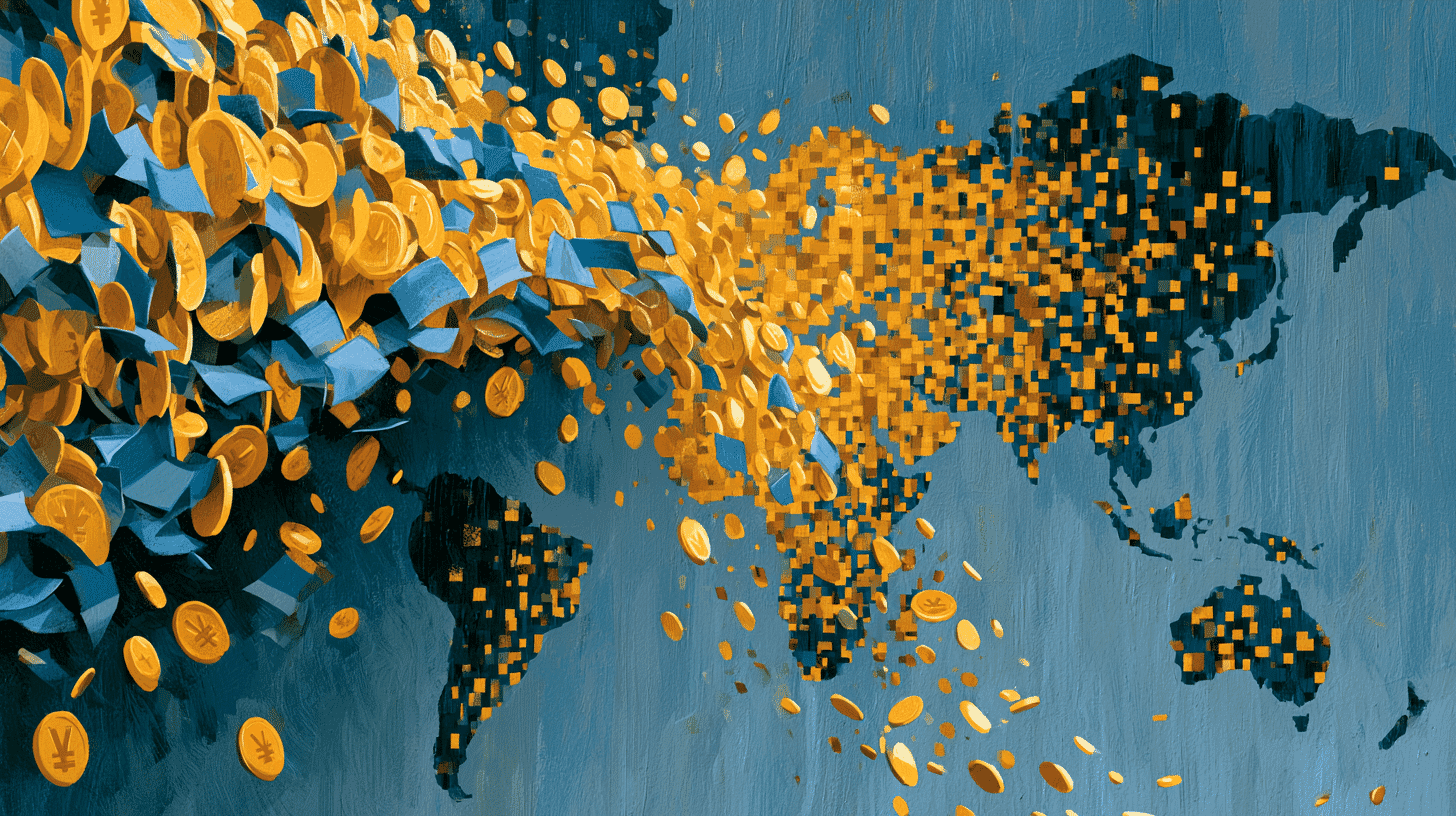
🎌 Japan just put public money behind anime and video-game blockbusters: up to ¥1.5 billion (about $9 million) per project. The first round went to 27 projects from names like MAPPA, Aniplex, Trigger, and mobile-game maker DeNA. The stated goal is to manufacture the next global mega-hit. The awkward part: a lot of people don't think the state should be cutting checks to companies that already turn a profit.
A subsidy engineered to chase ¥20 trillion
The program has a blunt marketing name: IP360 -Toward 20 Trillion Yen-. It's run by the Ministry of Economy, Trade and Industry (METI), and the number in the title is the whole point. Tokyo wants Japan's overseas content sales (anime, games, manga, music, live-action) to hit ¥20 trillion (roughly $123 billion) by 2033. For reference, that figure sat around ¥5.8 trillion ($36 billion) in 2023, so the target is more than triple where things stand today.
To get there, METI tripled its own content budget, from about ¥10 billion the year before to roughly ¥35 billion ($215 million) across nine funding tracks. The one that made headlines is Track 3, "large-scale work production support." It covers up to half of a project's production cost, capped at ¥1.5 billion per work, and it pays out across the pipeline (pre-production, production, localization and overseas promotion) over a two-year window ending February 2028.
Two design choices answer the obvious objections. First, there's a clawback: once a funded work's revenue passes four times its production cost, the company returns 10% of the excess profit, capped at the subsidy it received. Second, METI has publicly committed to a hands-off rule. Among the five principles it laid out for this policy is a promise not to meddle in creative content. In a country where "government money" and "creative freedom" don't usually sit comfortably in the same sentence, that pledge was deliberate.
Who made the cut
Out of 90 applications from 53 companies, 27 projects across 19 companies were selected: 7 in games, 8 in anime and 4 in live action, with K2 Pictures picked in both anime and live action.
The game side reads like a who's-who of Japanese studios: Square Enix, Sega, Konami, Koei Tecmo, Arc System Works, Applibot, and DeNA, whose entry is a new North American mobile title built for a soft-launch rollout. The anime slate leans prestige: Aniplex, Wit Studio, Trigger, Production I.G, CoMix Wave Films (Makoto Shinkai's studio), MAPPA, and others. On the live-action side, Toho Studios and AOI Pro. are among the picks.
What's telling is how several studios framed their applications. Aniplex's project is described as a push to strengthen a "sustainable production system." Production I.G's pitch centers on building a sustainable environment for creators. In an industry long criticized for burning out its animators, the money is being pointed, at least on paper, at the production base itself, not just at the finished frames.
There's a reason the list skews toward big, established players, and it's baked into the rules: eligibility is gated on past performance. In games, for instance, a studio needs a corporate best-selling title of at least ¥8 billion and a project budget of ¥2 billion or more. No proven hit on your record, no state co-funding for your next swing, and that eligibility floor is exactly what makes the next part contentious.
The part that lit up X
When word got out that a company like DeNA could receive up to ¥1.5 billion in public funds, Japanese social media pushed back hard. The core complaint was simple: this looks less like industrial policy and more like handing money to firms that don't need it.
METI felt the heat enough to respond directly on X on June 29, arguing the program is meant to spark investment, not to hand companies a profit. Its reasoning: even cash-rich firms tend to hold back on genuinely high-risk, globally ambitious projects, and a subsidy tips the math toward greenlighting them. The ministry also promised to track progress against hard KPIs so funded projects don't simply collapse after collecting the money.
Whether that's convincing depends on how much weight you put on the clawback and the KPI monitoring versus the plain optics of a profitable game company receiving nine figures of public support. Both readings are defensible.
Why Japan feels behind
Strip away the noise and the policy rests on one anxiety: everyone else is spending more. South Korea's content agency, KOCCA, runs on an annual budget in the neighborhood of ¥70 billion ($430 million) and has poured sustained money into exporting K-content for over a decade, a big part of why K-pop and Korean webtoons travel the way they do. In the United States, film and TV production leans on tax incentives that can offset a large share of production costs. Japan, by comparison, spent modestly and inconsistently.
There's a defensive angle too. METI recently estimated that piracy of Japanese digital content hit ¥5.7 trillion ($35 billion) in 2025, and ¥10.4 trillion ($64 billion) once bootleg character goods are counted. When that much value is leaking out, the argument goes, letting studios stay small and cautious is its own kind of loss. In a market with strong network effects, the player who invests first tends to take the whole prize.
It marks a real shift: a government that spent a decade selling "Cool Japan" as soft power now wants anime and games to earn hard currency, not just goodwill.
Japan is betting that a nudge of public money turns near-misses into worldwide hits. Does your country fund its film, game or animation industry? And when it does, do you think the money lands where it should?








Global Discussion
4 comments