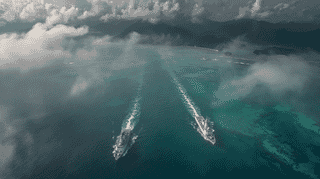
Japan Coast Guard's new 3,500-ton patrol ship "Suruga" launched on Feb 18, 2026. Built at $108M with twin 40mm guns and 25+ knot speed, this 8th Miyako-class vessel strengthens Japan's response to China's growing maritime assertiveness around the Senkaku Islands.
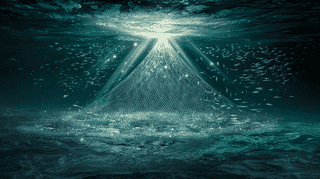
The Chinese vessel seized in Japan's EEZ used a "tiger net", a devastating method with 1cm mesh that strips the ocean bare, including juvenile fish. Explore how this "sea vacuum cleaner" works and why IUU fishing by Chinese fleets threatens oceans from South America to Africa.
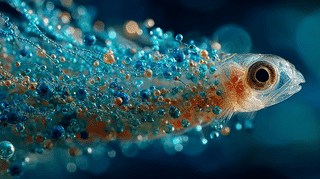
A Nagasaki University study reveals nanoplastics transferred through the food chain drastically reduce red sea bream larvae survival rates. With microplastic concentrations 27 times the global average, Japan's coastal waters face an invisible pollution crisis threatening fisheries and marine ecosystems.
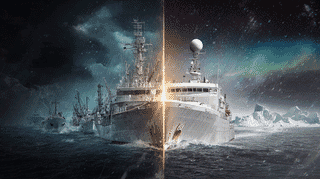
Japan's first nuclear-powered ship "Mutsu," launched in 1969, was plagued by a radiation leak incident and fierce public opposition. Yet engineers cut the hull apart, removed the reactor, and spent roughly $1.3 billion (in today's value) transforming it into "Mirai" — one of the world's largest ocean research vessels. Over 28 years, Mirai sailed 2.3 million km (58 trips around Earth), pioneered Arctic research, and even surveyed Fukushima's nuclear contamination. Retired in December 2025, its story of dramatic reinvention now passes the torch to the icebreaking successor "Mirai II."
Japan achieved a world-first by extracting rare earth mud from 6,000m deep near Minamitorishima in January 2026. Explore the latest on Japan's seabed mineral resource development, commercialization roadmap, environmental challenges, and what it means for global critical mineral supply chains.
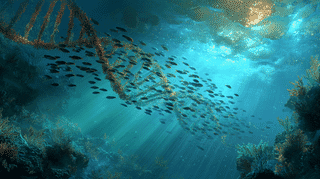
Japan's latest marine science is overturning long-held beliefs about fish. DNA analysis has dismantled the massive order Perciformes, nanoplastics are dramatically reducing fish larval survival rates, and a world-first observation reveals shortfin mako sharks "warming up" before deep dives. From environmental DNA survey revolutions to new species discoveries, explore cutting-edge fish ecology research from one of the world's most biodiverse marine regions.
An estimated 5 billion tons of gold are dissolved in Earth's oceans—20,000 times what humanity has ever mined. IHI's biosorption technology using algae has successfully extracted gold from hot springs and deep-sea vents. Could this breakthrough eventually set a ceiling on gold prices? We examine the science, economics, and challenges.
Japanese tech and trading giants NTT Data, Sumitomo Corporation, and JA Mitsui Leasing establish Intra-Asia Marine Networks to build and operate the I-AM Cable connecting Japan with Southeast Asia. The $1 billion project features 320Tbps capacity and aims to strengthen Japan's position as Asia-Pacific data hub by 2029.
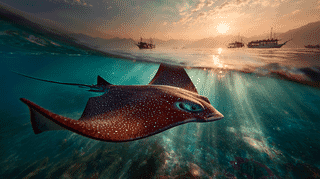
Nagasaki University researchers solved a 160-year taxonomic mystery dating back to Siebold's era, discovering that Japan's common red stingray actually comprises multiple species. The team formally described the new species Hemitrygon ariakensis, found primarily in the Ariake Sea, resolving confusion that began when specimens were first collected in the Edo period.
Japan's JAMSTEC will conduct the world's first rare earth mud mining test from 6,000m deep ocean off Minamitorishima in January 2026. A historic project key to Japan's economic security strategy to reduce dependence on China for critical minerals.