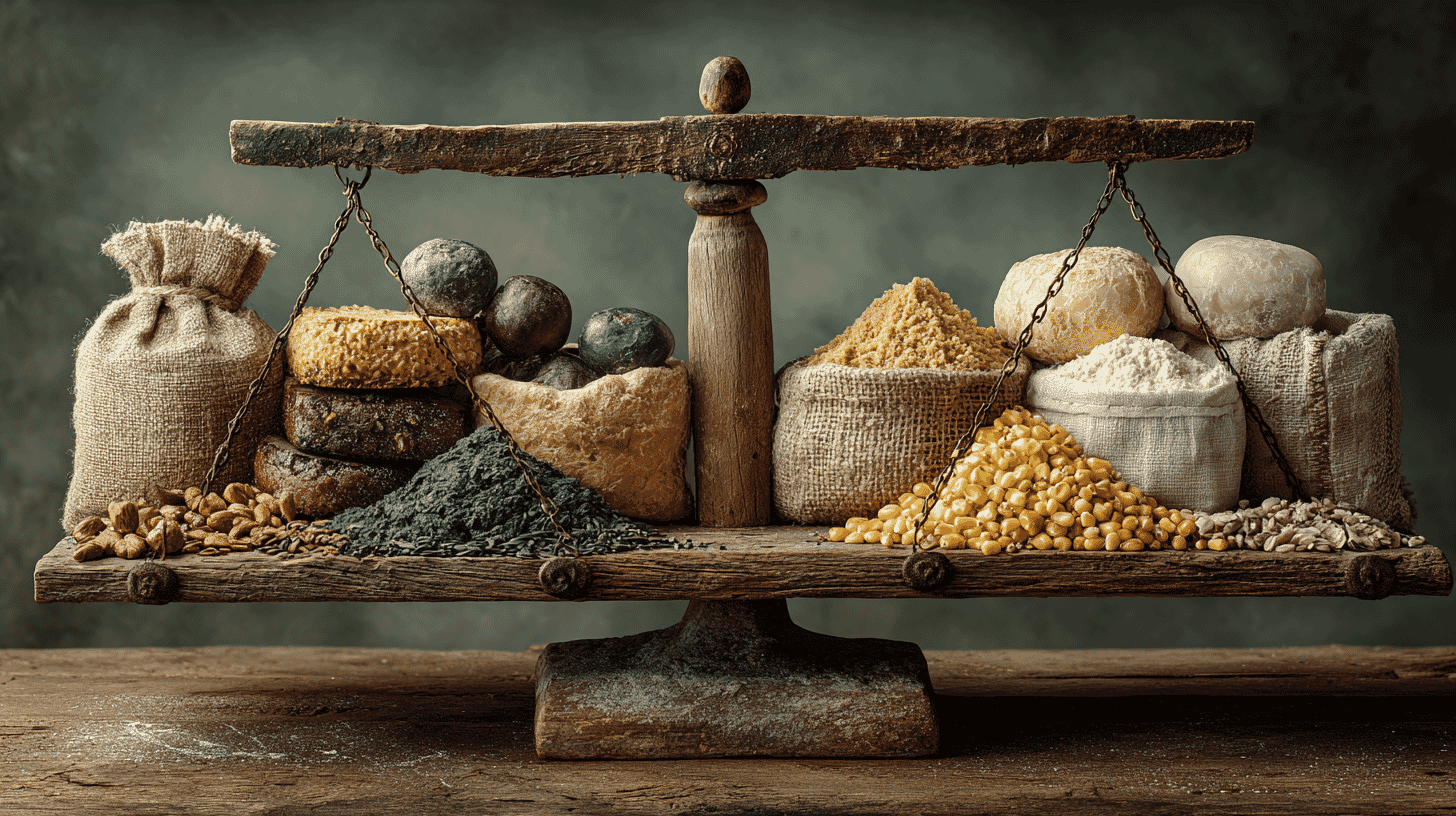
🍱 Japan just shipped a record amount of food abroad (wagyu beef, scallops, green tea, sake) for the thirteenth year running. And yet, by the most-quoted measure, the country still grows only 38% of the calories its people eat, a number that hasn't budged in fifteen years. Both things are true at once. Here's why that's not the contradiction it looks like, and where the real worry hides.
In February 2026, Japan's farm ministry announced that food and agricultural exports hit ¥1.7 trillion (about $10.6 billion) in 2025, up 12.8% from the year before and a record for the thirteenth straight year. Eight months earlier, the same ministry had reported that the calorie-based food self-sufficiency rate for fiscal 2024 was 38%: flat again, and under 40% for the fifteenth consecutive year.
Read side by side, the two headlines seem to argue with each other. A country drowning in food exports that can't feed itself? The puzzle dissolves once you look at what each number actually measures, and what Japan sells versus what it leans on.
A self-sufficiency rate is only as clear as the ruler you use
Japan publishes its food self-sufficiency in more than one way, and the gap between the versions is enormous.
The figure that makes international headlines is the calorie-based rate. It divides the calories produced domestically by the calories supplied to the population. For fiscal 2024 that came to 860 kilocalories out of 2,265 per person per day, or 38%. By this ruler Japan sits near the bottom of the developed world. The ministry's 2022 comparison puts Canada at 233%, Australia at 169%, France at 117% and the United States at 115%, with Japan at 38%, just ahead of South Korea's 32%.
Switch to the production-value rate (the one most countries actually use) and Japan's number jumps to 64% for fiscal 2024, three points higher than the year before. Measured this way, Japan (64%) sits close to Britain (61%) and Italy (75%) and comfortably above Germany (40%). Same country, same year, a 26-point swing.
Why the chasm? Calorie counting rewards bulk, cheap, energy-dense crops (wheat, corn, oilseeds) that sprawling exporters like Canada and Australia grow by the millions of tons. Japan, short on flat land, specializes instead in high-value, low-calorie food: vegetables, fruit, fish, premium beef. Those products barely move the calorie needle but carry real monetary weight, which is why the production-value figure looks so much healthier. The calorie-based metric is an outlier. Only Japan, South Korea and a handful of others lead with it.
There's a third wrinkle the ministry began publishing this year: an "intake-calorie" rate of 46%. The standard calorie figure uses calories supplied as its denominator, which includes everything thrown away. Japan wastes a famously large amount of food, so once you measure against the calories people actually eat (1,850 per day), the self-sufficiency rate rises to 46%. The 38% headline, in other words, partly counts the nation's garbage.
Japan sells what it has plenty of, and imports what it can't grow
None of this means the 38% is meaningless. It points to a genuine structural fact: the foods that determine Japan's calorie base are precisely the ones it imports.
Rice is the lone staple Japan essentially feeds itself, roughly 7 million tons a year, almost entirely domestic. Everything else in the calorie-heavy column is shipped in. Of the wheat, soybeans and corn the country consumes (about 25.7 million tons combined), some 24.3 million tons arrive from abroad. Japan grows just 16% of its own wheat and 7% of its soybeans (fiscal 2024). Most of the corn is feed for livestock.
And the export hits? They sit on the other side of the ledger. The 2025 surge was led by green tea, beef, yellowtail, scallops and alcoholic drinks like sake: premium goods with thin caloric value and fat price tags. The United States was the top buyer at ¥276 billion (about $1.7 billion), with green tea and wagyu in demand even after Washington's April tariffs.
The clearest illustration of the paradox is wagyu. Beef exports are booming, but Japanese cattle are fattened largely on imported feed, and Japan's feed self-sufficiency is only 27%. The calorie-based rate subtracts imported feed from domestic livestock output, so a steak raised, slaughtered and sold from Japan, then exported to a steakhouse in Los Angeles, contributes almost nothing to the calorie self-sufficiency number. The country can break export records on beef while its calorie base stays flat, because the cow ate imported corn.
Processed exports tell a similar story. A bottle of sake, a jar of seasoning, a box of confectionery: many of these are made partly from imported ingredients, then sold overseas. Shipping them out earns foreign currency, but it doesn't add a single domestically grown calorie to the balance sheet. A weak yen, in the 160s to the dollar in mid-2026, inflates the yen-denominated export total too, making the boom look even bigger in headline terms than it is in volume.
So the export record and the stuck self-sufficiency rate aren't fighting. They're describing two different layers of the same food system: a thin, lucrative top layer Japan exports, and a thick, calorie-dense base it buys from the world.
Where the real vulnerability actually sits
If the 38% figure overstates the alarm in one sense, it understates a different danger in another. The export trophies distract from a base that is quietly eroding, not on the demand side, but in the fields.
The number of core farmers (people whose main job is farming) fell to about 1.04 million in the 2025 agricultural census, down from 2.4 million in 2000, a drop of nearly 60% in a single generation. Their average age is 67.7, and people 65 and older make up around 70% of the total. Fewer than 13% are under 50. This is not an aging workforce so much as a workforce with almost no young replacements behind it.
The financial strain is showing up in failures. Farm-business bankruptcies in the first half of fiscal 2025 (April to September) reached 53, the highest for that period in 30 years, driven by surging costs for fuel, fertilizer and feed. And the fertilizer itself is another import dependency: Japan brings in nearly all of the phosphorus and potassium its soil needs. Even the 100%-domestic rice crop relies on fertilizer ingredients from abroad.
That is the layer worth watching. A record year of premium exports is real, but it does little to shore up the calorie base, the farming workforce or the fertilizer supply lines.
Tokyo has noticed the gap. The government's basic plan still targets a 45% calorie-based rate by fiscal 2030, and Prime Minister Sanae Takaichi has voiced unusual ambition on the issue, noting during her party leadership run that the US, Canada and France all clear 100% and that Japan should aim to "get as close as possible." Her government has earmarked a separate ¥2.5 trillion (about $15.6 billion, with ¥1.3 trillion in national funds) for a 2025–2029 "intensive agricultural restructuring period," consolidating farmland and backing wheat and soybean growers. Whether money can reverse a demographic slide this steep is the open question.
Japan's food story, then, isn't a simple tale of strength or decline. It's a country that has gotten very good at selling the world its finest, most expensive bites, while still buying back most of the calories that keep it fed.
How does your country measure food self-sufficiency, and does the headline number match what's really on your plate? I'd like to hear how the math looks where you live.
References
- https://www.agrinews.co.jp/opinion/index/342401
- https://www.maff.go.jp/j/press/kanbo/anpo/251010.html
- https://www.maff.go.jp/j/press/yusyutu_kokusai/kikaku/260203.html
- https://www.nikkei.com/article/DGXZQOUA022WU0S6A200C2000000/
- https://www.maff.go.jp/j/wpaper/w_maff/r6/r6_h/trend/part1/chap3/c3_3_00.html
- https://www.mri.co.jp/knowledge/column/20230302.html





Global Discussion
4 comments