🏛️ One of the buildings that made Kenzo Tange a household name in architecture is coming down. Not because nobody wanted to save it. A citizens' group offered to buy it, repair it, and turn it into a hotel. Kagawa Prefecture decided it had to go anyway. The wrecking has now begun while a lawsuit is still open, and an ¥847 million price tag has people asking what, exactly, the public is paying for.
A boat that was never meant to sail
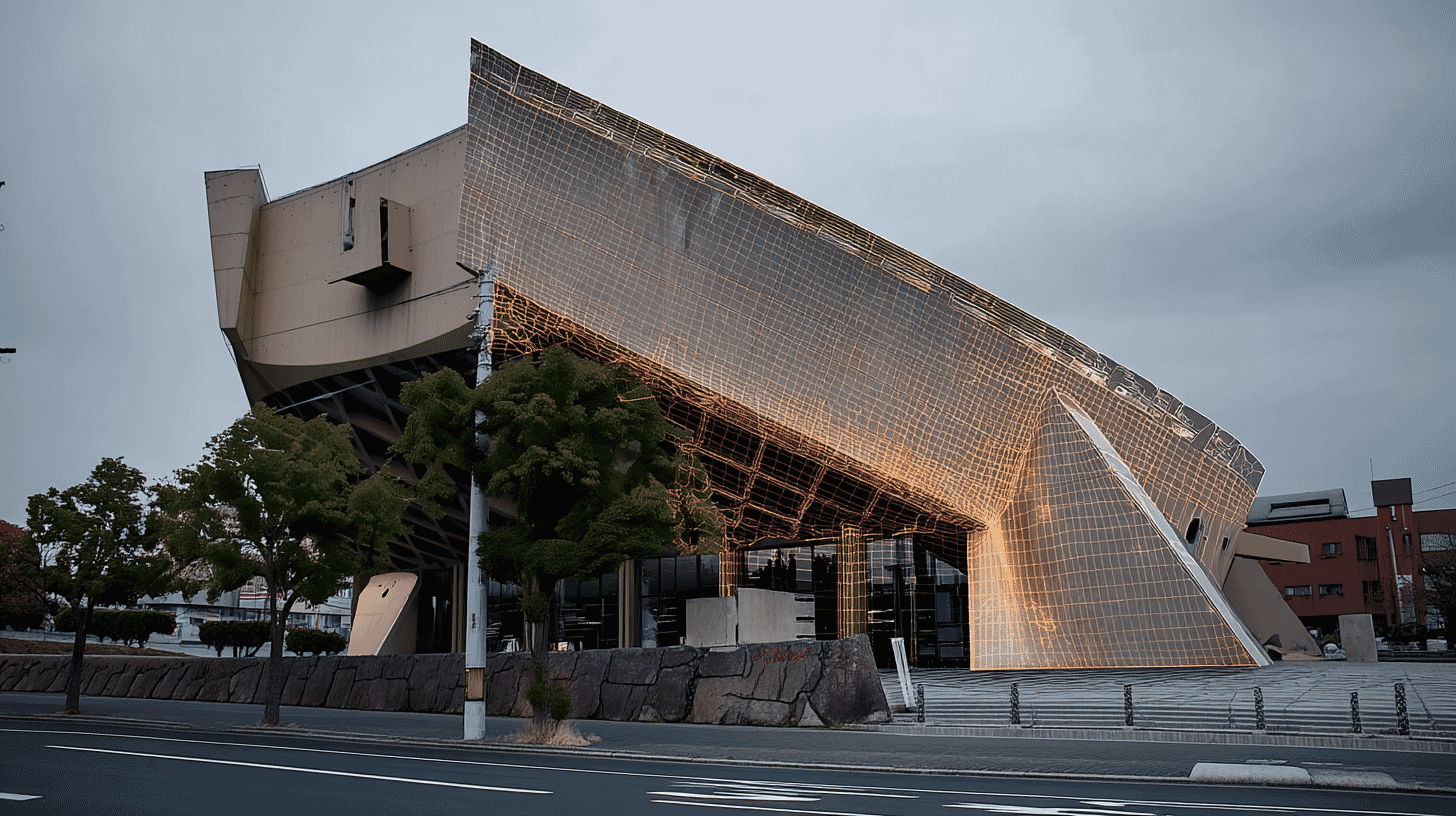
In the city of Takamatsu, on Japan's smallest main island of Shikoku, sits a concrete building shaped like an upturned boat. Locals have always called it the "Ship Gymnasium." Its real name is the former Kagawa Prefectural Gymnasium, and it was designed by Kenzo Tange (1913–2005), the first Japanese architect to win the Pritzker Prize and the man behind Hiroshima's Peace Memorial Museum and the twin towers of Tokyo's Metropolitan Government Building.
Tange finished it in 1964, the same year he completed the Yoyogi National Gymnasium for the Tokyo Olympics. Architects often describe the Takamatsu building as a smaller test run for Yoyogi: both achieve vast, column-free interiors by hanging the roof from steel cables rather than propping it up from below. At Takamatsu, the roof rises at each end and rests on four enormous pillars, with precast concrete slabs only about five centimeters thick stretched across the cables. The interior furnishings came from designer Isamu Kenmochi, and the stone garden was the work of Masatoshi Izumi, a longtime collaborator of sculptor Isamu Noguchi.
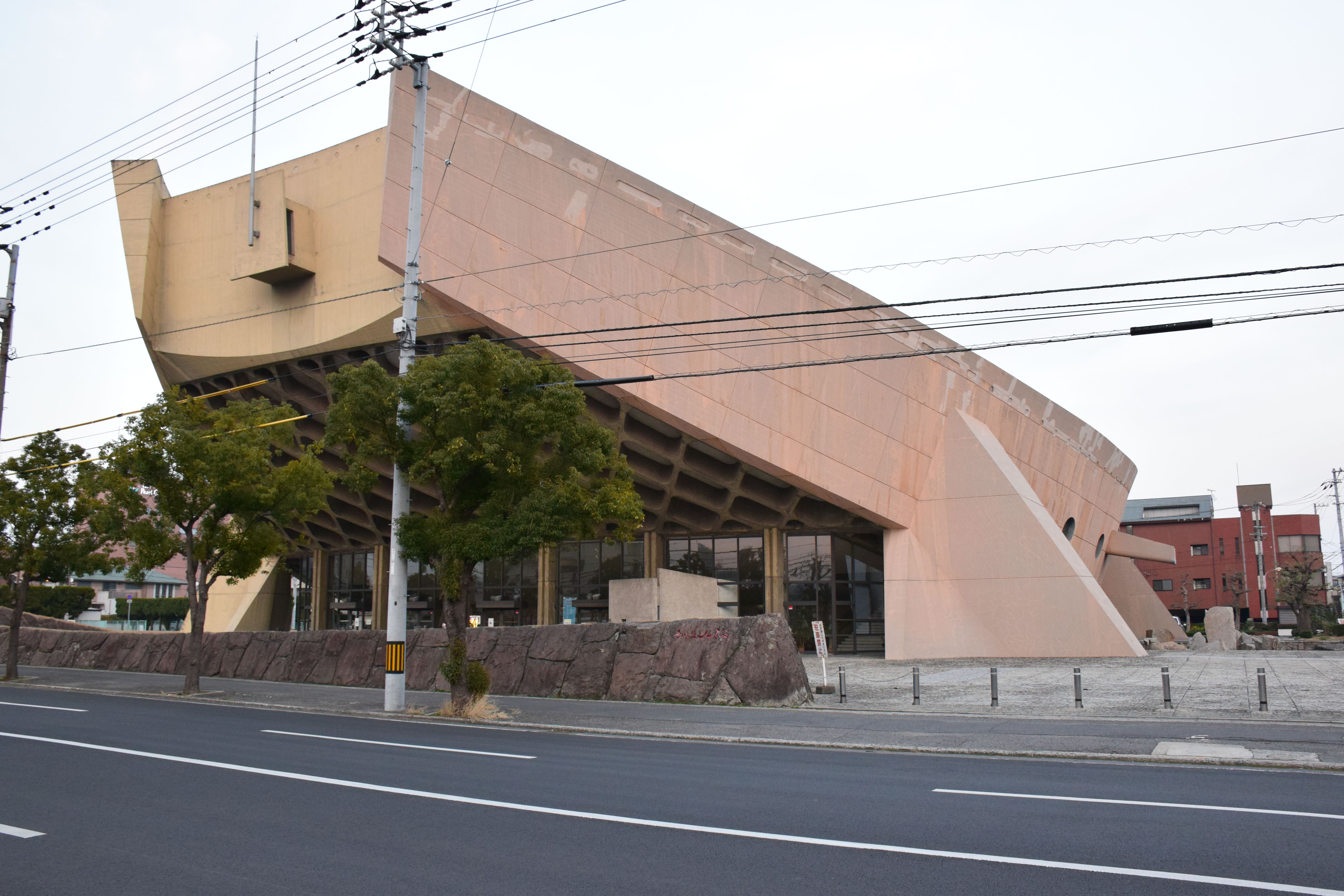
Photo: Mr. Udon / Wikimedia Commons (CC BY-SA 3.0)
This is not a building only specialists love. In 2018 the World Monuments Fund, a U.S. nonprofit that flags endangered heritage worldwide, placed it on its Watch list and channeled preservation funding to it. A few years later it was floated as a candidate for UNESCO World Heritage status.
Closed for a decade, then condemned
The gym shut its doors in September 2014. The suspension cables holding up that famous roof had begun to rust, the roof leaked, and the structure no longer met modern earthquake standards. Three separate attempts to find a contractor for a seismic retrofit failed, and estimates for full preservation work climbed toward ¥2 billion (about $12.5 million at roughly ¥160 to the dollar).
In February 2023, Kagawa's governor, Toyohito Ikeda, settled the question: the building would be demolished. The prefecture had already lined up a replacement, the Anabuki Arena Kagawa, designed by the Pritzker-winning duo SANAA, which opened in February 2025. From the prefecture's point of view, the old gym was a leaking, unsafe relic the region had outgrown.
Its core argument is about earthquakes. A 2012 seismic assessment, the prefecture says, found that the building could collapse in a Nankai Trough megaquake, the long-feared offshore rupture that disaster planners across western Japan treat as a matter of when, not if. The plaintiffs counter that the standard used in that assessment was written for low- and mid-rise reinforced-concrete buildings, not for a prestressed-concrete structure with a suspended roof. Responding to a citizen who wrote in to object, the prefecture said it had spent a decade looking, without success, for any party, public or private, willing to own and use the building, and that the safest course was to take it down on schedule. It has promised to preserve the gym's "cultural value" through 3D scans and video documentation.
The hotel that might have been
That last point is where critics dig in. In July 2025, a citizens' group called the Former Kagawa Prefectural Gymnasium Regeneration Committee said it wanted to do more than document the building. It wanted to buy it. Led by architect Keita Osada, with veteran renovation specialist Shigeru Aoki on its board, the group put forward two business plans to convert the gym into a hotel and cultural space, financed privately rather than with public money. Even the smaller of the two, a hotel with a book lounge, was projected to clear roughly ¥100 million (about $625,000) a year in operating profit.
Aoki, who has spent decades retrofitting old buildings, argued that proper renovation could remove the safety concerns. The group lined up support from Nomura Co., a major Japanese spatial-design firm, and read out preservation appeals it had received from the Museum of Modern Art in New York and the University of Illinois. The committee insists it was not trying to overturn the prefecture's reasoning so much as point out that, eleven years after closure, the situation had changed and the "demolition-first" decision deserved a second look.
The prefecture declined to negotiate, explaining at one point that its position and the committee's were too far apart for public discussion to be productive. A residents' audit request was rejected in September 2025. In November, the committee escalated, filing a residents' lawsuit to block the public spending on demolition.
The number that won't go away
In December 2025, the prefecture signed a demolition contract worth ¥847 million (about $5.3 million). For a building this size, that figure has drawn scrutiny.
The weekly magazine Shukan Gendai reported in June 2026 that it had obtained a detailed estimate, more than twenty pages and 305 line items, drawn up by a local construction firm that took part in the bidding. Built from the prefecture's own published specifications, it came to ¥368 million (about $2.3 million) before overhead and profit. The committee's Osada noted that the contracted cost works out to roughly ¥550,000 per tsubo (a tsubo is about 3.3 square meters), against a more typical ¥40,000 to ¥80,000 for demolishing a reinforced-concrete structure. For comparison, he pointed to the former Hashima city hall in Gifu Prefecture, demolished in mid-2025. It was larger, with more foundation piles and more asbestos, yet cost about ¥470 million (around $2.9 million).
An industry source quoted by the magazine said the method used to reach ¥847 million, marking up the unit price of each line item, is not illegal, and that the project could turn a profit in the ¥500 million range. Whether the final figure counts as a fair price, the source added, is open to debate. The prefecture has not been accused of breaking any rule; what its critics question is the value the public is getting.
Why start digging now?
The timing is the other sore point. When the first court hearing took place in March 2026, the prefecture said it intended to begin demolition by the end of that month. The start slipped after asbestos was newly detected and after residents at a March briefing raised worries about asbestos and ground subsidence. Work finally began on April 10, with crews posting signage and felling trees on the site, before the court had ruled on the committee's request for "evidence preservation," a hold meant to let experts inspect the building first.
To the campaigners, starting the teardown before that ruling looked like a move to make the lawsuit moot: once the building is gone, there is nothing left to argue about. They also note that until recently the prefecture had kept the site open as an overflow parking lot, with cars parked beneath the very structure it now calls too dangerous to leave standing. The prefecture sees it the other way around, saying every extra month leaves a dangerous building in place. Demolition is scheduled to reach the main structure in September 2026 and finish by mid-September 2027. Separately from the lawsuit, on June 8 a man living near the site asked the Takamatsu District Court for an injunction halting the work, arguing that it damages the landscape and living environment of neighbouring residents.
Not the first, and not the last
The Ship Gymnasium is no isolated case. Tange's own old Tokyo City Hall from 1957 was torn down in the early 1990s; his Grand Prince Hotel in Akasaka came down in 2013. Kisho Kurokawa's Nakagin Capsule Tower was dismantled in 2022, though some of its capsules were saved. Architecture writers abroad have started describing a pattern of postwar Japanese masterpieces falling, one by one, whenever a renovation bill runs higher than a rebuild.
There is a sharp irony in this particular case. A short walk from the doomed gym stands another Tange building from the same era, the former Kagawa Prefectural Office, which the national government has designated an Important Cultural Property. Two works by the same architect, in the same city: one protected, one being pulled apart while the courts are still in session.
What happens when a building is too young to be untouchable but too good to lose? Japan keeps answering that question with a demolition permit. How does your country decide which of its modern buildings are worth saving, and who gets to make that call?
Update: Three months into the work, as of July 10, 2026, the stone walls and planting on the site had all been removed and interior demolition had been under way since June. Asked in the prefectural assembly about pressing ahead while the case is live, Governor Toyohito Ikeda said the prefecture was not treating the courts lightly. The residents' lawsuit continues.
References
- https://news.yahoo.co.jp/articles/29077779c72113195fa0e26819d2853d2c64a5bd
- https://mag.tecture.jp/business/20250729-132960/
- https://gendai.media/articles/-/167439
- https://www.pref.kagawa.lg.jp/kocho/kocho/koe/k0001080401.html
- https://xtech.nikkei.com/atcl/nxt/column/18/00154/02785/
- https://www.dezeen.com/2023/02/21/kenzo-tange-kagawa-prefectural-gymnasium-demolition/
- https://news.ksb.co.jp/article/16626403
- https://news.ksb.co.jp/article/16716023





Global Discussion
4 comments