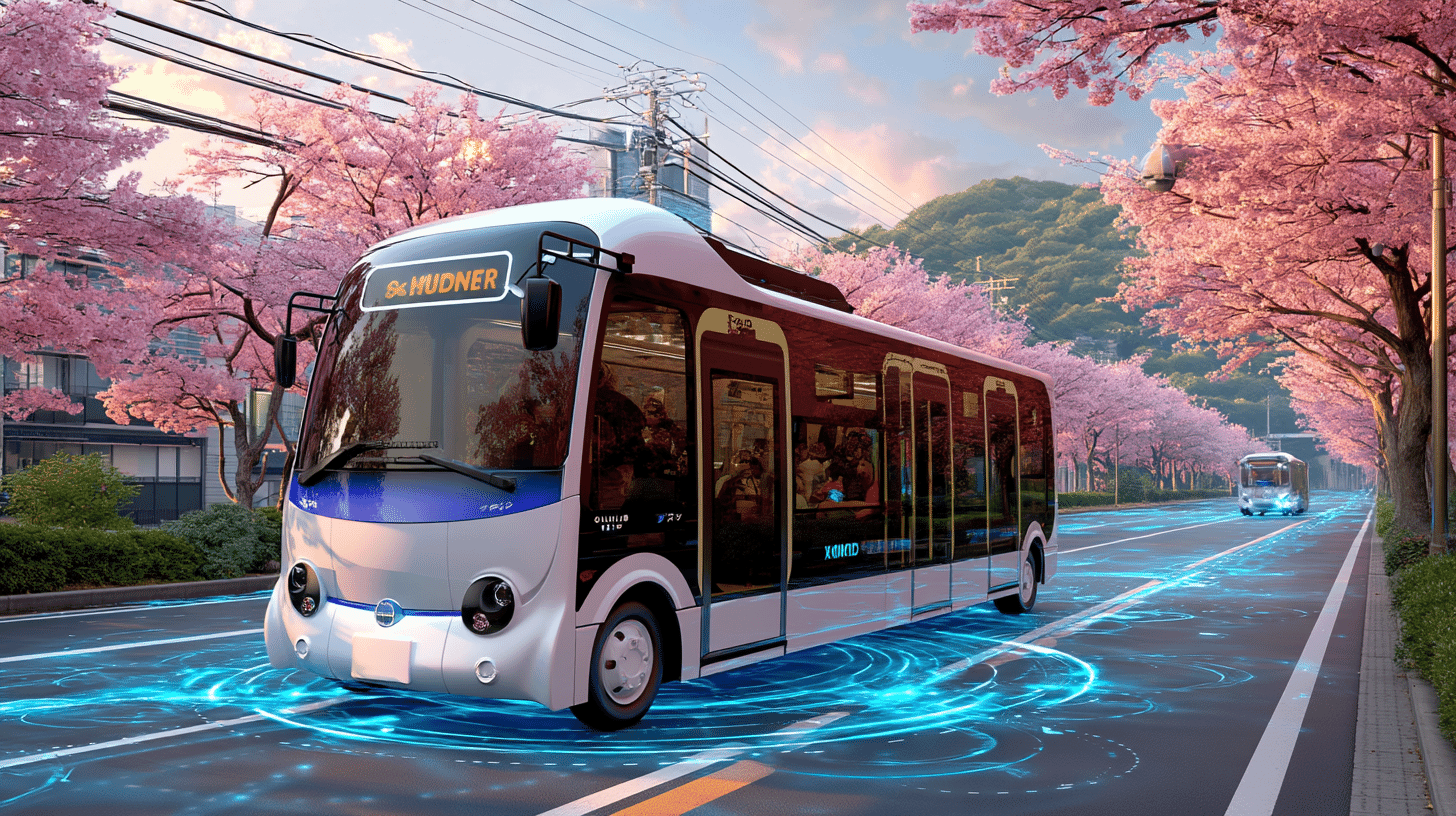
One of the biggest hurdles to putting autonomous buses into practical use is "communication stability." When your smartphone signal drops, it's annoying; when an autonomous vehicle's signal drops, it can be a matter of life and death. Sotetsu Bus and NTT Docomo Business have run a trial in Yokohama for an autonomous bus that "keeps the signal from cutting out."
An Autonomous Bus Trial in Yokohama
From January 17 to 22, 2026, a trial took place in Yokohama, Kanagawa Prefecture. A consortium of eight companies led by NTT Docomo Business, with Sotetsu Bus, NTT Advanced Technology, NTT Data Institute of Management Consulting and Stanley Electric among them, ran autonomous buses jointly with the City of Yokohama. The project was selected under the Ministry of Internal Affairs and Communications' fiscal 2024 supplementary budget program for regional digital transformation, in the Level 4 autonomous driving verification category. What set it apart was the pairing of communication technology with a "road-to-vehicle cooperation system."
The test route ran a round trip of about 10.6 km, from Tsurugamine Station on the Sotetsu Main Line to the north gate of Yokohama Zoorasia. On weekends the road clogs with zoo visitors, and it includes narrow stretches where vehicles struggle to pass each other. A hard case, chosen deliberately.
Why "Communication" Holds the Key to Autonomous Driving
We all encounter weak signals and slow connections on our phones, but for an autonomous driving system, unstable communication is a fatal problem.
Autonomous vehicles exchange driving data and information about their surroundings over the network in real time. If communication drops or lags, it directly affects vehicle control and, in the worst case, could lead to an accident. Especially in "Level 4" driving, which needs no human driver, a remote monitoring system must know the vehicle's status at all times, making stable communication an absolute requirement.
Combining Several Advanced Technologies
The trial brought together several advanced technologies.
First is NTT's wireless optimization technology "Cradio." It forecasts signal quality and hands the connection to another network before degradation sets in, holding dropouts to a minimum. Alongside it, "ISAP" traffic control curbs video delay and image degradation, with "5G Wide" and network slicing layered on top. The aim was to confirm that control-critical data still moves reliably in an urban environment where signal conditions keep shifting.
"Local 5G" was also used: a 5G network built independently for a specific area without relying on a carrier, which holds up better when the airwaves get crowded.
There are innovations on the road side, too. "Smart road lights" equipped with AI cameras and LiDAR sensors were installed along the shoulder. They detect vehicles and pedestrians within 50 meters in a straight line and share that information with the autonomous bus in real time. This is the "road-to-vehicle cooperation system," in which not just the vehicle but the road infrastructure works together to support safe driving.
Solving the Problem of Passing on Narrow Roads
The trial used two small buses (Hino Motors' "Poncho") to tackle "passing control" on narrow road sections.
Passing control means adjusting movement so that vehicles heading in opposite directions can pass each other safely. On roads with poor visibility or limited width, even human drivers face difficult judgments, but by linking roadside sensors with the vehicles, the system aims to achieve automatic stopping, deceleration, and passing decisions.
It also tested "one-to-two" remote monitoring using Tokai Rika's system. Using docomo MEC, a single monitor watches two buses at once, an important test of whether autonomous buses can enable running multiple vehicles at once and reducing staffing.
The Pressing Backdrop of a Bus Driver Shortage
Behind this trial is a bus driver shortage that is growing more severe nationwide.
According to the Japan Bus Association's estimates, about 30% of bus drivers are projected to be in short supply across the country by fiscal 2030. Since April 2024, a cap on overtime work has applied to the transport industry as well (the so-called "2024 problem"), further accelerating the shortage. Service cuts and route closures are happening not only in rural areas but in cities.
With many route-bus operators running in the red, expectations for autonomous driving technology rise year by year. The government has set a goal of realizing driverless mobility services at more than 100 locations nationwide by fiscal 2027.
Aiming for Commercialization in 2027
Sotetsu Bus has been running Level 2 autonomous driving trials since 2019. The previous fiscal year it ran a single small autonomous vehicle on a round trip of about 2 km around Zoorasia; this time it doubled the fleet to two vehicles and stretched the route more than fivefold, closer to real service conditions.
The companies, including NTT Docomo Business, aim to commercially apply these communication and control technologies to autonomous driving services by fiscal 2027. This trial is positioned as an important step toward that.
Public test rides were offered on January 21 and 22: ten round trips a day, ten seats per run, free of charge and by advance reservation.
Autonomous Bus Efforts Advancing Across Japan
The Yokohama trial is one part of a nationwide push to adopt autonomous buses.
The town of Sakai in Ibaraki Prefecture has run regular service since 2020, and the town of Eiheiji in Fukui Prefecture achieved Level 4 driving on public roads in May 2023. The city of Hitachi in Ibaraki Prefecture is also working toward commercial Level 4 autonomous service using medium-sized buses.
The city of Chitose in Hokkaido is running experiments in the harsh conditions of heavy snow and extreme cold, while the city of Sendai in Miyagi Prefecture is testing in coastal areas and mountainous zones where communication is unstable. Experiments tailored to each region's characteristics are being carried out around the country, building up know-how.
Challenges Technology Alone Cannot Solve
Putting autonomous buses into practical use depends not only on technical challenges but also on social acceptance.
Riders have said they feel "a sense of stability" and "can trust it," but running at a top speed of around 20 km/h can cause congestion behind the bus, raising the challenge of coexisting with ordinary drivers.
Even as autonomous driving advances, questions remain about non-driving tasks: helping elderly and disabled passengers board and alight, collecting fares, and handling onboard trouble. Full driverless operation is still some way off, and for now, introduction as a way to ease drivers' burden and address labor shortages is the realistic path.
With a driver shortage bearing down on the industry, Japan is in a hurry to get autonomous buses into service. Choosing narrow roads and a congested zoo entrance on a weekend was the point of this trial: test where it is hardest, not where it is easiest.
How is the adoption of autonomous buses progressing where you live? Is a shortage of public-transport drivers a problem there?







Global Discussion
16 comments