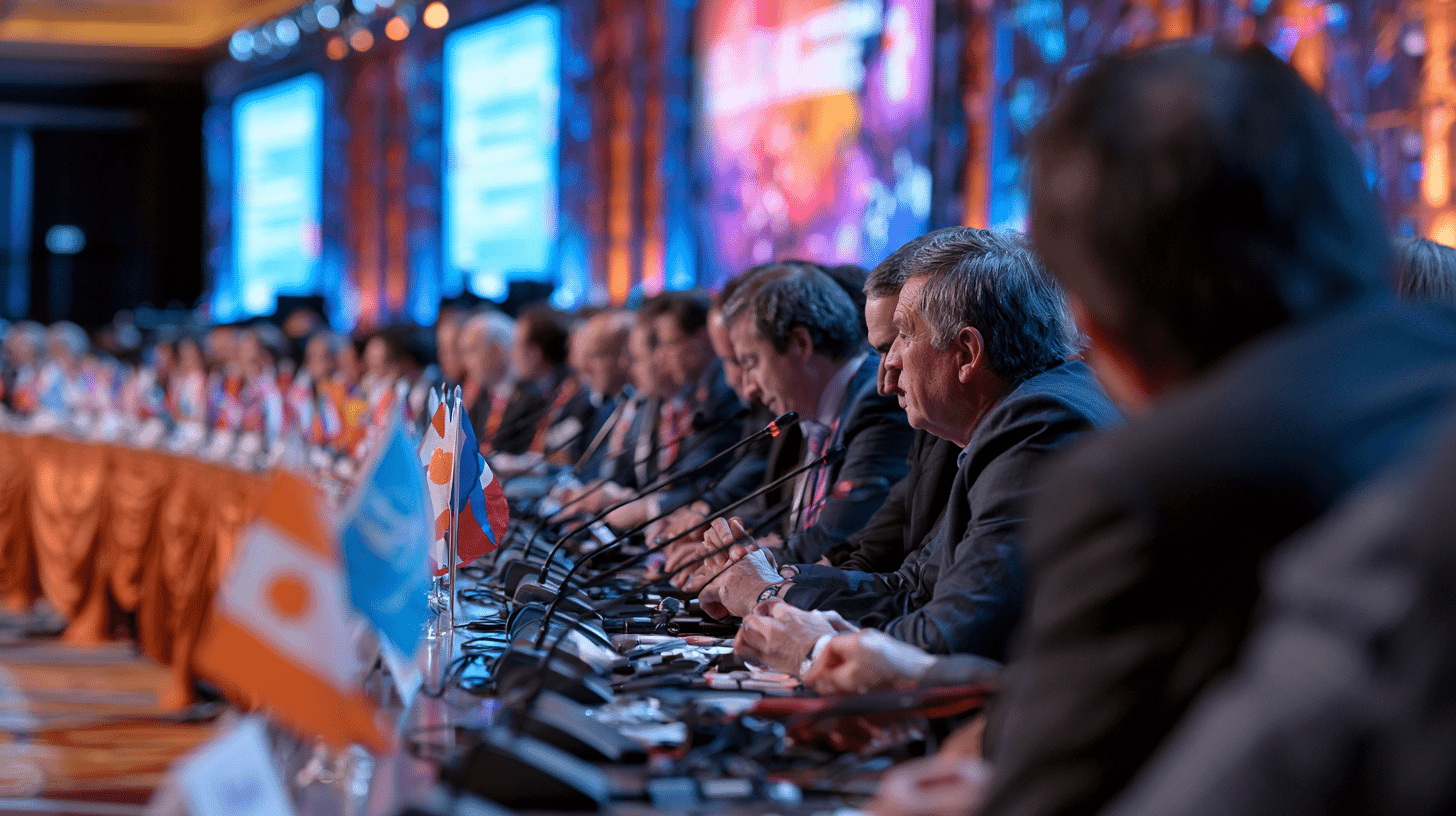
⚙️ Japan just told China to "fix it," on Chinese soil.
At an APEC trade meeting in Suzhou, Japan's industry minister demanded that countries restricting rare earth exports "appropriately rectify" the practice. He never said the word "China." He didn't have to.
Here's how a single remark about Taiwan turned into a slow squeeze on the metals that keep modern factories running, and why a brief exchange over dinner mattered as much as the speech.
A pointed demand, made on China's home turf
On May 22 and 23, trade ministers from the 21 economies of APEC, the Asia-Pacific Economic Cooperation forum, gathered in Suzhou, in eastern China. It is a regular working-level meeting, the kind that prepares the ground for November's leaders' summit. This year it carried more friction than usual.
Japan's Minister of Economy, Trade and Industry, Ryosei Akazawa, used his time on the floor to argue that export restrictions on rare earths and other critical minerals "could cause grave impact on global supply chains." He went a step further and said that countries imposing arbitrary export-control measures should "appropriately rectify" them.
What he did not do was name China. He didn't need to. The meeting was hosted by China and chaired by Chinese Commerce Minister Wang Wentao, and everyone in the room knew which exporter was on Akazawa's mind.
That choice, to raise the issue at a multilateral table rather than in a private complaint, was the whole point. A bilateral protest reads as Japan versus China, one country's grievance. Said out loud at APEC, the same sentence becomes a warning about a shared problem: if one supplier can choke the metals that twenty-one economies depend on, that is everyone's concern, not just Tokyo's. It is a quieter form of pressure, and harder for Beijing to wave away.
The 188-ton signal
To understand why Japan is uneasy, look at one number.
In April, China shipped 188 tons of rare-earth magnets to Japan, according to customs data compiled by a Chinese research firm. That was roughly flat against March's 184 tons, and it marked the second straight month below 200 tons, a notably thin level for an industrial economy the size of Japan's.
The contrast with the United States is telling. China sent 512 tons of rare-earth magnets to the U.S. in April, up 26% from the month before and the first time the figure topped 500 in three months, an improvement that lined up with a U.S.-China summit held in Beijing. Same supplier, two very different taps.
This is not the dramatic shutoff Japan saw in 2010. It is something subtler: a slow squeeze. Shipments have not stopped, but the paperwork takes longer. According to a Japanese government source, applications to export the heavy rare earths used in high-performance products, elements such as dysprosium and terbium, are clearing at only about half the requested volume. Factories are not idle yet, but the margin is shrinking. "The strain is spreading, bit by bit" is how one Japanese industry insider put it.
How a remark about Taiwan became a metals problem
The squeeze has a clear starting point, and it is not about minerals at all.
In November 2025, Prime Minister Sanae Takaichi told the Diet that a hypothetical Chinese attack on Taiwan could amount to a "survival-threatening situation" for Japan, language that, under Japanese security law, could justify a response by the country's Self-Defense Forces. Beijing reacted sharply. It urged Chinese citizens not to travel to Japan, and shipments of some rare earths slowed.
Then, on January 6, 2026, China's Commerce Ministry announced tighter export controls on dual-use goods, items with both civilian and military applications, bound for Japan, effective the same day. Beijing did not publish a detailed product list. Most analysts read rare earths as part of it.
The result was a diplomatic deep freeze. For months, ministers from the two governments simply did not meet.
Why rare earths make such a good card
Rare earths are a group of 17 metallic elements. In tiny amounts they sharply boost the performance of other materials, which is why they sit inside electric-vehicle motors, wind turbines, smartphones, semiconductor manufacturing equipment, MRI scanners and defense hardware.
The leverage comes from concentration. According to the U.S. Geological Survey, China accounts for roughly 70% of the world's rare-earth mining and about 90% of refining and processing. For the "heavy" rare earths needed in the strongest magnets, dependence on China runs close to 100%. A country with that kind of grip can turn a tap without firing a shot.
Japan has been here before. In 2010, after a collision between a Chinese fishing boat and Japanese patrol vessels near the disputed Senkaku Islands, rare-earth shipments from China to Japan effectively stopped from late September until November, about two months, though Beijing never acknowledged a halt. The episode, remembered in Japan as the "rare earth shock," hit a country that then relied on China for around 90% of its supply.
Japan's quiet exit plan
The 2010 scare pushed Japan to spread its risk, and fifteen years on, dependence on China has fallen to roughly 60%. The work continues on several fronts at once.
Offshore, Japan is testing whether it can pull rare-earth-rich mud from the deep seabed near Minamitorishima, a remote island in its own waters. On the diplomatic side, Tokyo signed a critical-minerals framework with Washington, agreed by Takaichi and U.S. President Donald Trump in late October 2025, to jointly develop mining and processing outside China. Japanese trading houses have also backed Australia's Lynas, the largest rare-earth producer outside China, and Tokyo has pushed the issue through the G7.
None of this replaces China tomorrow. Refining rare earths cleanly and at competitive cost is genuinely hard, and a homegrown supply chain is years away. But the direction of travel is set, and Beijing knows it.
A standing chat at the dinner
The most-watched moment in Suzhou was not the speech. It was a conversation that almost didn't happen.
Akazawa and Wang Wentao exchanged only a brief "standing chat," or tachibanashi, as the dinner on May 22 was getting under way: a few unscheduled minutes on their feet. Short as it was, it was the first ministerial-level contact between Japan and China since the post-Takaichi freeze. Akazawa declined to describe what was said, calling it a diplomatic matter, but he framed the meeting as "good preparation" for the APEC leaders' summit in Shenzhen this November.
Japan's Foreign Vice-Minister, Iwao Horii, also spoke briefly with Wang, and used the moment to raise the safety of Japanese nationals in China after two Japanese citizens were injured in a knife attack in Shanghai on May 19.
Arata Kuno, a professor at Asia University, called the Akazawa-Wang contact a first step toward dialogue worth a positive read, while cautioning that it is still unclear what would actually trigger a real thaw, and that Japan will need to keep working at it and be seen to keep working at it.
So the trip ended with mixed results: a public demand China is unlikely to act on quickly, and a private channel pried slightly open. For Japan, both may have been the point.
Depending on a single supplier for the metals inside every motor, magnet and missile is a strategic gamble, and Japan is learning, slowly, how much that gamble costs. How does your country secure its critical minerals? And if cheaper supply meant deeper dependence, would you take the deal?
Update: After this article was published, Chinese customs figures released on June 20, 2026 showed that rare-earth magnet shipments to Japan fell 34.6% month-on-month in May, to 123 tons, the lowest level since May 2025. Shipments in March and April were more than 80% below the same months a year earlier.
References
- https://www.nikkei.com/article/DGXZQOGM212GN0R20C26A5000000/
- https://news.yahoo.co.jp/articles/872df961c70deca9753a2eae18185a6e83e5817c
- https://news.yahoo.co.jp/articles/385631726b681fdeefaa763589d90167f82b799d
- https://www.apec.org/press/news-releases/2026/0523_MRT_Statement
- https://www.jiji.com/jc/article?k=2026010900873&g=eco
- https://www.jetro.go.jp/biz/areareports/special/2026/0101/5229e687b7a111eb.html








Global Discussion
4 comments