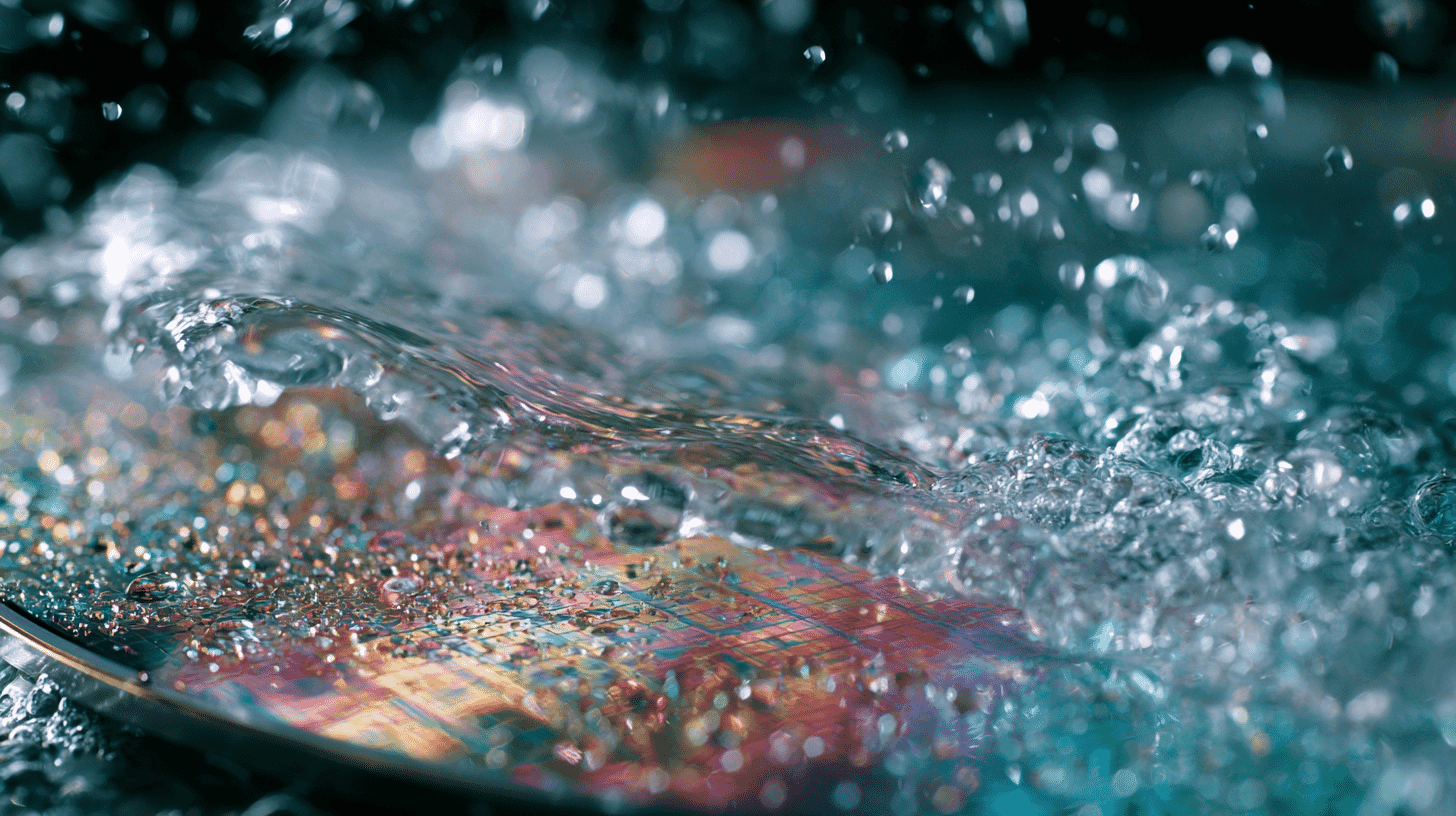
💧 The purest water on Earth isn't sold in bottles. It's made in factories, you wouldn't want to drink it, and without it your phone, your laptop and every AI chip on the planet simply would not exist. Three Japanese companies most people have never heard of quietly supply much of the world with it.
This is the story of ultra-pure water, or UPW, and why a handful of firms in Japan have spent decades turning ordinary tap water into something close to a theoretical absolute.
Water so clean it's "hungry"
Start with a number. Ordinary water conducts a little electricity because it carries dissolved minerals and ions. Strip all of that away and the water's electrical resistance climbs. At 25°C, the highest value physically possible is about 18.24 megohm-centimeters, a ceiling set by the way water molecules themselves split apart. Chip fabs demand water that stays above 18, which means almost everything that isn't an H₂O molecule has been removed.
Engineers reach for analogies because the cleanliness is hard to picture. One common description in Japan: fill a domed baseball stadium with this water and the total impurity allowed would be smaller than a single sugar cube. An advanced fab can pour close to 1,000 tons of it through its lines every hour. Strip water this bare and it turns aggressive: with nothing left to dissolve, it starts pulling atoms out of whatever it touches, including the very pipes meant to hold it. The industry nickname says it plainly: hungry water.
Purity at this scale even has its own vocabulary. Water is graded by electrical resistance, but the silicon it later rinses is graded in "nines," and semiconductor-grade silicon is refined to "eleven nines," 99.999999999% pure. Seen from a distance, the entire industry is one long war on impurity, and water is the front line. A modern chip is built through more than a thousand process steps, and between many of them the wafer must be rinsed. Any leftover particle or stray ion can kill a circuit etched at the scale of a few nanometers. Only water this clean can wash without leaving anything behind.
The "big three" nobody outside the industry can name
Making UPW at that scale is less about water than about engineering. A plant strings reverse-osmosis membranes, ion-exchange resins, ultraviolet sterilizers, degassers and filters into one continuous system, monitors purity in real time, and recycles much of the output. Very few companies anywhere can build and run one. In Japan, three dominate, and locals call them the "big three" of pure water. A neat way to tell them apart: one wins on scale, one on technology, one on focus.
Kurita, the king of pure water
Kurita Water Industries is the giant. Its share of the semiconductor UPW segment is usually put at around 20%, and some 2025 analyses go as high as 25%, which makes it the world leader. The roots are almost poetically unglamorous: founded in Kobe in 1949 by a former navy engineer who turned the boiler know-how he'd picked up in the service into water-treatment chemicals, then expanded from there. Kurita entered the chip world in 1973, installed an ultra-pure water system at a Japanese electronics plant, slashed the defect rate, and watched its reputation spread across the industry. People in Japan call it the "stagehand" of water, the unseen hand behind the scenes.
What sets Kurita apart is breadth. It doesn't just sell purification gear; it bundles chemicals, equipment, precision cleaning, wastewater recycling and round-the-clock operation into a single package, and increasingly it sells the water itself rather than the machine, a recurring "water as a utility" model that keeps revenue flowing as long as a fab runs. Sales reached 402.9 billion yen (roughly $2.7 billion at ¥150 to the dollar) in the year to March 2026, up 3.6%, with operating profit up 16.8% to 58.3 billion yen. An impairment at a US subsidiary pulled net profit down 21%, to 16.0 billion yen. For the year to March 2027 the company guides for 425 billion yen in sales and a rebound in net profit to 42 billion, carried by large orders won in North America, Europe and Korea, and it is racing to cut order-to-delivery time by 30% to keep pace with the cutting edge.
Organo, the technologist
If Kurita rules on scale, Organo wins on the bleeding edge. It is, as one Japanese business magazine put it, TSMC's unsung right hand: Organo supplies nearly all of the ultra-pure water systems at the Taiwanese giant's fabs. The partnership rests on a brutal fact of chipmaking, that water quality is non-negotiable. A single stray particle on a circuit means a dead chip, so once Organo earned TSMC's trust it became very hard to dislodge.
Its edge is technical depth. Holding water at the extreme means inventing the very methods that can measure trace impurities, and Organo develops that analysis in-house. It also leads in "functional water," ultra-pure water dosed with specific gases or chemicals to sharpen its cleaning power, which matters more as chipmakers stack dies in 3D. Electronics is roughly 60% of sales, and like Kurita it has leaned into sticky service and maintenance. Sales rose 8.8% to 177.7 billion yen in the year to March 2026, with operating profit of 37.6 billion and net profit of 28.4 billion, both records for a second straight year, lifted by advanced-node investment tied to generative AI. It guides for 200 billion yen in the year to March 2027 and will split its stock five for one in October 2026.
Nomura Micro Science, the pure-play specialist
The smallest of the three is also the most distinctive. Based in Atsugi near Tokyo, Nomura Micro Science is a pure-play: it designs, builds and maintains ultra-pure water systems and little else, without even a manufacturing arm of its own. While its rivals spread across many water businesses, Nomura bet early on going abroad. It moved into Korea and China ahead of the pack and became a long-standing partner to the world's biggest memory makers, Samsung and SK Hynix, adding a US presence and, in 2024, a Singapore arm.
That focus has made it fast, lean and highly profitable, with return on equity that has at times approached 30%. Sales jumped about 32% to a record 96.4 billion yen in the year to March 2025, helped by a large US project. But concentration cuts both ways. In the rebound year to March 2026, with that project rolled off, sales fell 41.6% to 56.2 billion yen, operating profit dropped 56.6%, and net profit collapsed 62.6% to 3.8 billion. New orders fell 49.5%. Management guides for net profit of 11.1 billion in the year to March 2027, nearly triple, but the swing itself doesn't go away. Specialization is its superpower and its weak point at once.
Why Japan got this good
Step back and the same structural advantages keep appearing, the kind rivals can't copy in a hurry. The first is the craft of precision control, what Japanese manufacturers call "fitting" know-how, accumulated over decades on real production lines. Holding water at the edge of theoretical purity, tracking impurities measured in parts per trillion, and keeping a plant stable around the clock is tacit knowledge that doesn't fit neatly into a manual. The second is lock-in: once a fab tunes its process around a given water system, switching suppliers is risky and expensive, so contracts run long. The third is ecosystem, because Japan also houses world-leading makers of the membranes, ion-exchange resins and silicon wafers feeding the same supply chain, and that density lets the water firms iterate fast with partners next door.
There is a fourth edge that matters more every year: recycling. Fabs are increasingly built in dry regions to dodge floods and storms, so reusing water isn't optional, it's a condition of operating. Japanese firms have leaned into reclaiming wastewater and even recovering valuable metals like copper from it, then bundling purification and reuse into one service. That bundle is often what wins the largest contracts.
The contest is heating up
The quiet years are ending, because the prize is growing. Estimates of the UPW market's size vary widely depending on how it's drawn, but research firms broadly agree it is expanding at something like 8 to 11% a year, with semiconductors as the main engine. The AI boom, the race to 2-nanometer chips and beyond, and the wave of new fabs in Japan, the United States and Europe all translate directly into demand for more water systems.
That has drawn in heavyweight rivals. France's Veolia, the engineering group Ovivo, and America's Ecolab are global leaders in their own right, and newer players are pressing hard: the US firm Gradiant won a contract in March 2025 to build UPW capacity for a major chipmaker in Dresden, Germany, its second semiconductor water project in that city and a sign that the European buildout is up for grabs. Even the supply chain is shifting, with chemical makers investing to sharpen the ion-exchange resins the whole industry depends on.
The Japanese leaders aren't standing still, expanding in North America and working to cut delivery times for cutting-edge fabs. But the climate is no longer all tailwind. US tariffs made some chipmakers cautious about capital spending earlier in the cycle before orders recovered, and geopolitics hangs over every cross-border project. What looked like a sleepy utility business has become a strategic chokepoint, the kind of quiet infrastructure that decides whether the next generation of chips gets built at all.
So the next time you unlock your phone, remember the ocean of almost impossibly clean water behind it, very likely made by a company you've never heard of. Does your country produce its own ultra-pure water, or does the hardware you rely on quietly run on someone else's?
Note: Company figures reflect full-year results for the year ended March 2026, reported in May 2026.
References
- https://business.nikkei.com/atcl/gen/19/00155/091800192/
- https://business.nikkei.com/atcl/gen/19/00689/112100003/
- https://www.kurita.co.jp/water_master/contents01/index.html
- https://www.mcas.co.jp/feature/feature-88174/
- https://ja.wikipedia.org/wiki/%E8%B6%85%E7%B4%94%E6%B0%B4
- https://www.kurita-water.com/ir/library/results/
- https://www.intelmarketresearch.com/global-microelectronics-ultrapure-water-forecast-market-27010




Global Discussion
0 comments