🍚 On November 12, 2026, Japan's farm newspaper Nihon Nogyo Shimbun reported that "warlord meals" are being revived as local health food, and its headline leads with Tokugawa Ieyasu, the long-lived founder of the Tokugawa shogunate. So what did samurai actually eat? The sources describe a lot of rice, a bowl of soup and maybe one side dish. And the famous story that tempura killed Ieyasu does not match the dates in the record.
Rice First, Everything Else Second
The everyday meal of the Edo period was built on ichiju issai, "one soup, one side." According to Japan's Ministry of Agriculture, people ate a lot of rice and very little else. White rice had long been a food of the elite; in the provinces, people mostly ate brown rice. Three meals a day reportedly became common only from the mid-Edo period. Before that, two was normal.
Samurai pay was measured in rice. The basic stipend unit, one fuchi, assumed 5 go of rice per person per day. Foot soldiers normally brought their own food. According to a column by the rice research arm of Plenus, a Japanese bento chain, which draws on Zohyo Monogatari, an early Edo-period handbook for foot soldiers, those whose battles dragged on were issued 6 go of rice and 1 sho of water per man per day, plus 1 go of salt and 2 go of miso for every 10 men, handed out three or four days at a time. One go is about 180 milliliters, so 5 to 6 go comes to roughly 0.9 to 1.1 liters of uncooked rice a day.
What Soldiers Carried Into Battle
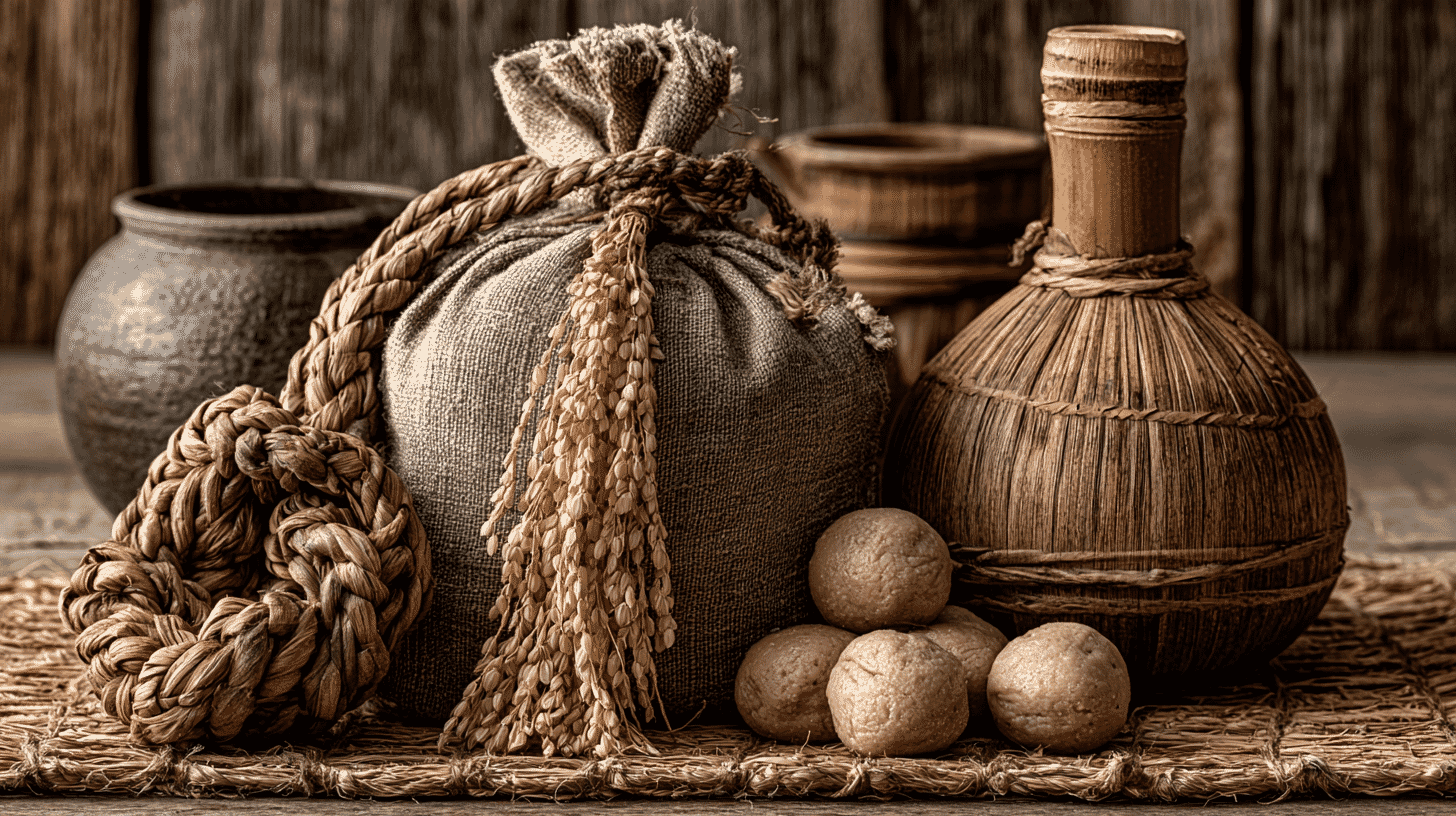
Cooked rice spoils, so armies dried it. Hoshii was steamed rice dried for travel, eaten as is or soaked in water.
For imogara-nawa, taro stems were braided into rope, simmered in miso and dried. A soldier wore it around his waist and used it as rope. When he was hungry, he tore off a length, dropped it into his upturned helmet with water and boiled it into miso soup. One bundle made about 10 servings. The same Plenus column notes that a rope soaked in sweat and mud did not make good soup.
Hyorogan were pills of buckwheat flour, soybean flour and black sesame kneaded with sake or honey. The recipe survives in a ninja manual.
The same amount shows up in Ieyasu's own orders. According to the anecdote collection discussed below, for the summer siege of Osaka in 1615 he set supplies at five days and told his attendants to carry nothing but waist rations: 3 sho of white rice, 10 dried bonito, one salted sea bream, a little miso and pickles. Three sho over five days works out to 6 go a day.
Ieyasu's Barley Rice and Homemade Medicine
Most stories about Ieyasu's eating come from the Toshogu Gojikki Furoku, the anecdote volumes of the Tokugawa Jikki, an official history compiled by the shogunate in the early 19th century from older anecdote books. They were put together about two centuries after his death and are tradition, not records from his lifetime.
While he was still based in Mikawa, Ieyasu ate barley rice in summer. One day his attendants hid white rice at the bottom of the bowl with a thin layer of barley on top. He was not pleased. The realm is at war, he said, and no one high or low can rest easy; how could he alone seek comfort and a full stomach? He was said to be cutting his own expenses to pay for the army.
When Oda Nobunaga sent him a basket of out-of-season peaches in the eleventh month, Ieyasu only looked at them. A taste for rarities, he said, ends with a realm wasting land and money on luxuries, and he handed the peaches out. The rival warlord Takeda Shingen supposedly read this as Ieyasu guarding his health. The compilers dismissed that as a misunderstanding and recorded it as a story about thrift.
At his retirement castle in Sunpu, the women complained that the pickles were far too salty. When Ieyasu told the kitchen steward to go lighter on the salt in the miso and pickles, the steward whispered that milder pickles would be eaten faster and cost far more. Ieyasu laughed and left it alone.
Escaping through Iga after Nobunaga's death in 1582, Ieyasu reached a boat and asked if there was any food. The boatmen gave him their own rice, cooked together with millet and barley, and salted snails. He called it tasty and ate three bowls.
For his medicine, there is physical evidence. Kunozan Toshogu Shrine, which holds his personal belongings, says he made medicines not only for himself but for his family and retainers. His effects include a Korean medical book, bottles that still contain powders and a mortar and pestle. He was also an avid falconer. Born at Okazaki Castle in 1543 (many Japanese sources say 1542, following the year in the Japanese calendar), he lived to 73.
Did Tempura Really Kill Ieyasu?
The story that tempura killed Ieyasu has been told for a long time. According to the Furoku, in the first month of 1616, during a falconry outing at Tanaka in Suruga, the Kyoto merchant Chaya Shirojiro mentioned a dish popular around Kyoto and Osaka: sea bream fried in kaya (torreya) oil and topped with grated garlic chives. A gift of sea bream had just arrived, so Ieyasu had it cooked that way. His stomach hurt that night. The word "tempura" does not appear in the text; that label came later.
He seemed to recover, then declined. By the end of the third month he vomited a prescribed medicine and refused any more. He died on the 17th day of the fourth month of 1616, about three months after the meal. Food poisoning does not fit that timeline. A later shogunate genealogy notes a lump in his abdomen, and stomach cancer is now the leading theory. Historian Joji Fujii is more cautious: the fried fish is often blamed, he writes, but nothing is certain.
Lifestyle magazine Serai reports that the medicine-loving shogun diagnosed himself with parasites and kept taking his own remedy. His physician Katayama Sotetsu diagnosed a lump in the abdomen, advised him to stop, and was banished for it.
Nobunaga has a food legend of his own. Dramas often show him gulping yuzuke, rice in hot water, before the Battle of Okehazama in 1560. The Shincho Koki, the chronicle by his retainer Ota Gyuichi, says only that he ate his meal standing up. According to Gendai Business, no source shows he ate hot-water rice before the battle, and most specialists consider it a later invention.
White Rice and the "Edo Affliction"
As white rice spread in Edo, samurai who came from the provinces fell ill with weak, unsteady legs, and often recovered once they went home. People called it Edo wazurai, the Edo affliction. It was beriberi, caused by a lack of vitamin B1, which sits in the rice germ that polishing removes. A diet of mostly rice and one side dish left little room to make up for it.
In the Meiji era, navy surgeon Takaki Kanehiro cut beriberi sharply aboard a navy ship by changing the sailors' diet. In 1910, Umetaro Suzuki extracted oryzanin, later known as vitamin B1, from rice bran.
Warlord Meals in Okazaki Today
In April 2023, Okazaki in Aichi Prefecture, where Ieyasu was born, launched "Ieyasu-meshi" for visitors. Its five dishes were set under food culture historian Hisao Nagayama: rice with barley, a vegetable-heavy soup made with Hatcho miso, chicken or sweetfish, simmered or dressed seasonal vegetables, and pickled eggplant or grated yam. A looser standard, "Mikawa Bushi Gohan," is built on barley or mixed-grain rice (white rice and other swaps are allowed) and bean miso, with a main dish and local vegetables. Hatcho miso is named after Hatcho village, eight cho (about 870 meters) west of Okazaki Castle.
The city's own page describes the meals as a modern arrangement of foods Ieyasu is "said to have" favored. They are not reconstructed from documents. The farm paper's headline also names Ishida Mitsunari and Uesugi Kenshin.
Which historical figure in your country has a food story that gets shaky once you check the sources?
References
- https://www.agrinews.co.jp/news/index/418345
- https://www.city.okazaki.lg.jp/300/304/p038991.html
- https://www.chunichi.co.jp/article/670941
- https://warp.ndl.go.jp/20260524/20260502204921/http://www.maff.go.jp/j/meiji150/eiyo/01.html
- https://warp.ndl.go.jp/20260524/20260502204921/http://www.maff.go.jp/j/meiji150/eiyo/02.html
- https://www.maff.go.jp/j/syokuiku/kodomo_navi/oneday/quiz_a1.html
- https://kotobank.jp/word/%E6%89%B6%E6%8C%81-124992
- https://kotobank.jp/word/%E5%B9%B2%E9%A3%AF-630778
- https://kotobank.jp/word/%E5%90%88-61351
- https://www.plenus.co.jp/kome-academy/bento_library/column/index.html
- https://ja.wikipedia.org/wiki/%E5%BE%B3%E5%B7%9D%E5%AE%B6%E5%BA%B7
- https://ja.wikipedia.org/wiki/%E5%BE%B3%E5%B7%9D%E5%AE%9F%E7%B4%80
- https://ja.wikisource.org/wiki/%E6%9D%B1%E7%85%A7%E5%AE%AE%E5%BE%A1%E5%AE%9F%E7%B4%80%E9%99%84%E9%8C%B2/%E5%B7%BB%E4%BA%8C%E5%8D%81
- https://ja.wikisource.org/wiki/%E6%9D%B1%E7%85%A7%E5%AE%AE%E5%BE%A1%E5%AE%9F%E7%B4%80%E9%99%84%E9%8C%B2/%E5%B7%BB%E5%8D%81%E5%85%AD
- https://ja.wikisource.org/wiki/%E6%9D%B1%E7%85%A7%E5%AE%AE%E5%BE%A1%E5%AE%9F%E7%B4%80%E9%99%84%E9%8C%B2/%E5%B7%BB%E5%8D%81%E4%B9%9D
- https://ja.wikisource.org/wiki/%E6%9D%B1%E7%85%A7%E5%AE%AE%E5%BE%A1%E5%AE%9F%E7%B4%80%E9%99%84%E9%8C%B2/%E5%B7%BB%E5%8D%81%E4%BA%94
- https://ja.wikisource.org/wiki/%E6%9D%B1%E7%85%A7%E5%AE%AE%E5%BE%A1%E5%AE%9F%E7%B4%80%E9%99%84%E9%8C%B2/%E5%B7%BB%E5%9B%9B
- https://ja.wikisource.org/wiki/%E4%BF%A1%E9%95%B7%E5%85%AC%E8%A8%98
- https://www.mlit.go.jp/tagengo-db/R3-00057.html
- https://president.jp/articles/-/24965
- https://president.jp/articles/-/77312
- https://getnavi.jp/gourmet/826838/
- https://www.shinchosha.co.jp/book/610119/
- https://serai.jp/health/1036506
- https://gendai.media/articles/-/155465
- https://aichinow.pref.aichi.jp/spots/detail/1818/


Global Discussion
4 comments