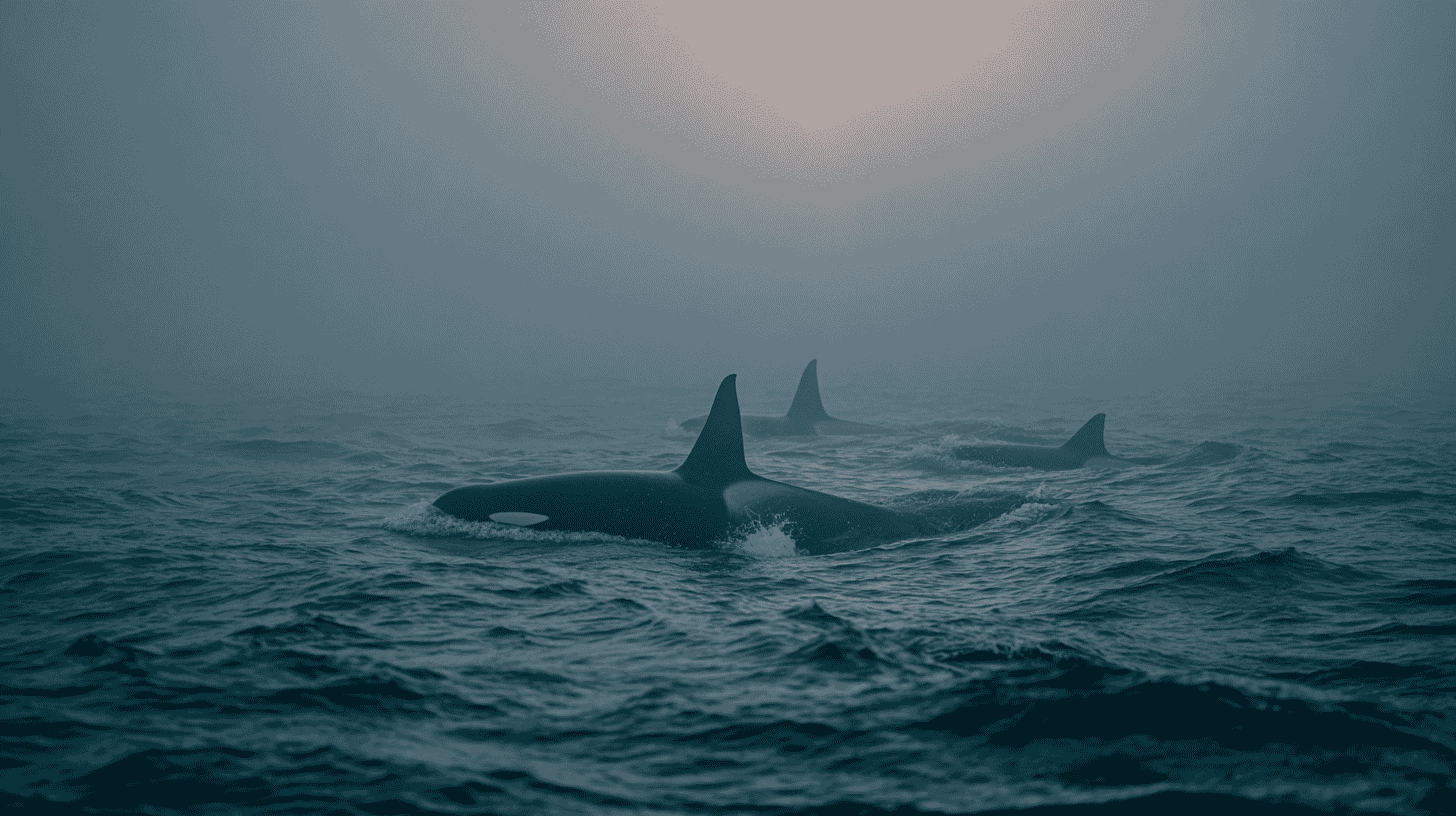
🐋 On June 8, the fog off Rausu, on Hokkaido's Shiretoko Peninsula, was so thick that a photographer watching from high ground could not make out the whale. A fishing boat spotted it first: a white dorsal fin among the black ones. The fin belonged to a male orca first seen here in 2019 and missing for three years. His photo made the rounds again in October. He is one of three white orcas now identified off Rausu, and the reason there are so many may lie in the genes of the region's orcas.
A male back after three years
The photographer posts on X as Shiretoko Dream, and 2026 is his 18th year photographing orcas off Rausu. When word of the sighting reached the captain of a Shiretoko Nature Cruise boat, the photographer was watching from high ground and could not see it through the fog. He went out on the boat instead and got his photos. The same male was seen again on June 14, 15 and 22.
Kyodo News reported from a tour boat on June 22. About 4 km (2.5 miles) off Rausu port, it met more than ten orcas moving in groups of two to five, with a white one among them. According to the operator, Shiretoko Nature Cruise, this was the first year in two that a white orca had appeared.
The story came back in October, when the website Maidona News followed up with the photographer. By then his post on X had about 2.95 million views. With this male, he had now met all three white orcas known from these waters.
Three white orcas in one strait
Until 2019, no white orca had been recorded in these waters. By April 2018, researchers had photo-identified 506 orcas off eastern Hokkaido, and none of them was white apart from one adult male with a white patch on his fin. Then, in May and July 2019, two white orcas appeared in the Nemuro Strait off Rausu: a mature male and a female or young male. Hiroshi Oizumi of Tokai University and his co-authors published them in Mammalian Science in 2020 as the first records from Japanese coastal waters.
Fog played a part then too: on May 16, 2019, poor visibility kept the survey boat from starting its search until late morning, and the July animal vanished into thick fog about five minutes after it was found.
Shiretoko Nature Cruise says three different white orcas have now been identified off Rausu. The tall-finned male, first seen in 2019, last showed up in June 2023 before this year. The other two were last seen swimming side by side in June 2024.
Leucistic or albino?
Passengers often ask the crews the same thing: is it an albino? Nobody knows yet.
Albinism affects the skin and eyes, and the giveaway is pink eyes. Leucism comes from faulty pigment cells. It can be patchy, and the eyes stay dark. Erich Hoyt, a research fellow at the UK group Whale and Dolphin Conservation (WDC), has said only pink eyes would settle it.
Eye colour is hard to see on a whale at sea. Oizumi's team could not check eye colour in their 2019 photos, and could not tell which condition they were looking at. Shiretoko Nature Cruise says the same about its three. Olga Filatova and colleagues, Hoyt among them, described the creamy, slightly yellowish colour of Russia's white orcas in 2016 as looking more like a form of albinism than leucism, but stopped short of a verdict.
In Canada, Tl'uk, a mammal-eating Bigg's orca born in 2018 whose name means moon in a Coast Salish language, is greyish rather than pure white. Jared Towers of Fisheries and Oceans Canada said it was not quite pure white, and it lacked the pink eyes that would point to albinism.
Chimo, a two-year-old female captured in British Columbia in 1970, had Chediak-Higashi syndrome, a genetic disorder that causes partial albinism and a weak immune system, and she died at 4. As of their 2020 paper, Oizumi's team noted that she was the only orca confirmed as albino, and only after her death. Russia's Iceberg, by contrast, was a male first seen off the Commander Islands in August 2010. When he was announced in April 2012, researchers put him at about 16 from the size of his fin and said he looked very healthy. He was seen again around the Kuril Islands in 2016.
Why the western North Pacific?
In 2021, Hoyt estimated that white orcas make up about 1 in 1,000 of all orcas in the western North Pacific, probably the highest ratio anywhere. In 2016 he had already said that five, or up to eight, white orcas in one area may well point to inbreeding.
In 2018, Filatova and colleagues published the full mitochondrial genomes of 26 orcas from the western North Pacific in the Journal of Heredity. Diversity was much lower than in the Aleutians and the eastern North Pacific. Their results suggest that the region was settled, or resettled, by small groups of orcas after the last ice age.
I read these two findings as pointing the same way. In a population that grew from a few founding families, a rare hidden trait can show up more often. If that is right, the white whales of Rausu are less a lucky accident than a sign of how small the region's orca families may be. Nobody has tested this for the Rausu animals, and white orcas are still not proven to be albino here.
Watching from Shiretoko
Shiretoko became a UNESCO World Heritage site in 2005, and UNESCO lists orcas among the marine mammals that use its waters seasonally. Off Rausu, the operator says, the best chance of meeting them is usually from early May to mid-July.
In December 2025, a Kyoto University-led team that sequenced the mitochondrial genomes of 25 orcas around Hokkaido reported both fish-eating residents and mammal-eating transients. The university describes it as the first time ecotypes had been worked out for Japanese orcas. Neither the study nor the operator's blog says which kind the white male belongs to. Elsewhere, white colouring has turned up in both: researchers thought Iceberg ate fish, while Tl'uk hunts mammals.
In these same cold waters, divers had a nickname for a sea angel years before it was described as a new species.
Has a white whale or dolphin ever turned up where you live, and did people read it as a good sign or a worrying one?
References
- https://maidonanews.jp/article/16940569
- https://www.e-shiretoko.com/en/blog/154397/
- https://www.e-shiretoko.com/en/blog/82461/
- https://kumanichi.com/articles/2005412
- https://www.jstage.jst.go.jp/article/mammalianscience/60/2/60_243/_article/-char/ja
- https://www.livescience.com/pair-white-orcas-killer-whales-japan.html
- https://www.iflscience.com/extremely-rare-white-orcas-spotted-russian-waters-37713
- https://doi.org/10.1093/jhered/esy037
- https://www.kfsk.org/2020/08/12/rare-white-orca-visits-alaska-panhandle/
- https://www.livescience.com/19857-white-albino-killer-whale-iceberg.html
- https://www.kyoto-u.ac.jp/ja/research-news/2026-01-23-5
- https://whc.unesco.org/en/list/1193









Global Discussion
4 comments