🥱 You may well yawn before you finish this article. In an experiment by the American psychologist Robert Provine, 30 percent of people who spent 5 minutes reading about yawning said they yawned while doing it. Everyone yawns, every day, and nobody can yet say for sure what it is for. In 2026 a Japanese research team published a close look at yawning in lungfish.
Yawning is contagious
In the same experiment, only 11 percent of people who read about hiccups yawned. Count everyone who yawned or felt the urge, and the yawning group jumped to 75 percent. Show people 5 minutes of video of someone yawning and 55 percent yawn back; a video of smiles gets 21 percent.
It is not just us. In a 2004 experiment at the Kyoto University Primate Research Institute, 2 of 6 adult female chimpanzees clearly yawned more after watching videos of other chimps yawning. In 2013 a team at the University of Tokyo tested 25 dogs and found they caught yawns from their owners more often than from a stranger. Budgerigars were shown to catch yawns in a 2015 experiment, and in 2025 researchers at the University of Pisa in Italy reported contagious yawning in zebrafish, the first time it had been confirmed in a cold-blooded animal.
You may have heard that people who catch yawns easily are more empathetic. A 2017 review that went back through the studies found the evidence for that link inconsistent and inconclusive.
It is not about oxygen
Many of us were taught that yawning makes up for a lack of oxygen. Provine put that idea to the test in 1987. Having people breathe air with 3 or 5 percent carbon dioxide made no difference to how often they yawned. Neither did breathing pure oxygen. Exercise hard enough to double the breathing rate did not increase yawning either.
Researchers at the University of Massachusetts Amherst reported something similar in a conference abstract: breathing air with only 13 percent oxygen did not make people yawn more.
Yawns also happen where no one can breathe. Human fetuses yawn in the womb, sometimes by the 12th week of pregnancy. In 2021 a team at Mie University in Japan documented yawning in dolphins and a dugong underwater.
Three leading ideas, no winner yet
One idea is that yawning cools the brain. In a 2007 experiment by Andrew and Gordon Gallup at the State University of New York at Albany, people watched videos of others yawning while holding a pack to their forehead. With a warm or room-temperature pack, contagious yawning occurred 41 percent of the time. With a cold pack, it fell to 9 percent. In 2021 a study that timed 1,291 yawns across 101 species of mammals and birds found that animals with bigger brains and more neurons yawn longer. The authors' explanation is that bigger brains take longer to cool.
Another ties yawning to waking up and switching gears. Yawns cluster around waking, bedtime and the moment before we get moving. In 2023 Hokkaido University showed that young white-spotted char tend to yawn just before they leave the riverbed and start swimming. Yet studies comparing brain waves before and after human yawns have not found a clear arousal effect.
A third looks at the group. In a 2021 experiment in the United States, 38 people who watched videos of others yawning then spotted snakes faster in a search task. The researchers suggest that when one member of a group yawns and drops its guard, those who see it pick up the slack. By their account, this was the first experiment to show a social function for yawning.
A 2010 review concluded that theories giving yawning a bodily job, such as breathing, arousal or temperature control, all lacked evidence. The brain-cooling idea has gathered support since then, but researchers have not settled on a single answer.
Fish yawn too
The University of Massachusetts Amherst researchers compared video of cartilaginous fish, ray-finned fish (the group most fish belong to), one lungfish, amphibians, reptiles, birds and mammals. All shared the same jaw movement: open slowly, hold, snap shut. From this, they suggest the behavior may have been conserved for about 400 million years.
In the 2026 study, a team led by Akiko Enokizu, a researcher at Kindai University, with corresponding author Tadamichi Morisaka, a professor at Mie University, watched lungfish at the JT Biohistory Research Hall in Takatsuki, Osaka, and Toba Aquarium in Mie Prefecture. Their paper appeared in the journal Behavioural Processes on October 10, 2026. They studied the Australian lungfish, which relies mainly on its gills, and three African lungfish species that depend on their lungs, one individual of each species, four in total.
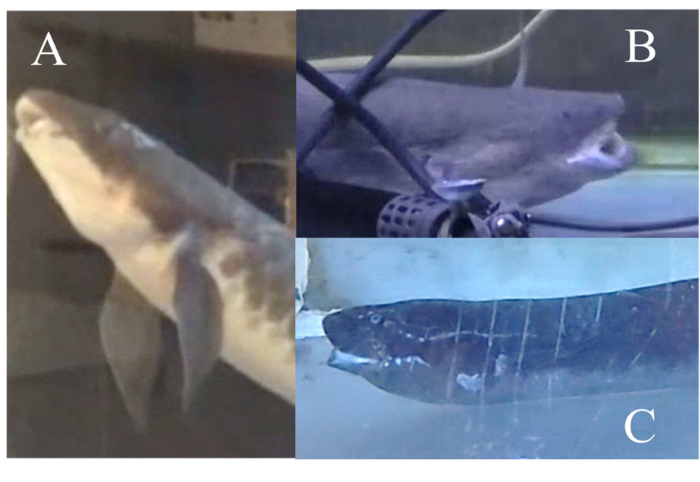
Source: Press release by Mie University, Kindai University, JT Biohistory Research Hall and Toba Aquarium (Enokizu et al., 2026)
All four species yawned underwater. The Australian lungfish yawned more often, but the effort spent on yawning, frequency multiplied by duration, did not differ much between gill and lung breathers. Only the Australian lungfish became more active after yawning; the two African lungfish that could be compared showed no such pattern.
The two lineages are thought to have split about 140 million years ago. The team's interpretation is that yawning was important enough to survive the switch from gills to lungs, though its role may have changed along the way. The paper itself cautions that with one fish per species, the findings cannot establish species-level differences.
The team calls this the first report of yawning in lungfish, but the Massachusetts conference abstract already included video of one lungfish. What the abstract did not have was data: how often the fish yawn, and whether they become more active afterward.
Japan's yawn research runs through its aquariums
Japan's studies of dolphins, a dugong and lungfish were all done with the help of aquariums and research facilities. The dolphin study took 119 hours of observation at Minamichita Beachland in Aichi Prefecture to find 5 yawns. The dugong study at Toba Aquarium logged about 20 hours and 14 yawns. Yawns come when they come, so the work relies on long hours of footage and patient counting.
Enokizu is first author on all three papers. After confirming that yawning survived in mammals that moved from land into the sea, the team turned to fish that went the other way, from water toward land. Next, the team says, it wants to study animals that live between water and land, to test whether yawning needs breathing at all.
So, did you yawn?
If you did, you may have just repeated a move passed down from very ancient fish. Where you live, how does a yawn in a meeting or a classroom go over?
References
- https://www.mie-u.ac.jp/news/topics/2026/11/post-4340.html
- https://www.zaikei.co.jp/releases/3710267/
- https://doi.org/10.1016/j.beproc.2026.105448
- https://www.americanscientist.org/sites/americanscientist.org/files/200510314450_646.pdf
- https://doi.org/10.1016/s0163-1047(87)90944-7
- https://sicb.org/abstracts/yawning-breathing-and-stretching-in-humans-and-other-vertebrates/
- https://pmc.ncbi.nlm.nih.gov/articles/PMC1810104/
- https://www.japantimes.co.jp/news/2004/07/25/national/yawning-contagious-in-chimps/
- https://journals.plos.org/plosone/article?id=10.1371/journal.pone.0071365
- https://doi.org/10.1007/s10071-015-0873-1
- https://www.nature.com/articles/s42003-025-08004-z
- https://doi.org/10.1016/j.neubiorev.2017.07.006
- https://doi.org/10.1177/147470490700500109
- https://doi.org/10.1038/s42003-021-02019-y
- https://www.hokudai.ac.jp/news/pdf/230118_pr.pdf
- https://doi.org/10.1016/j.neubiorev.2010.03.008
- https://doi.org/10.1007/s10071-020-01462-4
- https://www.mie-u.ac.jp/R-navi/release/cat775/post-41.html
- https://www.mie-u.ac.jp/R-navi/release/cat775/post-47.html








Global Discussion
4 comments