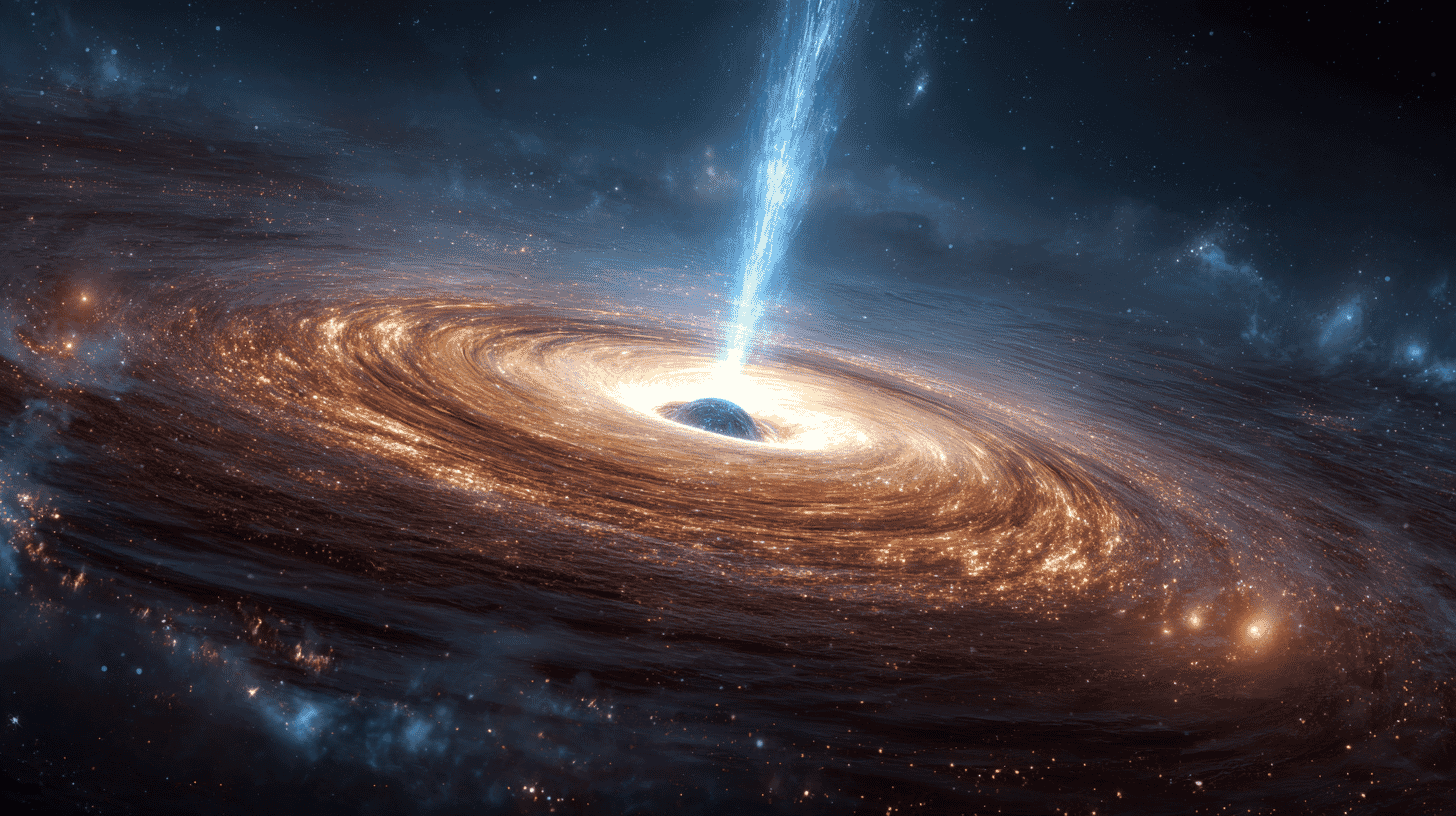
🔭 Japan's XRISM X-ray satellite has spent 3 years in orbit with a door jammed shut over its main instrument. It has still pinned down where a giant black hole about 420 million light-years away launches its jet, because the X-rays that mattered were never the ones the door blocks.
A door that won't open
XRISM (pronounced "crism") lifted off from Japan on September 7, 2023, on an H-IIA rocket. The mission is led by JAXA, with NASA and the European Space Agency as partners. Its key instrument, Resolve, measures X-rays as heat. Each X-ray that hits the detector warms it by a tiny amount, and that amount reveals the X-ray's energy. To notice changes that small, the detector is chilled to 50 millikelvin, barely above absolute zero.
The two X-ray observatories JAXA launched before XRISM, Suzaku and Hitomi, both ran into trouble after launch. Suzaku lost its spectrometer. Hitomi, launched on February 17, 2016, went silent on March 26, a little over a month later. It had spun out of control and broken apart. XRISM was built to take over Hitomi's mission.
Resolve sits behind a protective door called the gate valve, a beryllium window backed by steel mesh. It was there to shield the detector on the ground, and it was supposed to swing open in space. JAXA tried to open it 3 times in November and December 2023. In September 2025 it ran vibration through the instrument 12 times to shake the door loose. The door stayed shut. JAXA's assessment is that the shaking was not strong enough to clear a cable harness that is in the way.
Resolve still works through the window, but at a cost. According to JAXA, the beryllium absorbs almost all X-rays below about 1.8 keV, when the plan had been to open the door and see down to about 0.3 keV, and it also cuts how much light gets through at higher energies. (keV, or kilo-electronvolt, is the unit astronomers use for X-ray energy.) Aurora Simionescu of the Netherlands Institute for Space Research, who studies the hot gas around galaxies, told Space.com in 2024 that she was deeply disappointed to lose the low-energy X-rays that work depends on. In August 2026, JAXA told a Japanese government science panel that it had extended XRISM's main operations by 3.5 years, through March 2030, and would keep studying how to open the door.
Why would a black hole throw anything out?
Black holes are supposed to swallow things. Yet some of the giant ones at the centers of galaxies fire narrow jets of plasma at close to the speed of light, and those jets help shape how their galaxies grow.
The leading idea is that a jet runs on the black hole's spin. As the black hole rotates, it twists the magnetic field lines around it like rope being wound tight, and that stored energy flings gas outward. For this to work, strong magnetic fields have to be held close to the black hole.
That requirement is a problem for black holes that feed heavily. They should be wrapped in a cold, thin disk of gas reaching almost all the way in, and disks like that are thought to be poor at holding strong magnetic fields. A hungry black hole with a powerful jet looked like a contradiction.
3C 120 is a galaxy whose central black hole is exactly that kind. The galaxy lies about 420 million light-years away in the direction of Taurus, and the black hole weighs about 60 million times as much as the Sun. According to the team led by Hirofumi Noda of Tohoku University and Kazuhiro Hada of Nagoya City University, it swallows matter equal to about 100,000 Earths a year while firing a strong jet. The new paper puts its output at 10 to 20 percent of the theoretical ceiling for a black hole of its mass. M87, whose black hole became famous in 2019 as the first ever imaged, runs at around a millionth of that ceiling.
Iron as a ruler
The X-ray clue comes from iron. Iron atoms in the disk give off X-rays at a precise energy, 6.4 keV. Near a black hole, that sharp line gets smeared out. Gas racing toward us appears shifted up in energy, and the black hole's gravity drags the light back down. The closer the disk reaches to the black hole, the more stretched the line becomes, so the shape of the smear tells you where the disk's inner edge is.
This ruler has a Japanese history. In 1995, data from Japan's ASCA satellite showed an iron line stretched by gravity around the black hole in the galaxy MCG–6-30-15. A long argument followed. Some astronomers suspected the stretching was an illusion created by gas absorbing light along the way, and instruments before XRISM could not tell the two apart. XRISM's 2024 look at the same galaxy confirmed that the broadened line is real; that paper came out in December 2025, about 30 years after ASCA's report.
The iron signal sits well above the energies the door blocks. In their paper, the team says plainly that because the gate valve was closed, they limited the analysis to 3–12 keV. The broad iron feature they were after spans roughly 4 to 7 keV, comfortably inside that window. The door cost them light and some energy range. It did not cost them the line.
A telescope as wide as Earth
To see where the jet starts, the team needed radio. Radio astronomers can link dishes across continents so they work like a single telescope almost as wide as the planet, the same technique behind the 2019 image of M87. The team used 3 such networks. The Global Millimeter VLBI Array observed at 3 mm with 18 stations in the US, Europe, South Korea, Chile and Greenland. The US Very Long Baseline Array used 10 stations at 7 mm and 2 cm. The East Asian VLBI Network contributed 10 stations in Japan, South Korea and China at 1 cm.
Tohoku University calls this the world's first simultaneous observation by XRISM and an international radio network. "Simultaneous" here means the same season rather than the same night: XRISM watched 3C 120 from March 19 to 24, 2025, and the sharpest radio image was taken on April 26–27, 2025. The paper treats them as one coordinated campaign.
A record with no grooves near the label
The iron line shows that the cold, flat disk ends at about 20 gravitational radii, a unit set by the black hole's mass that is roughly the size of the black hole itself. For a black hole this heavy, that comes to about 12 times the Earth–Sun distance, a bit beyond the orbit of Saturn. Inside that edge, the cold disk gives way to a hot, puffed-up flow reaching hundreds of millions of degrees.
The radio images show the jet getting narrower and narrower toward the black hole. Traced back, its base fits within about 10 gravitational radii, inside the zone where the cold disk has already stopped.
It is like a vinyl record whose grooves stop well short of the center: the grooves are the cold disk, the blank label is the hot flow, and the jet shoots out of the spindle hole. A hot, puffed-up flow is the kind of place that can hold strong magnetic fields. The paper ties the jet to that inner flow and names the spin mechanism as the likely engine, without claiming proof. In the paper's picture, the contradiction is resolved not by changing the theory but by where the disk stops.
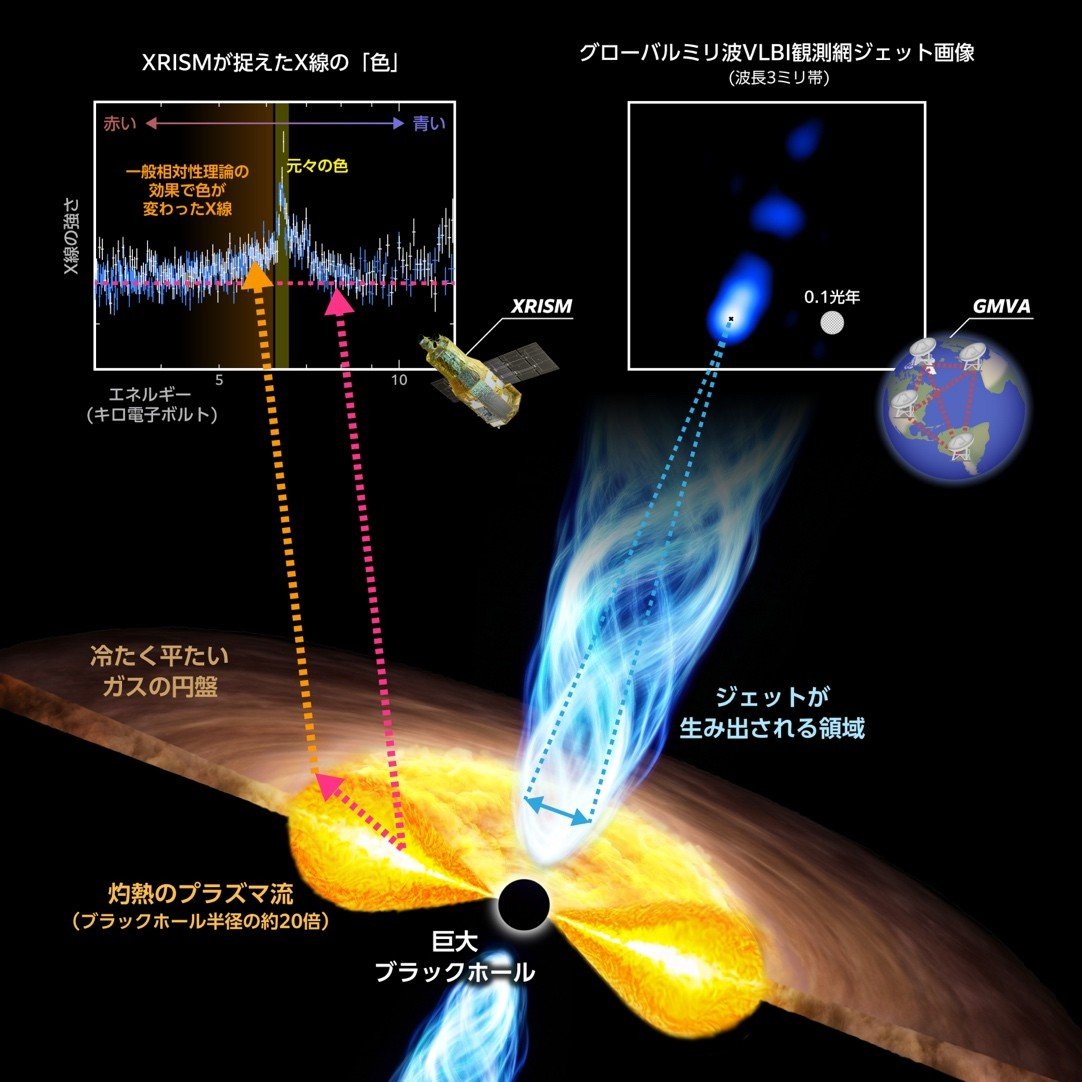
Source: Tohoku University press release
One black hole, then the next
The result comes from a single black hole. The Japanese space news site sorae, citing Tohoku University, reports that the team is running similar observations of heavier black holes to see whether the same picture holds.
As of October 2026, Resolve's door is still shut, and the low-energy X-rays Simionescu wanted remain out of reach. Even so, the satellite built to take over Hitomi's mission keeps producing results like this one, door and all. How black holes grew so fast in the early universe is a separate puzzle, which we looked at in our piece on "little red dots".
Has a spacecraft or telescope from your country kept doing good science after something on board broke?
References
- https://www.tohoku.ac.jp/japanese/2026/10/item20261020-03-jet.html
- https://doi.org/10.3847/2041-8213/aeaa2c
- https://sorae.info/astronomy/20261026-jet-of-3c-120.html
- https://www.mext.go.jp/content/20260826-mxt_uchukai01-000051679_03.pdf
- https://www.space.com/xrism-jammed-gate-door-jaxa
- https://svs.gsfc.nasa.gov/14244
- https://www.isas.jaxa.jp/missions/spacecraft/past/hitomi.html
- https://www.isas.jaxa.jp/missions/spacecraft/current/xrism.html
- https://doi.org/10.1038/375659a0
- https://doi.org/10.3847/1538-4357/ae1225
- https://www.eso.org/public/news/eso1907/
- https://science.nasa.gov/saturn/facts/








Global Discussion
3 comments