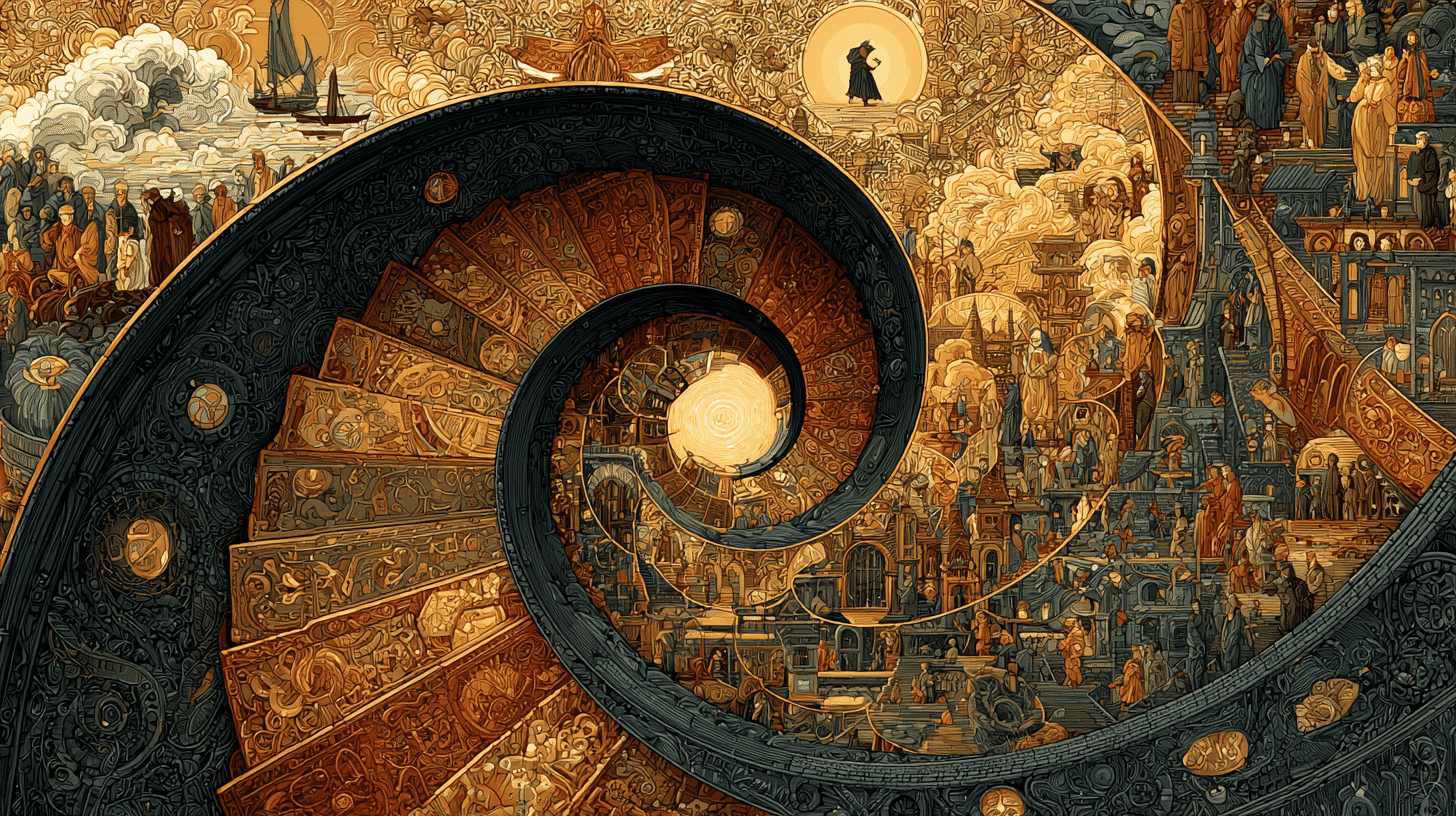
A seven-meter-wide ceramic relief by AKIRA creator Katsuhiro Otomo went up in Tokyo's Ginza subway station last December. Photos and project specs traveled fast across English-language media: Hypebeast, Anime News Network, and AKIRA fan sites all covered the unveiling. But five days later, Nippon TV released a Japanese-only interview with Otomo that has not crossed the language barrier. The abandoned first design, the reason Kaneda's bike ended up in the frame, and a quiet admission that what he wants to do next is paint ink-wash pictures at home. What follows draws on that roughly nine-minute video, published December 20, 2025.
What "Procession Spin" Is
On December 15, 2025, Katsuhiro Otomo, the creator of AKIRA, unveiled a massive ceramic relief titled "Procession Spin" near Exit B1 of Ginza Station on the Tokyo Metro Hibiya Line. Measuring 2.4 meters tall and 7 meters wide, the artwork arranges centuries of Japanese craft and industry into a single swirling composition: Jomon-era flame pottery, an Eleven-Headed Kannon Buddhist statue, the Tokyo Metro Ginza Line 1000 Series train, the Nishi Kyushu Shinkansen, and the H3 rocket all coexist in one continuous flow.
The piece is built from 164 ceramic tiles and 4 bronze pieces, 168 in total, colored with 290 different glazes. Otomo spent about three years on the original drawings; seven craftsmen at CREARE Atami-Yugawara Studio in Shizuoka Prefecture then spent roughly two more bringing them into three dimensions. Soil from rice paddies was refined into the glaze for the Jomon pottery section on the right, and the Eleven-Headed Kannon at the center is finished in gold leaf. It's the 563rd public artwork commissioned by the Japan Traffic Culture Association.
In the bottom-left corner sits the unmistakable red bike of Shotaro Kaneda, the AKIRA protagonist's iconic ride. Otomo personally colored that section himself.
This is not his first public commission. He created a work for Sendai Airport in 2015 and another for the Ookayama campus of what is now the Institute of Science Tokyo in 2020.
That much has been reported in detail by Hypebeast, Anime News Network, akira.fan, and others. What follows are the parts overseas coverage hasn't picked up, drawn from a Nippon TV interview on the network's official YouTube culture channel.
Chapter-by-Chapter Highlights
"Finally done"
The interview opens with Otomo reflecting on the roughly four years that had passed since the first project meeting. According to the Nippon TV report, public art is not the kind of work that proceeds in a straight line to completion, and he described the relief at having reached the end of a long, winding road.
The big design pivot, from straight line to spiral
The most striking revelation is that the current swirling composition was not the original plan. According to the Nippon TV video, Otomo initially envisioned a linear arrangement: a single road threading from the Jomon era to the future. When he actually drew it out, however, he found the result aesthetically unconvincing and rebuilt the entire composition into a circular, spiraling layout.
The redo cost him significant time, but the resulting work invites viewers to feel the cyclical movement of history from any angle. The "swirling artwork" and "era-spanning ode" descriptions used by Western press take on new meaning once you know there was an aborted linear version behind it.
The Kaneda bike was a doodle born from frustration
The detail English-language outlets latched onto hardest was the Kaneda bike in the lower-left corner. Hypebeast called it "perhaps a nod to Shotaro Kaneda". Anime News Network ran with the headline "Kaneda is literally along for the ride."
But Otomo's own account, given in the Nippon TV interview, is more deflationary. According to the video, the bike came in during a moment when he was creatively stuck: a half-resigned, "might as well draw it" gesture. Not a calculated tribute, not a layered homage. Just a small piece of play that slipped in when the serious work hit a wall.
"I'm not an artist, I'm an entertainer"
In the interview, Otomo pushes back against framing himself as an "artist." The Nippon TV video reports that he sees himself as someone whose instinct is to entertain whoever shows up, rather than to surface his interior world, and that at the core his self-identification remains "manga artist."
It's a quietly contrarian self-definition for someone the international art world has been busy elevating to the status of a cultural monument.
Jomon flame pottery as "the cutting edge of its time"
Asked what inspires him, Otomo names "the wonderful work of our predecessors": Jomon-period flame pottery, the Kamakura-period Buddhist sculptures of Unkei and Kaikei. According to the video, he doesn't see these as preserved relics. He sees them as what their makers genuinely believed was the coolest thing possible at that moment: the cutting edge of their era.
He compares it to the Beatles: contemporary rock sits on top of their work, sometimes without knowing it, until one day someone hears them properly and gets leveled. His own work, he says, is something like a thank-you note to the predecessors who shaped him.
Like ukiyo-e were once "souvenirs"
Otomo offers a generous frame for thinking about the future of contemporary pop culture. Edo-period ukiyo-e prints (nishiki-e) were originally produced as cheap souvenirs for visitors to Edo, mass entertainment rather than high art. Today they hang in museums worldwide. According to the video, Otomo suggests that whatever is most enthusiastically embraced in our own moment, whether games, anime, or manga, may follow the same trajectory.
It's a perspective that releases working creators from the pressure to aim at "high art" and redirects them toward the older, more honest target: thrill the people in front of you right now.
"If I'd gone to America in my twenties, I wouldn't have come back"
On the question of building a career overseas, Otomo reflects that not speaking English well was part of why he stayed in Japan. According to the Nippon TV interview, he believes that if he had gone to the United States in his twenties he would have stayed there. Today, though, "overseas" no longer shines the way it once did, and he's content with Tokyo.
What Didn't Fit Here
This article covers the major beats of the interview's nine chapters. Sections on his reference materials (3:22), why he wove Japanese history into the piece (4:59), and his core working principle (8:04) are worth watching in the original video.
The most striking moment comes at the end. On what keeps him creating, Otomo offers a deceptively simple line: it has to be interesting to him, first. On what comes next, he says he wants to pass the baton, and quietly paint sumi-e ink wash at home. A creator who spent his career drawing the future, gesturing toward one of the most stripped-down classical forms in Japanese art for his next chapter.
Why This Interview Hasn't Crossed Over
"Procession Spin" itself was widely covered in English. But that coverage leaned heavily on the press release and the brief, formal statements Otomo made at the unveiling. The kind of unguarded talk in this Nippon TV piece, meaning the real friction of making the work, the accidental origin of the bike, the views on art and retirement, sits behind a language wall unless someone translates and reframes it.
One comment on an English-language art blog captures the gap: a fan watched the interview but found the auto-subtitles too weak to tell whether the difficulty Otomo kept describing was about the business side or the actual making. Interest without access: that is exactly the gap this article tries to bridge.
What Makes This One Unusual
Manga artists making large public artworks is no longer unusual in Japan; Otomo himself has done it twice before. What distinguishes "Procession Spin" is how far into the process the artist went: original drawings, supervision of the fabrication, and hands-on glaze coloring on the Kaneda bike section.
When pop-culture creators appear in public space, the usual arrangement is a secondary design treatment of existing characters. This is the opposite: artwork drawn specifically for this wall, then translated into three dimensions by craftsmen. Which is also why the Kaneda bike is not the point of the piece. In a composition that pulls Jomon flame pottery, a Ginza Line 1000 Series train, the Nishi Kyushu Shinkansen, and the H3 rocket into one spiral, the bike sits in a corner, functioning exactly as the piece of play Otomo says it was.
In Your Country?
In Japan, world-class pop-culture creators stepping into permanent public art has been quietly expanding over the past decade or two. In your country, how do manga artists, animation directors, or game creators leave their mark on public space? And if there are Japanese creators whose voices the English-language press isn't capturing, which ones would you want translated next?
References
- Nippon TV News Culture (official): "Manga 'AKIRA' creator Katsuhiro Otomo interview: what inspires him is 'the wonderful work of our predecessors'", published December 20, 2025: https://www.youtube.com/watch?v=NXJrIA1MkGo
- Hypebeast: https://hypebeast.com/2026/1/katsuhiro-otomo-tokyo-ginza-station-artwork
- Anime News Network: https://www.animenewsnetwork.com/interest/2025-12-15/.232112
- Japan Traffic Culture Association official page: https://jptca.org/publicart563/
- Comic Natalie: https://natalie.mu/comic/news/652298







Global Discussion
15 comments