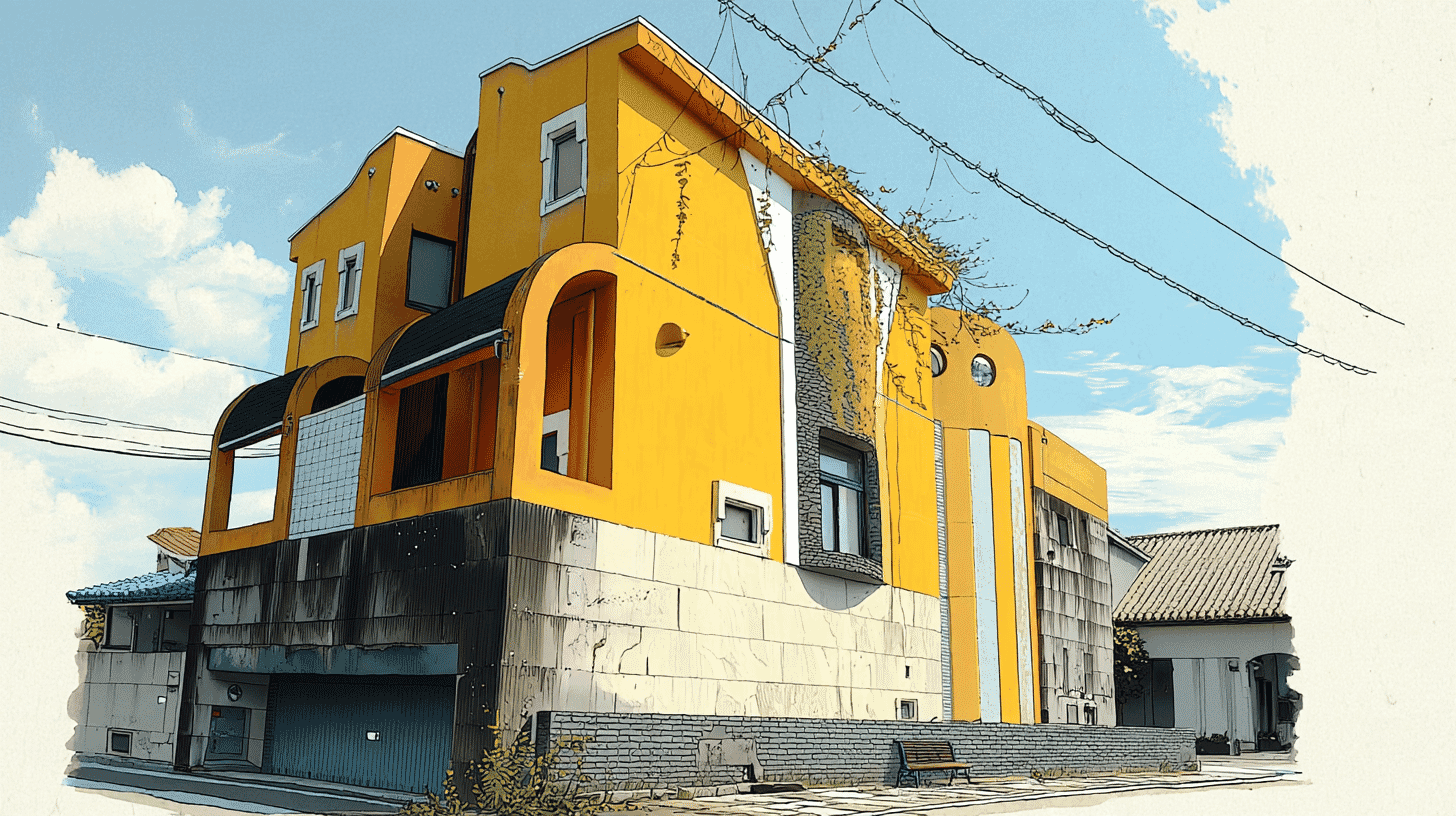
The yellow house where Dragon Ball was born is not going to become a museum. Demolition of Akira Toriyama's home and studio in Kiyosu, Aichi Prefecture, began in October, and most of the building is already gone. In Japan, two reactions arrived at once: "it should have been saved" and "leave the family alone." Behind them is an older question about what Japan does with the places where its great cartoonists worked.
The yellow house in Kiyosu
According to a Mainichi Shimbun report distributed on November 3, the house had been Toriyama's workplace for many years. Its yellow exterior made it easy to spot, and locals and fans called it a "sacred site."
Toriyama died on March 1, 2024, at 68. His company, Bird Studio, was also based in the building, but the Mainichi says it moved to Tokyo in August 2026.
Kiyosu Mayor Sumio Nagata said he understood the demolition to be the family's decision, and that the city would respect it and watch over the work so it can be completed in a quiet, undisturbed setting. As of November 3, the family had not publicly explained why the house is being torn down.
Takashi Matsuyama, 68, an illustrator who once worked as Toriyama's assistant, told the paper that almost all of Toriyama's work came out of that house, and that it was sad to lose a place where he had worked himself. He added that turning it into a museum would probably have been hard in a residential neighborhood, and that it can live on in memory. A woman in her 60s who lives nearby said foreigners often came to look at it, and that losing a symbol of the city felt like a waste.
The cartoonist who never moved to Tokyo
The house matters because Toriyama never moved to Tokyo. He kept working in Kiyosu.
In a 1995 interview with Weekly Playboy, he said he hated crowds and did not want to go to Tokyo, according to a translation by the English-language fan site Kanzenshuu. The same piece noted that a cartoonist working from the provinces was a rare thing when Toriyama made his debut.
In March 2024, the Chunichi Shimbun ran an interview with his first assistant, who recalled that finished pages were usually flown from Nagoya Airport to Tokyo. He had assumed that becoming a cartoonist at all meant moving to Tokyo. That was the era in which a comic that would later be read around the world was being drawn in a house on a residential street in Aichi.
His ties to the town lasted to the end. Kiyosu marked its 20th anniversary as a city in 2025, and the anniversary logo is Toriyama's design. The city launched its promotion using the logo on July 5, 2024, about four months after his death was announced.
"Save it" versus "leave it be"
Photos of the demolition spread on social media at the end of October. Reactions on Hatena Bookmark and X split cleanly in two.
One side says that losing the workplace of an artist with this much global influence shows how little Japan cares about preserving its culture. Some offered concrete fixes: record the building in 3D at the very least, or move it somewhere else.
The other side says it was a private home and the decision belongs to the family. Posts collected by Togetter on October 31 include the suggestion that uninvited visitors may be part of the reason it is coming down. Among fans, posts asking people not to go and look, even after the work is finished, have been circulating.
The family's wish for quiet is not new. When Toriyama's death was announced on March 8, 2024, a joint statement from Bird Studio and Capsule Corporation Tokyo said that, in line with his wishes, condolence visits and flowers would be declined, and asked the media not to approach the family.
Fans abroad have voiced the first view too. On October 30, "Bola de Drac," a fan account that posts in Catalan, wrote on X that it hurt to watch the place where the series was born disappear, and that it could not understand why it would not become a museum.
Tokiwa-so was torn down, then rebuilt
Tokiwa-so, in Tokyo's Toshima Ward, was the wooden apartment building where Osamu Tezuka, the two Fujiko Fujio artists, Fujio Akatsuka, Shotaro Ishinomori and others lived when they were young. It has long been called a "sacred site of manga," and it was demolished in December 1982 because it had grown old.
On July 7, 2020, it came back as the Toshima City Tokiwaso Manga Museum. The ward reproduced the original based on interviews with former residents and others, at a total cost of about 980 million yen ($6.2 million). Donations through Japan's hometown tax program, which lets people direct part of their taxes to a municipality of their choice, came to 424.75 million yen ($2.7 million) from 960 donors as of June 26, 2020. It was not built on the original lot, but in a ward park about 300 meters away.
One Hatena Bookmark comment cited this precedent: Tokiwa-so is a reproduction too, so let the family do what suits them.
Japanese houses also come down sooner than American or English ones. In the latest estimate from Japan's Ministry of Land, Infrastructure, Transport and Tourism (its housing economy data for fiscal 2025), homes torn down in Japan between 2018 and 2023 were on average 35.7 years old, compared with 56.7 years in the United States and 51.4 years in England, a gap of 16 to 21 years.
What Buenos Aires did
Quino (Joaquín Salvador Lavado), the creator of Mafalda, lived in a building at Chile 371 in the San Telmo neighborhood. According to the city's tourism office, he often drew Mafalda sitting at the entrance of that building, which now carries a commemorative plaque. The plaque went up in 2007, and in 2009 a statue of Mafalda sitting on a bench was placed nearby.
According to Infobae, the original idea was to put the statue right in front of the building's entrance. Residents pushed back at a building meeting and the plan was reworked, on the grounds that crowds of fans would block the way in. The statue ended up on the corner of Chile and Defensa, about 10 meters away, and the paper says the residents' worries turned out to be justified.
Buenos Aires chose to remember its cartoonist on a street corner rather than inside his building.
Where you live, do the homes of beloved writers and artists become museums, or does a single plaque tell people where they stood?
References
- https://mainichi.jp/articles/20261102/k00/00m/310/234000c
- https://www.kanzenshuu.com/?p=42416
- https://www.kanzenshuu.com/2024/03/15/new-translation-chunichi-shimbun-hisashi-tanaka
- https://www.city.kiyosu.aichi.jp/shisei_joho/koho_kiyosu/back_number/koho2024/kohokiyosu_202408.files/photo0608.pdf
- https://gamebiz.jp/news/401984
- https://togetter.com/li/2764884
- https://b.hatena.ne.jp/entry/s/news.yahoo.co.jp/articles/adfc659f7bb45a9c40a02b6c032f82ddc955a949
- https://www.toy-people.com/en/?p=115953
- https://www.gotokyo.org/jp/spot/1777/index.html
- https://kyodonewsprwire.jp/release/202007071757
- https://www.nippon.com/ja/japan-topics/g00934/
- https://www.mlit.go.jp/statistics/details/t-jutaku-2_tk_000002.html
- https://turismo.buenosaires.gob.ar/en/atractivo/530pm-curiosities-san-telmo
- https://www.infobae.com/cultura/2020/09/30/mafalda-patrona-de-san-telmo/



Global Discussion
3 comments