⚙️ Somewhere inside the wheel hub of an electric car, the gearbox of an offshore wind turbine, or the axle of a bullet train, there is a ring of hardened steel that almost no one ever thinks about. How long that machine lasts often comes down to how clean that steel is: how few microscopic specks of impurity are buried inside it. For decades, the company that made the cleanest bearing steel in the world sat in a quiet corner of western Japan. On April 1, 2027, its name will disappear.
The steel you've never heard of, hiding in machines you use every day
Sanyo Special Steel doesn't make bearings. It makes the steel that bearings are made from, a distinction that matters enormously and that almost no consumer ever encounters.
A bearing is the small ring of rolling balls or rollers that lets a wheel, a shaft, or a turbine spin with as little friction as possible. Push it hard enough, long enough, and it eventually fails from metal fatigue. What decides when that happens is buried in the steel itself: tiny non-metallic particles called inclusions, left over from the smelting process. Each one is a weak point where a crack can begin. The fewer and smaller they are, the longer the bearing survives. Engineers call this property cleanliness, and it is measured in fractions that are hard to picture: a few parts per million of oxygen, inclusions a few microns across.
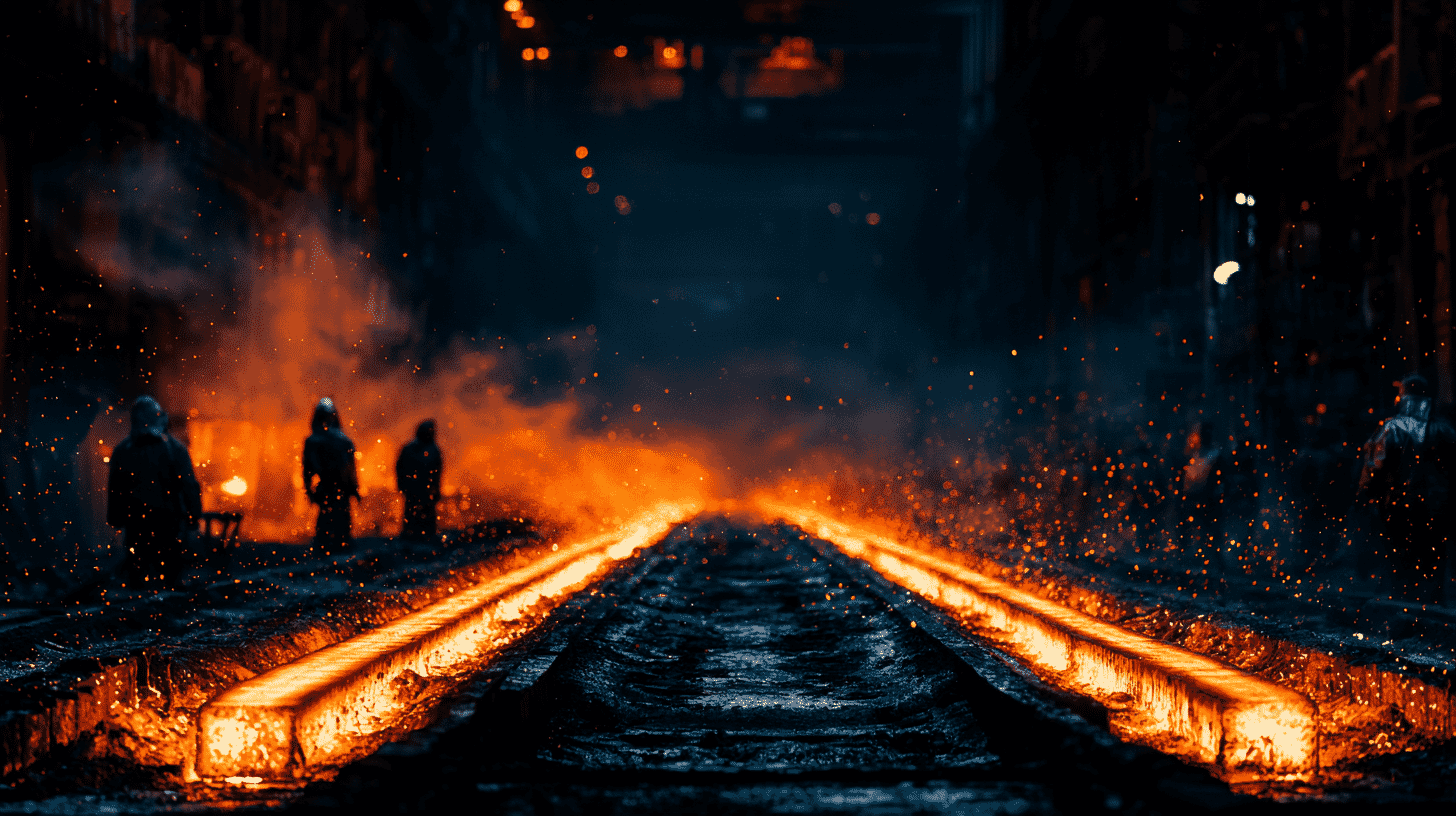
Sanyo built its entire identity on chasing that number down. From its single domestic plant in Himeji, Hyogo Prefecture, it refined a production route (electric furnace, ladle refining, vacuum degassing, and a fully vertical continuous caster) designed to strip out impurities at industrial scale. It went further with two proprietary processes it named SNRP and SURP, which control not just how many inclusions remain but how large the largest one can possibly be. In 2016 the work earned one of Japan's most prestigious industrial honors, the Okochi Memorial Production Prize, for a high-productivity process to make ultra-clean bearing steel.
The payoff is invisible but everywhere. Sanyo holds the No. 1 share of bearing steel in Japan, a little over 30 percent, and its steel feeds the parts that absolutely cannot be allowed to fail: railway and automotive components, and the bearings deep inside wind turbines, which sit hundreds of feet in the air where replacing them is a nightmare. The company was founded in 1933 as Sanyo Steel Works, runs on recycled scrap, and counts only a few thousand employees. By the standards of global steel it is small. By the standards of bearing steel, it is a quiet world champion.
A company that already died once: in a novel, and in life
This is not the first time Sanyo's name has been wiped out.
On March 6, 1965, Sanyo Special Steel filed for court-supervised reorganisation with debts put at about ¥50 billion (some accounts say ¥48 billion), roughly $140 million at the era's fixed exchange rate, and the largest corporate failure in postwar Japan up to that point. Investigators then discovered the company had been hiding losses through accounting fraud running into the billions of yen. The scandal reached the National Diet, helped reshape Japan's auditing rules, and dragged down its main lender, Kobe Bank, which was eventually folded into the lineage that became today's Sumitomo Mitsui Banking Corporation.
The episode was so dramatic that the novelist Yamasaki Toyoko used it as the skeleton for The Grand Family (Karei naru ichizoku), her 1973 epic about a banking dynasty's ambition and ruin. The doomed special-steel maker in the book, Hanshin Special Steel, is modeled on Sanyo; its tragic heir has been played by major stars across film and television adaptations in 1974, 2007 and 2021. To a Japanese reader, "Sanyo Special Steel" still carries the weight of that story.
What the novel doesn't tell you is the sequel: Sanyo was rebuilt, climbed back, and spent the next half-century becoming the best in the world at one very specific, very unglamorous thing. And now, having survived a death that became literature, it is about to give up its name a second time, this time deliberately, from a position of technical strength rather than collapse.
The wall: a global glut, and a home market shrinking under it
The decision came out of one of the harshest environments the steel industry has faced in a generation.
The core problem is too much steel. At its March 2026 meeting, the OECD's Steel Committee warned that global excess steelmaking capacity had reached roughly 640 million metric tons in 2025, more than two hundred million tons above everything the OECD's own members produce combined. Its June 2026 Steel Outlook projects the figure reaching 745 million tons by 2028. The single biggest driver is China, where domestic demand has fallen for years while output has not adjusted. Chinese mills exported a record 131 million tons of steel in 2025, up about 153 percent from 2020 and more than the entire European Union produced that year. Global steel demand, meanwhile, has now declined four years running.
That flood depresses prices everywhere and squeezes specialists hardest, because even high-end producers compete in markets disrupted by cheap commodity tonnage. Layer on Japan's shrinking domestic demand and the shift to electric vehicles, which changes in ways still being worked out exactly which special steels carmakers need, and the picture for a mid-sized, single-plant maker becomes clear. Being the cleanest is not, by itself, a strategy for surviving a structural glut.
The choice: stop being independent
Sanyo's answer, taken in stages, was to stop standing alone.
The integration has been years in the making. In 2019, what was then Nippon Steel & Sumitomo Metal lifted its stake to make Sanyo a majority-owned subsidiary, and in the same step Sanyo took over the Swedish special-steel maker Ovako, which the group had bought the year before, giving it a European manufacturing base. In April 2025, Nippon Steel absorbed the remaining shares and made Sanyo a wholly-owned subsidiary, ending its life as a listed company. Then, on May 13, 2026, both boards approved the final step: a merger, effective April 1, 2027, in which Nippon Steel is the surviving company and Sanyo Special Steel is dissolved.
Because Sanyo is already wholly owned, the deal issues no new shares and pays no cash; under Japanese company law it qualifies as a simplified merger for Nippon Steel and a short-form merger for Sanyo, so neither side even holds a shareholder vote. The stated logic is to fuse the two companies' bar, wire and special-steel operations: sharpening cost competitiveness on scrap procurement and slotting Sanyo's cleanliness know-how into the global supply network of what Nippon Steel calls the world's strongest comprehensive steelmaker. According to local reporting in the Kobe Shimbun, the Himeji plant is set to keep running, rebranded as Nippon Steel's "Sanyo district," with no plant closures or job cuts currently planned. The technology and the people stay; the sign on the gate changes.
A Swedish thread running through a Japanese name
There is one more reason the merger is more interesting than a routine corporate tidy-up: it has to clear a review in Sweden.
The Ovako deal was not a random European bolt-on. Ovako is one of the world's largest makers of seamless tubes for the bearing industry, and its roots run back through the early-20th-century Swedish bearing business, the same industrial soil that produced SKF, the Gothenburg company that is still the world's largest bearing maker. A century later, that Swedish bearing-steel lineage flows through a Japanese company that is itself about to be absorbed into a larger one. Because Ovako is now a strategic Swedish asset inside the group, the 2027 merger is conditional on notice that the Inspectorate of Strategic Products has finished its review under Sweden's foreign-investment screening law. The world of clean steel, it turns out, is smaller and more tangled than its obscurity suggests.
What vanishes, what stays, and who guarantees clean steel
It's worth being precise about what is and isn't disappearing. The global bearing market, worth roughly $58 billion in 2024, is dominated by a handful of downstream giants: SKF of Sweden, Schaeffler of Germany with its FAG and INA brands, and the big Japanese makers NSK, NTN and JTEKT. By unit volume, China now turns out a huge share of the world's bearings. But all of them, premium and commodity alike, depend on someone upstream supplying steel clean enough to trust. That is the layer where Sanyo lives, and that layer isn't going anywhere. Only the independent name is.
Whether that's a loss is still debated. Some in Japan see a storied specialist being quietly swallowed, and worry that the obsessive craft culture behind world-beating cleanliness gets diluted inside a global organisation. Others read it as the only realistic move: in a market drowning in surplus steel, a single plant in Himeji is far stronger as one node in a global network than as a lone flag. Both readings can be true at once.
What's hard to argue with is how invisible the whole thing is to the people who depend on it. The next time a train carries you somewhere, or a wind turbine spins above a ridgeline, something is turning on steel whose quality was decided by a few parts per million. In Japan, that quality has long had a name attached to it, one that survived a famous bankruptcy, inspired a famous novel, and is about to quietly retire. Whose hands guarantee the cleanliness of the steel inside the bearings spinning in your country right now?
References
- https://www.kobe-np.co.jp/news/economy/202605/0020350113.shtml
- https://news.mynavi.jp/techplus/article/20260515-4459234/
- https://www.nipponsteel.com/news
- https://www.sanyo-steel.co.jp/technology/snap.php
- https://ja.wikipedia.org/wiki/%E5%B1%B1%E9%99%BD%E7%89%B9%E6%AE%8A%E8%A3%BD%E9%8B%BC
- https://www.dailyshincho.jp/article/2019/03180556/?all=1
- https://en.wikipedia.org/wiki/Ovako
- https://www.americanmanufacturing.org/blog/global-steel-overcapacity-has-reached-crisis-levels/
- https://www.gminsights.com/industry-analysis/bearings-market-report




Global Discussion
0 comments