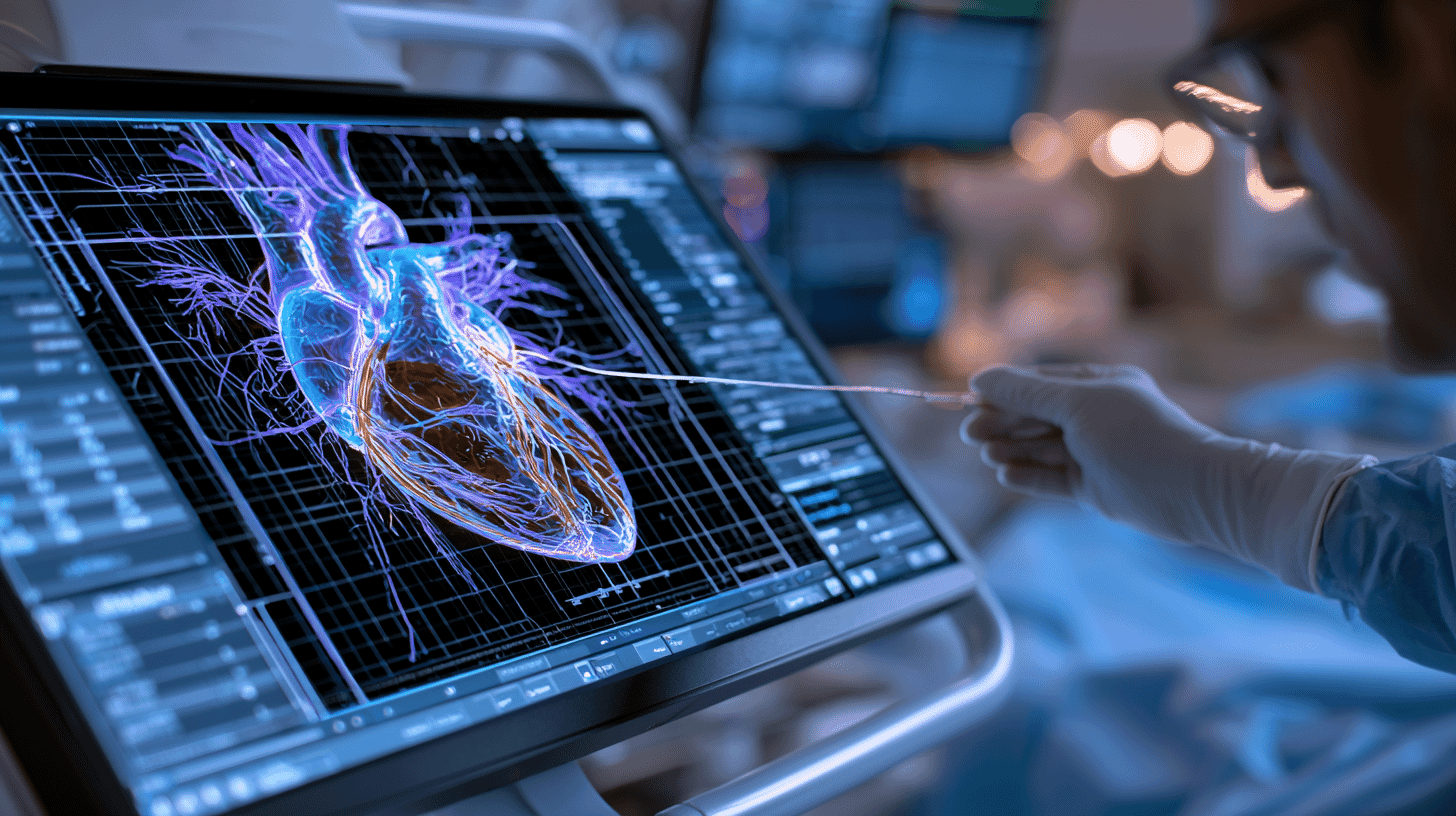
🫀 Putting new muscle into a damaged heart has usually meant opening the chest. This spring, a team in Japan did it through a blood vessel instead, threading a catheter inside the heart and releasing tiny clusters of muscle grown from iPS cells. It was the first time anyone, anywhere, has delivered iPS-derived heart tissue by catheter. And the patient was soon well enough to go home.
A catheter, a failing heart, and lab-grown muscle
In late March 2026, doctors at Shinshu University Hospital in Nagano Prefecture treated the first patient in a trial called EMERALD. The patient had dilated cardiomyopathy, a condition in which the heart muscle stretches, thins, and slowly loses the power to pump blood.
Rather than cutting the chest open, the team used a catheter, a flexible tube pushed up through a blood vessel and steered into the heart. Through it they injected roughly 150 million heart-muscle cells straight into the wall of the failing organ.
The procedure was run by Heartseed, a Tokyo biotech spun out of Keio University, and the company disclosed the case on June 12. It is the world's first clinical use of catheter-delivered iPS-derived cardiac tissue. An independent safety committee reviewed four weeks of data before clearing the trial to continue. Koichiro Kuwabara, the cardiologist who led the case, described it as finishing in a relatively short time and without complications, and called it a meaningful step toward treatments that ask less of the patient's body.
This is still very early. HS-005, the name of the therapy, is still experimental and unapproved, and EMERALD is a Phase I/II trial, the stage where doctors are mainly confirming that something is safe.
What exactly is a "cardiac spheroid"?
iPS cells, short for induced pluripotent stem cells, are ordinary cells, often from skin or blood, reprogrammed back into a blank state from which they can become almost any cell in the body. The Japanese researcher Shinya Yamanaka won a Nobel Prize for the discovery, and Japan has pushed iPS research hard ever since.
Heartseed's method starts by turning donor iPS cells into high-purity ventricular muscle, the kind that does the heart's heavy lifting. Instead of injecting loose single cells, the company packs them into microscopic balls it calls cardiac spheroids. In animal studies, bundling the cells this way helped more of them survive and take hold after transplant.
The hope is twofold. The grafted muscle is meant to physically knit into the patient's own heart and add contracting force, which researchers call remuscularization. The cells are also expected to release signals that grow fresh blood vessels around the injection site. In plain terms: patch in new muscle, then coax the heart to feed it.
Outside in, inside out
This is Heartseed's second route to the same idea, and the contrast is the entire point.
Its lead program, HS-001, delivers the same spheroids the direct way. The chest is opened and the cells are injected into the outer wall of the heart with a custom needle. That trial, called LAPiS, has already dosed patients and is in follow-up. Open surgery is more invasive, but it let the company test the cells with maximum control first.
HS-005 flips the geometry. The catheter enters through a blood vessel and approaches the heart from the inside, placing cells into the muscle wall with no major incision. To make that precise, Heartseed worked with Japan Lifeline, a firm known for heart catheters, on a delivery system that maps the heart in 3D and carries an electrode at its tip. The electrode reads the heart's own electrical signals to confirm the cells are landing in muscle before they are released.
If it holds up, it turns a major operation into something closer to a routine catheter procedure.
The route abroad, though, is being rebuilt. The exclusive worldwide licence outside Japan that Heartseed signed with the Danish drugmaker Novo Nordisk in 2021 was terminated in September 2025, on notice from Novo Nordisk. Heartseed is running the Japanese development on its own and looking for a new overseas partner.
A shot at the "heart failure pandemic"
The stakes are large. Heartseed counts about 1.2 million people living with heart failure in Japan and more than 65 million worldwide, numbers climbing fast enough that doctors now talk about a "heart failure pandemic." Heart disease is the second-leading cause of death in Japan, after cancer, and the leading cause across the world.
For the worst cases, today's drugs mostly ease symptoms rather than rebuild damaged muscle, and a heart transplant, limited by a chronic shortage of donors, is often the only fundamental option. That is the gap regenerative approaches are trying to close.
The road ahead is still long. EMERALD plans to enroll 14 patients in all, split between those with ischemic heart disease and those with dilated cardiomyopathy. Its main measure is safety at 26 weeks, with effectiveness, things like better heart-wall motion and a shrinking, overstrained heart, assessed out to 52 weeks. One patient recovering well is a start, not a verdict.
How are failing hearts treated where you live, and how close is regenerative medicine to the clinic in your country?
References
- https://heartseed.jp/news/assets/2026/06/765435bdf6c12c7c4d2b762ea485d68600241aab.pdf
- https://heartseed.jp/news/assets/2025/11/e40d43ccc4811cc7634b23bb5d3c2cb446fc596e.pdf
- https://bio.nikkeibp.co.jp/atcl/release/25/09/11/25563/
- https://heartseed.jp/news/heartseedipshs-001-iiilapis1.html
- https://minkabu.jp/news/4050679
- https://bio.nikkeibp.co.jp/atcl/news/p1/26/06/14/14694/
- https://www.nikkei.com/article/DGXZQOUC300TI0Q5A930C2000000/







Global Discussion
3 comments