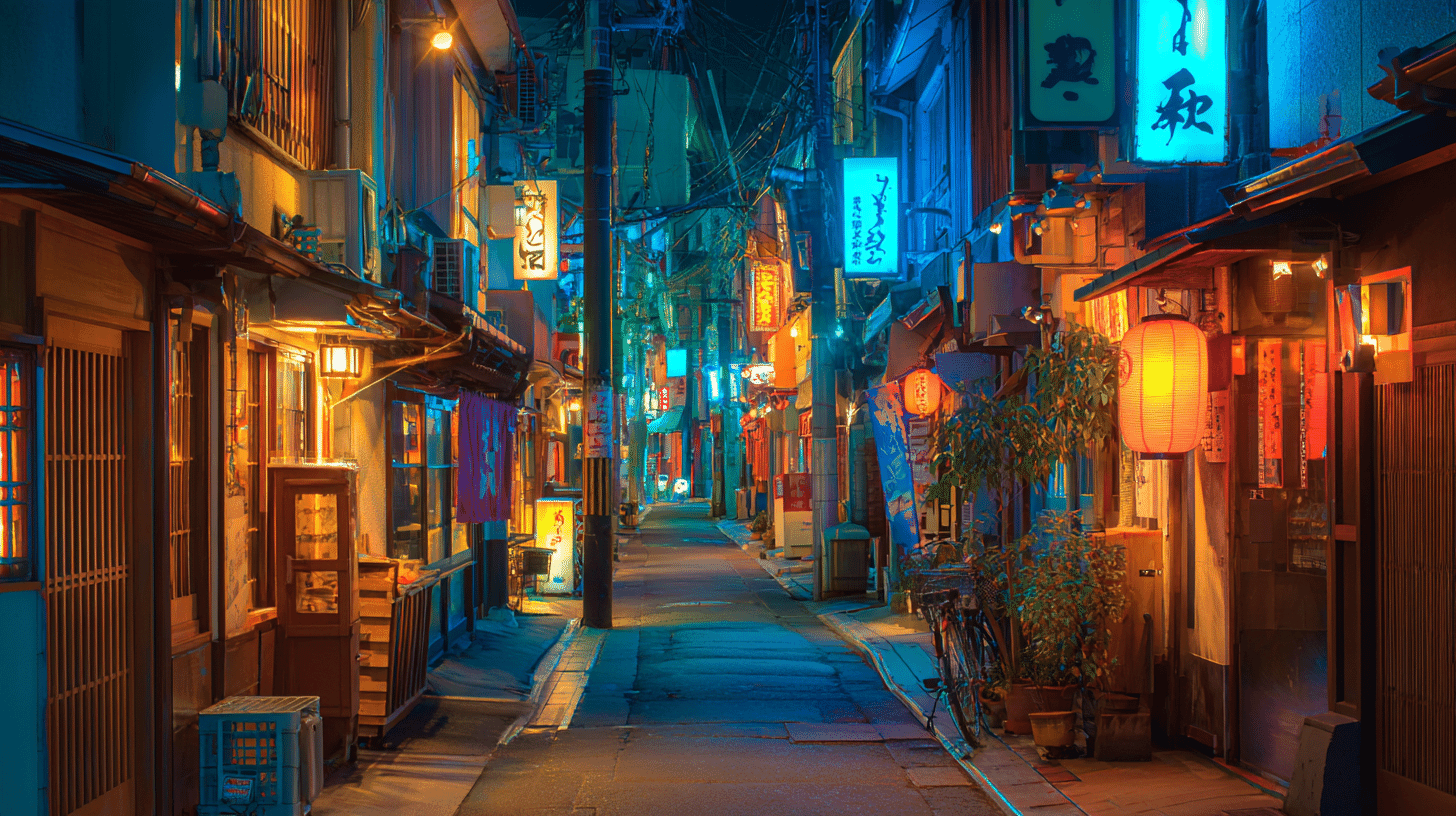
🎤 Walk down a back street near a train station in many Japanese towns and you'll pass a row of small lit signs, each above a heavy door with no window. Behind most of those doors is a short counter, a karaoke machine and an owner everyone calls "mama." These are snack bars, or sunakku. The usual explanation for why a bar would be named after a light meal goes back to a law passed just before the 1964 Tokyo Olympics.
A counter, a mama and a bottle with your name on it
There is no official definition of a snack bar. Koichi Taniguchi, a Tokyo Metropolitan University law professor who heads a group of academics called the Sunakku Research Society, describes one as a place where a mama serves customers from across a counter.
Regulars buy a whole bottle of whisky or shochu, and the bar hangs a name tag on it and keeps it on the shelf until their next visit. This is "bottle keep." Snack bars are usually the second stop of the night, so the food is mostly dry nibbles: rice crackers with peanuts, dried seafood, chocolate. And there is karaoke, standard equipment since the 1980s by Taniguchi's account, sung in front of the whole room.
Pricing is usually a flat "set." Taniguchi told the magazine site GetNavi web in 2019 that the standard was about 3,000 yen (about $19) including drinks from a house bottle, with no time limit. It can be 1,500 to 2,000 yen (about $9 to $13) in some regions and 4,000 yen (about $25) or more at upscale places, he said, and some bars charge by the hour or bill drinks and karaoke separately. What people end up paying tends to be higher. In a 2019 survey by the government-backed business portal J-Net21, the most common spend per visit among snack bar and pub users was 5,000 to 9,999 yen (about $31 to $63), at 35%. (Dollar figures here use a rate of about 159.6 yen to the dollar as of Nov. 16, 2026.)
How that compares with Japan's other conversation bars, per Taniguchi:
| Type | How it works |
|---|---|
| Snack bar | The mama talks from behind the counter. Flat set price; no requesting a particular staff member. |
| Girls bar | Counter service, no entertainment license. Usually an hourly charge plus drinks for the staff. |
| Cabaret club (kyabakura), club | Entertainment license. Hourly charges, and you can request a particular staff member. |
Why a bar is named after a light meal
On May 1, 1964, in the run-up to that autumn's Tokyo Olympics, Japan promulgated an amendment to its nightlife business law. It let prefectures restrict by ordinance where, when and how businesses serving food and drink operated late at night, defined as 11 p.m. to sunrise.
In the widely accepted account, as Taniguchi tells it, the snack bar grew out of the "stand bar." As the Games approached, enforcement tightened and places that only poured drinks found it hard to stay open late. A place registered as an eatery serving light meals, as Business Insider Japan also notes, could stay open longer. So owners started serving food and calling themselves "snack bars."
The midnight line
"Snack" is not a legal category. The word does not appear anywhere in the Fueiho, the law that governs Japan's nightlife businesses. What the law regulates is an activity called settai, which it defines, in our rough translation, as hosting customers in a way that creates a festive, pleasure-seeking mood.
That splits bars into two lanes:
- A business that offers settai needs a license from the prefectural public safety commission. Licensed businesses cannot operate between midnight and 6 a.m., unless a prefectural ordinance sets a later hour for certain districts.
- A bar that serves alcohol after midnight files a notification with the commission instead of obtaining a license. It can stay open late, but it cannot offer settai.
So which side of the line is a chat with the mama? The National Police Agency's interpretation guidelines, reissued on July 1, 2026, are specific. Staying beside a particular customer or small group and keeping up a conversation is settai. So is urging that customer to sing, clapping along or singing with them, or playing games with them. Serving drinks to order from behind the counter is not, and neither is what the guidelines describe as exchanging courtesy greetings and making a little small talk.
Bars on both sides of that line call themselves snack bars. One that is open long after midnight has, on paper, registered as a bar where the conversation stays on the counter side. One where staff join your table is supposed to hold a license and close at midnight. Practice varies, and you can't tell from the sign. What has changed is the risk: since June 28, 2025, the penalties for operating without a license have been far heavier.
Per person, the 2010 count put Miyazaki ahead of Tokyo
Nobody knows exactly how many snack bars Japan has, and the figures in circulation are not measured the same way. Taniguchi counted about 100,000 listings in the Town Page phone directory as of 2015, yet in a 2019 Japan Times feature he gave a rough estimate of 70,000. Business Insider Japan put the figure at 40,000 to 80,000 in December 2025, noting that there are no precise statistics. In November 2026 the head of Snack Technologies, a company that sells software to snack bars, said the number had gone from more than 120,000 to below 50,000. None of these is an official count, but the ones that comment on a trend all describe a decline.
Tokyo and Hokkaido have the most in absolute terms. Per capita, though, a ranking built from the Town Page database for October 2010 put Miyazaki Prefecture first, followed by Aomori, Okinawa, Nagasaki and Kochi. Taniguchi also found clusters on remote islands, in farming and fishing towns, and around large Self-Defense Force bases and big industrial cities.
Taniguchi's group gave its 2017 book a title that translates as "Japan's Nighttime Public Sphere." In a town with few other places to gather after dark, the snack bar is where people talk not only with the mama but with whoever is on the next stool.
In Yokosuka, Kanagawa Prefecture, a "care snack" (kaigo sunakku) that Taniguchi described in 2019 served customers who were in principle 65 or older, with nurses and care workers on staff. In Kunitachi, western Tokyo, a woman born in 1998 took over a long-running snack bar in 2022, the year she graduated from university. And on July 20, 2026, a national snack bar association held its first Tokyo Snack Summit, drawing more than 300 people.
Walking in as a visitor
In November 2023 the weekly AERA reported that guided snack bar tours were being organized for foreign visitors, and that some mamas were puzzled by guests who didn't understand the otoshi, a small dish that doubles as a cover charge. A few habits help:
- Ask before you sit. Open the door and ask if they can take you ("Ima hairemasu ka?"). Some snack bars are members-only, so a "no" isn't personal. Once in, ask where to sit, because regulars often have their own seats.
- Ask the price first. Taniguchi says overcharging is rare at snack bars, but prices are seldom posted outside. Mayuko Igarashi, who has visited hundreds of snack bars, says sets generally run from 3,000 to 10,000 yen (about $19 to $63), and that a bar which states its price clearly is a safe bet while one that dodges the question is not.
- Share the microphone. Check the karaoke history and avoid a regular's signature song. Applaud other singers, don't queue songs back to back, and plan on about 2 hours, which Taniguchi calls the norm.
- Don't follow a street tout. Someone on the sidewalk offering a cheap bar is a different business. See our guide to Tokyo's rip-off bars and street touts.
A snack bar inside a video arcade
The newest version is not in a back street at all. On Nov. 13, 2026, arcade operator GENDA GiGO Entertainment opened a pop-up called GiGO NEO SNACK with Snack Technologies on the 5th floor of GiGO Akihabara Bldg. 5 in Tokyo's Akihabara district, for a run scheduled to end on Nov. 30. The setup: 1,000 yen (about $6) per 60 minutes, the first 2 karaoke songs free, and color-coded wristbands showing whether a customer is into anime and manga, games, idols and so on. It was designed for people in their 20s and 30s.
Where you live, is there a bar or café where the person behind the counter knows your name and your usual? What keeps it going?
References
- https://gamebiz.jp/news/435513
- https://game.watch.impress.co.jp/docs/preview/2156343.html
- https://laws.e-gov.go.jp/law/323AC0000000122
- https://www.npa.go.jp/laws/notification/seian/hoan/hoantsutatu2/R080701kaisiyaku.pdf
- https://www.shugiin.go.jp/internet/itdb_housei.nsf/html/houritsu/04619640501077.htm
- https://www.pref.kumamoto.jp/site/police/237222.html
- https://getnavi.jp/lifestyle/403342/
- https://getnavi.jp/lifestyle/424774/
- https://toyokeizai.net/articles/-/194727
- https://www.nippon.com/ja/japan-topics/g00627/
- https://features.japantimes.co.jp/snack-bars/
- https://www.businessinsider.jp/article/2512-reiwa-no-snack/
- https://www.moneypost.jp/1041552
- https://j-net21.smrj.go.jp/startup/research/restaurant/cons-barpub.html
- https://dot.asahi.com/articles/-/205159
- https://zaikei.co.jp/releases/3437767/
- https://www.daily.co.jp/gossip/subculture/2026/07/25/0020631488.shtml
- https://www.gltjp.com/en/article/item/20825/
- https://ndlsearch.ndl.go.jp/en/books/R100000002-I028281358
Global Discussion
0 comments