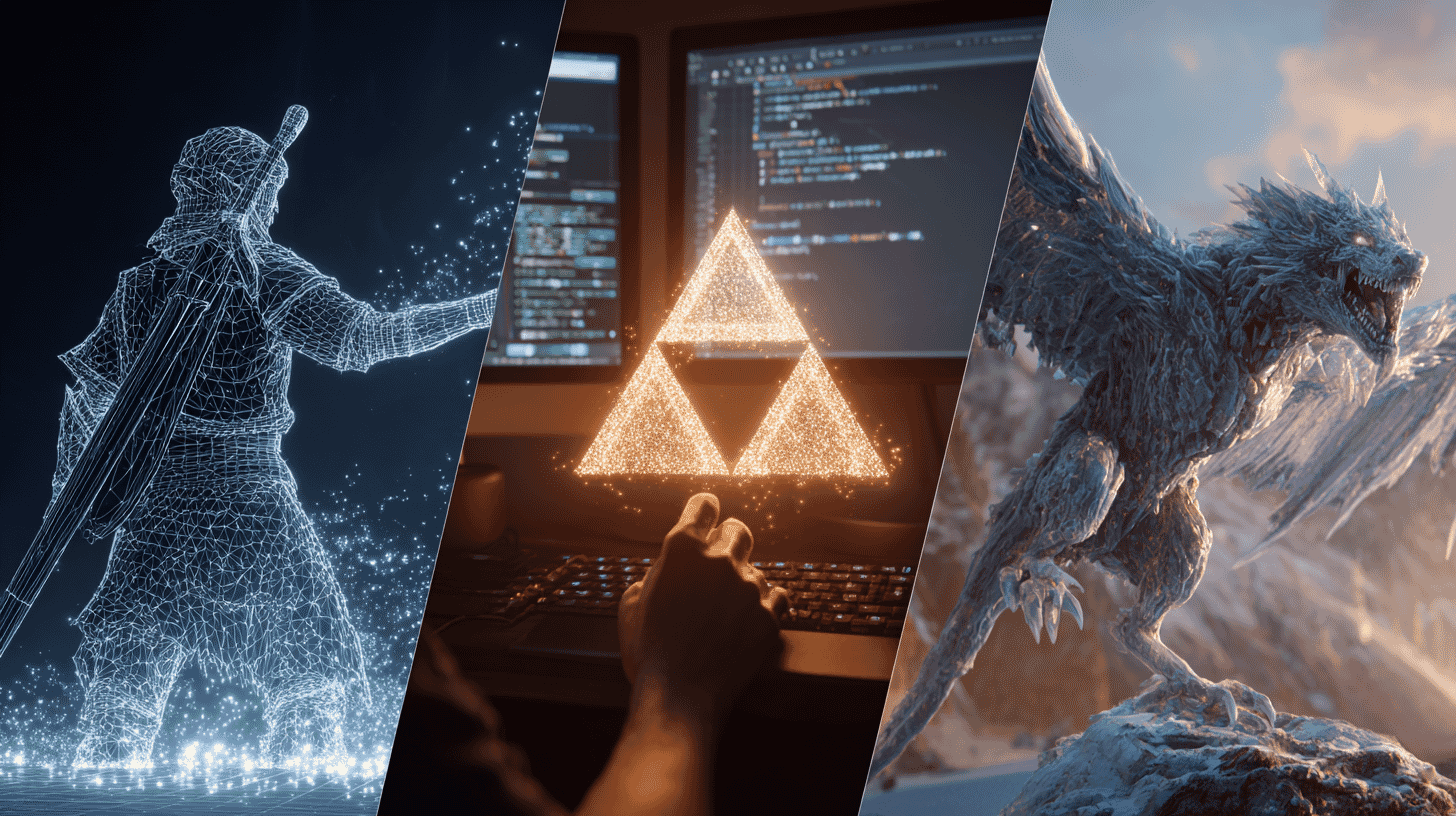
How deeply was Monolith Soft involved in making Zelda: Tears of the Kingdom? Over three consecutive days in April 2026, the studio published staff interviews from its modeling, programming, and animation teams, revealing a level of contribution far beyond what most fans realized. From designing enemy characters to wrestling with physics speed limits on giant bosses, here's everything we learned about the studio behind the scenes of Nintendo's masterpiece.
Monolith Soft's 15-Year Zelda Journey
Most gamers know Monolith Soft as the creator of the Xenoblade Chronicles series. Fewer realize the studio has been involved with The Legend of Zelda for 15 years, starting in the summer of 2010 with Skyward Sword, then A Link Between Worlds, Breath of the Wild, and finally Tears of the Kingdom.
The relationship has deepened with each title. By 2024, Monolith Soft became a wholly owned subsidiary of Nintendo. In a December 2025 conversation published on the studio's website, Nintendo's Zelda series general manager Hirotaka Iwamoto stated his desire for Monolith Soft to take on an even more central role in future Zelda development.
Then in April 2026, Monolith Soft published three back-to-back staff interviews covering its Character Art & Modeling, Programming, and Animation teams. Together, they paint a picture of a studio that was far more than a support contractor: it was a creative partner from day one.
Modeling Team: Designing Horriblin, Sculpting Ganondorf's Muscles, and 120,000 Fuse Combinations
The first interview (April 6) featured the modeling team's leader H.O., enemy character modeler E.S., and weapon/material modeler A.O.
A key revelation: Monolith Soft joined the project during its earliest stages, contributing design ideas before production even began. Staff sketched concepts based on directives from Nintendo's art director, and some of those early ideas made it into the final game.
One notable example is Horriblin, the cave-dwelling enemy. A Monolith Soft designer sketched the creature just two weeks after joining the project, inspired by the keyword "cave." Although it wasn't immediately adopted (cave gameplay hadn't been finalized yet), the design was later officially approved when cave mechanics were established.
For Ganondorf, the team worked closely with Nintendo to express not just strength and menace, but what they described as an "eerie allure." Muscle definition and facial shadow placement were refined until the very end to capture the right atmosphere.
Perhaps the biggest challenge was supporting Fuse, the game's weapon-combination mechanic. With over 120,000 possible combinations of weapons and materials, every pairing needed to look correct. A.O. built the production pipeline on Monolith Soft's side from scratch, documenting attachment rules, quality standards, and tool workflows in close coordination with Nintendo.
Programming Team: Making Tulin Feel Like a Bird and Keeping Creativity Alive
The second interview (April 7) featured programming team lead Y.T., generalist programmer M.K., and enemy programmer H.N.
Monolith Soft's programmers handled gameplay implementation rather than engine-level work. Their involvement grew from Breath of the Wild's DLC to a significantly larger role in Tears of the Kingdom.
Y.T. shared a memorable example: programming Tulin, one of the Sages who accompanies Link. As a bird character, Tulin needed to fly freely to look natural, but if he wandered too far, players couldn't use his ability when needed. Making him follow Link too closely would make him feel like a drone rather than a living creature. Balancing this "creature-like behavior" with "gameplay functionality" required careful tuning across caves, dungeons, boss battles, and interactions with other Sages.
M.K. described the "Ball Carry" mini-challenge: a simple task where players transport a ball using whatever method they can imagine. As a programmer, M.K.'s instinct was to flag the risks of such an open-ended system. In the past, he would have suggested safer alternatives. But working on this project taught him to prioritize making creative ideas work rather than avoiding risk, with the entire programming team collaborating to solve problems together.
The team emphasized two cultural pillars: rapid prototyping ("build it quickly and test") and frank communication. A team-wide chat policy explicitly stated: "If you don't know who to ask, just ask anyway." Regular retrospectives produced small but practical guidelines for resolving common points of hesitation.
Animation Team: Speed Limits on Frost Gleeok and a Custom System for a Town Band
The third interview (April 8) featured NPC animation lead T.T., enemy animators H.S. and F.W. All three joined Monolith Soft through mid-career hiring, and Tears of the Kingdom was their first project at the company.
Like the other teams, animators participated from the idea phase. H.S. drew concept sketches during early development. T.T.'s team explored how NPCs could express Hyrule's reconstruction theme, eventually developing the idea that townspeople would join fights against monsters.
F.W., who joined later, expected to receive detailed specifications and simply create animation data accordingly. Instead, he found himself involved in designing enemy behaviors and ecology from the ground up. The team didn't separate "people who think about gameplay" from "people who make data."
The most technically fascinating story involved Frost Gleeok. The game enforced speed limits on character movement to maintain system stability. Normally not an issue, but Frost Gleeok's enormous size meant that even moderate motion created speed-limit violations. Initially, animators had to guess which body parts were exceeding limits. After sharing the problem with the team, a custom debug tool was built to visualize speed violations in real-time, dramatically improving efficiency.
Another charming detail: a town band that originally played short looping "sort of performing" animations. A staff member suggested making them actually perform the full song. Monolith Soft created a complete song-length animation, and Nintendo built a dedicated synchronization system so the music and animation would stay in sync even if players interrupted the performance.
The Common Thread: Everyone Builds the Game Together
Across all three interviews, a consistent picture emerges. Monolith Soft wasn't just executing tasks: the studio participated in ideation, prototyped solutions, communicated directly with Nintendo leads, and stayed involved through final debugging.
Weekly all-hands meetings where the director shared strategy directly with hundreds of staff. Modelers thinking about gameplay readability, not just polygon counts. Programmers fighting for creative ideas instead of defaulting to safe alternatives. Animators designing enemy behaviors, not just keyframing movements.
As modeler A.O. put it: the goal was never to finish a model: it was to deliver a fun game to players.
The published interviews cover only three of seven departments. The dedicated page also introduces Game Design, Landscape Art & Modeling, VFX Design, and Cinematic Design teams, along with recruitment links, a clear signal that Monolith Soft's role in Zelda will only grow from here.
In Japan, many fans are now calling Monolith Soft a co-developer of Zelda rather than just a support studio. How much attention does the gaming community in your country pay to the contributions of external studios? Share your thoughts in the comments!
References
- https://www.monolithsoft.co.jp/interview/dev01/index.html
- https://www.monolithsoft.co.jp/interview/dev01/interview_characterart-modeling.html
- https://www.monolithsoft.co.jp/interview/dev01/interview_programming.html
- https://www.monolithsoft.co.jp/interview/dev01/interview_animation.html
- https://www.monolithsoft.co.jp/interview/dev01/collab-talk.html


Global Discussion
13 comments