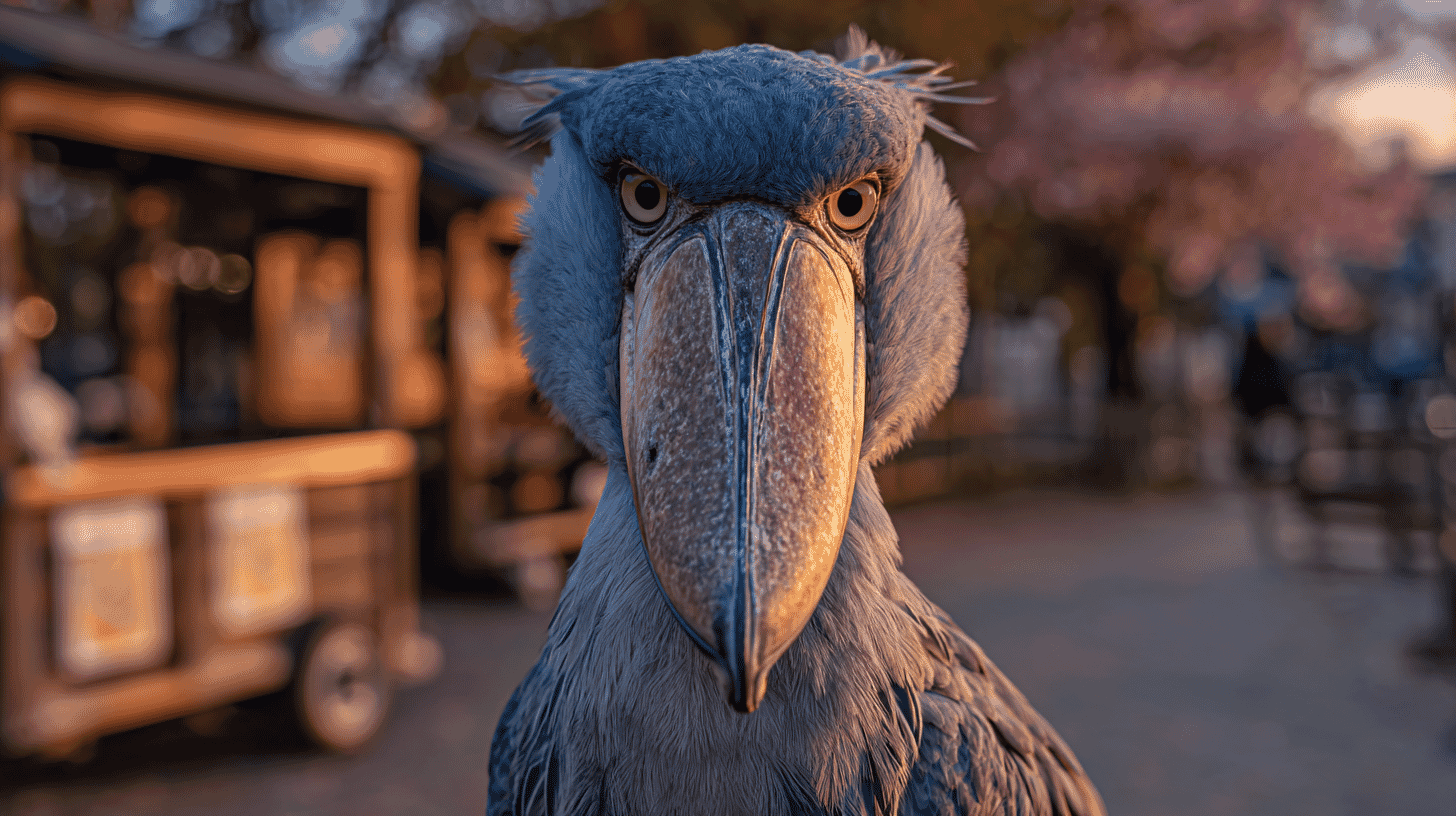
Tokyo's most famous zoo has lost its pandas and named a giant, glaring, almost-motionless African bird as its new star. A shoebill instead of pandas sounds like a losing trade. Here is what is happening at Ueno Zoo, and why the casting might actually work.
Panda Loss: Ueno Goes Pandaless for the First Time in 15 Years
Ueno Zoo, founded in 1882 in central Tokyo, is Japan's oldest and most visited zoo. Pandas have been the headline act on and off since 1972, when Kang Kang and Lan Lan arrived as a diplomatic gift from China marking the normalization of Japan-China relations. Generations of Japanese children have grown up treating Ueno and pandas as the same word.
In January 2026, Ueno Zoo's twin giant pandas Xiao Xiao and Lei Lei were returned to China under the standard loan agreement. This particular departure left the zoo without any pandas at all for the first time in 15 years.
The impact showed up immediately. Visitor counts in February and March 2026 fell year-on-year, two consecutive months of decline. In the nearby Ameyoko shopping district, vendors who built entire product lines around panda merchandise are waiting for the next loan from China. The honorary chairman of the local merchants' association puts it plainly: "The pandas will come back. We're just in a charging period."
The zoo houses about 300 species and 3,000 animals: elephants, gorillas, tigers, penguins, plenty to choose from. So which one did Tokyo authorities pick as the new face?
A bird that doesn't move.
The "Wait, You Can't Be Serious" Reaction
Let's address the obvious: at first glance, putting a shoebill next to a panda and calling them "equivalent" is a tough sell.
A panda is round, monochrome, sits and chews bamboo, rolls around, and produces especially photogenic babies. A shoebill stands up to 140 cm tall (around 4'7"), has a wingspan of roughly 2.5 meters, holds an unsettlingly intense stare, barely moves, and when it does move, it is usually to swallow a catfish or a baby crocodile whole.
The bird's scientific name, Balaeniceps rex, means "whale-headed king." Its English name, shoebill, refers to that enormous shoe-shaped beak. The Japanese name hashibirokou translates roughly as "wide-billed stork." In no language has anyone tried to make this bird sound cute.
Even Tokyo Governor Yuriko Koike, who inspected the zoo on April 30, 2026, put it honestly: "There's something kimo-kawa about the atmosphere it gives off."
That word, kimo-kawa, is a Japanese portmanteau of kimoi (creepy) and kawaii (cute). The governor leading with it tells you something: nobody is pretending this bird is conventionally adorable. The pitch is more interesting than that.
Now Hear the Case for the Shoebill
The shoebill is one of those animals where resistance crumbles the moment you learn anything about it. Five reasons why.
1. It bows to people
When a shoebill recognizes and trusts a particular keeper or visitor, it sometimes performs a slow, deep bow. In the wild the gesture belongs to courtship displays. In captivity it reads as affection. A female shoebill named Futaba at Kakegawa Flower and Bird Garden in Shizuoka Prefecture became popular on social media for bowing to staff and visitors, and now has her own photo book.
2. It clatters its beak instead of vocalizing
Shoebills almost never vocalize. Instead they communicate by "clattering," rapidly snapping those massive beaks together to produce a hollow wooden sound. It can mean courtship, threat, or, most often in zoos, recognition of a keeper the bird trusts. The first time you hear it, it is unnerving. After a while it starts to sound like hello.
3. It has visible bedhead
The shoebill has a small crest of feathers sticking up from the back of its head. There is no honest way to describe them except as bedhead. The contrast between the terrifying stare and the permanently rumpled head is the entire foundation of the kimo-kawa appeal.
4. Its eyes go white
If you watch a shoebill long enough, its eyes suddenly turn solid white. First-time observers often think the bird has died. It hasn't. That is the nictitating membrane, the translucent third eyelid birds and some reptiles use to protect their eyes underwater. Shoebills close theirs especially slowly, which makes the moment easy to catch.
5. The not-moving thing is, scientifically, a feat
Here is the part most casual visitors miss: the shoebill isn't lazy. It's hunting. In the wetlands of South Sudan, Uganda and Tanzania, shoebills wait motionless for hours beside a fishing spot, because lungfish breathe air and must eventually surface. The slightest movement spooks the prey, so the bird doesn't move. Its hunting success rate is reported at around 60%, exceptionally high for a wild predator.
The shoebill isn't slacking. It's concentrating with monastic discipline. In a smartphone-attention-span era, an animal that can stand silent and motionless for hours is content all by itself.
Why Ueno Has the Most Shoebills in Japan
Here is the fact that elevates the whole conversation: only a handful of facilities in Japan keep shoebills at all. The Tokyo Metropolitan Government put the national total at 14 birds as of April 2026. Ueno Zoo holds four of them, the largest single group in the country.
The reason is supply. Shoebills are classified as Vulnerable on the IUCN Red List, with an estimated wild population of 5,000 to 8,000. They are listed under CITES Appendix II, which heavily restricts international trade, so new imports are difficult. Captive breeding has succeeded only twice on record: at Pairi Daiza in Belgium in 2008, and at Tampa's Lowry Park Zoo in 2009. Japan has had none.
Several Japanese facilities are chasing that Asian first. Chiba Zoological Park is building a wetland-replica exhibit due to open in spring 2028, and its female, Shizuka, laid eggs in the summer of 2025. Kobe Animal Kingdom brought in two young birds from the Democratic Republic of the Congo in 2025. And a female moved from Nasu Animal Kingdom to Noichi Zoological Park in Kochi Prefecture has been part of a breeding attempt since December 2022.
Ueno, meanwhile, holds the largest Japanese group of a globally rare bird that is essentially impossible to acquire more of. That is a quietly powerful asset.
The "Hashibirokart" and a Real Strategy
Tokyo isn't messing around. On April 30 Governor Koike inspected the zoo to unveil the Hashibirokart ("shoebill cart"), a small electric vehicle with a shoebill's face mounted on the nose. It seats five, carries up to four passengers per group, and entered service in May 2026. The ride is free, though visitors need a same-day online ticket issued first-come, first-served, and the four-minute loop runs through the Panda Forest, the enclosure that used to house the pandas. Zoo staff say shoebill merchandise is now among the best-selling in the park.
The local Ameyoko shopping district is on board too. A bag shop near the zoo started carrying shoebill goods alongside panda items in March 2026 and reports strong sales. The merchants' association is openly asking visitors to back the shoebill during what it calls the panda charging period. Tokyo is answering the panda gap by repositioning rather than panicking.
Post-Panda Japan and the "Awkward Idol" Tradition
Step back, and this stops being purely a zoo attendance story. It starts to look like something more cultural.
Japan has a deep tradition of taking objectively disadvantaged characters, the plain and regional and weird-looking and expressionless, and converting them into cultural institutions. Funassyi, Kumamon, Gunma-chan and the entire universe of yuru-kyara mascots were built on the principle. The language has unusually rich vocabulary for turning ugliness into endearment: kimo-kawa (creepy-cute), busa-kawa (ugly-cute), muhyojo-moe (the appeal of expressionlessness). Underneath sits wabi-sabi, an aesthetic that openly values stillness, waiting and quiet imperfection.
By that lens the shoebill isn't a panda compromise. It's close to a perfect match for the Japanese sensibility: a bird that wins fans by bowing, standing still, silently concentrating and being mildly terrifying. Maybe the post-panda era at Ueno isn't a downgrade, but the start of a longer story Tokyo gets to write on its own terms.
Does your country have a zoo animal like this, strange-looking, hard to market on paper, but somehow deeply beloved by the public? We'd love to hear about the unconventional animal stars from your part of the world that expanded what "cute" can mean.
References
- Ueno Zoo's next "oshi" is the shoebill, Nippon TV News
- No pandas at Ueno Zoo for first time in 15 years, TBS NEWS DIG
- Tokyo MX: Shoebill becomes new face of Ueno Zoo
- Hashibirokart visitor information, Ueno Zoo
- Shoebills at Ueno Zoo, Tokyo Metropolitan Government video
- Chiba Zoological Park aims for Asia's first shoebill breeding, Tokyo Shimbun
- Where to see shoebills in Japan, Rurubu Kids
- Shoebill characteristics and charm, anicom you




Global Discussion
14 comments