
🏙️ Japan is one of the last major economies where a non-resident foreigner can buy a downtown apartment outright: no permit, no residency test, no surcharge, freehold title.
At the last lower-house election every party ran on doing something about foreign nationals, and property sat at the centre of it. Still, no binding rule aimed at foreigners buying homes has passed. The reasons have less to do with attitudes toward foreigners than with a developer balance sheet, a donation ledger, and a trade commitment Japan made in the 1990s.
When "by summer" turned into "speed it up"
On July 24, 2026, Chief Cabinet Secretary Minoru Kihara wrapped up the third meeting of the cabinet-level council on accepting foreign nationals with an instruction that sounded like progress and read like a delay. On rules for land acquisition viewed through a security lens, he told ministers to accelerate their work toward a framework due this summer.
Summer was already three-quarters gone.
The expert panel meant to produce that framework first met on March 4, 2026, and held its fourth session on July 21. Its remit stretches from military bases and border islands to the more everyday question of who is buying Tokyo condominiums. As of late July 2026, neither answer has been published.
The party track had already blinked. On June 4, the Liberal Democratic Party's task force on foreign national policy, chaired by Yoshitaka Shindo, handed the government its recommendations. On security-sensitive land it asked for restrictions on anyone of concern, regardless of nationality. On apartments, the language shrank to a promise to look again once the transport ministry finishes surveying who actually buys them. The Nikkei's reading was blunt: the government and the LDP are not going there this year.
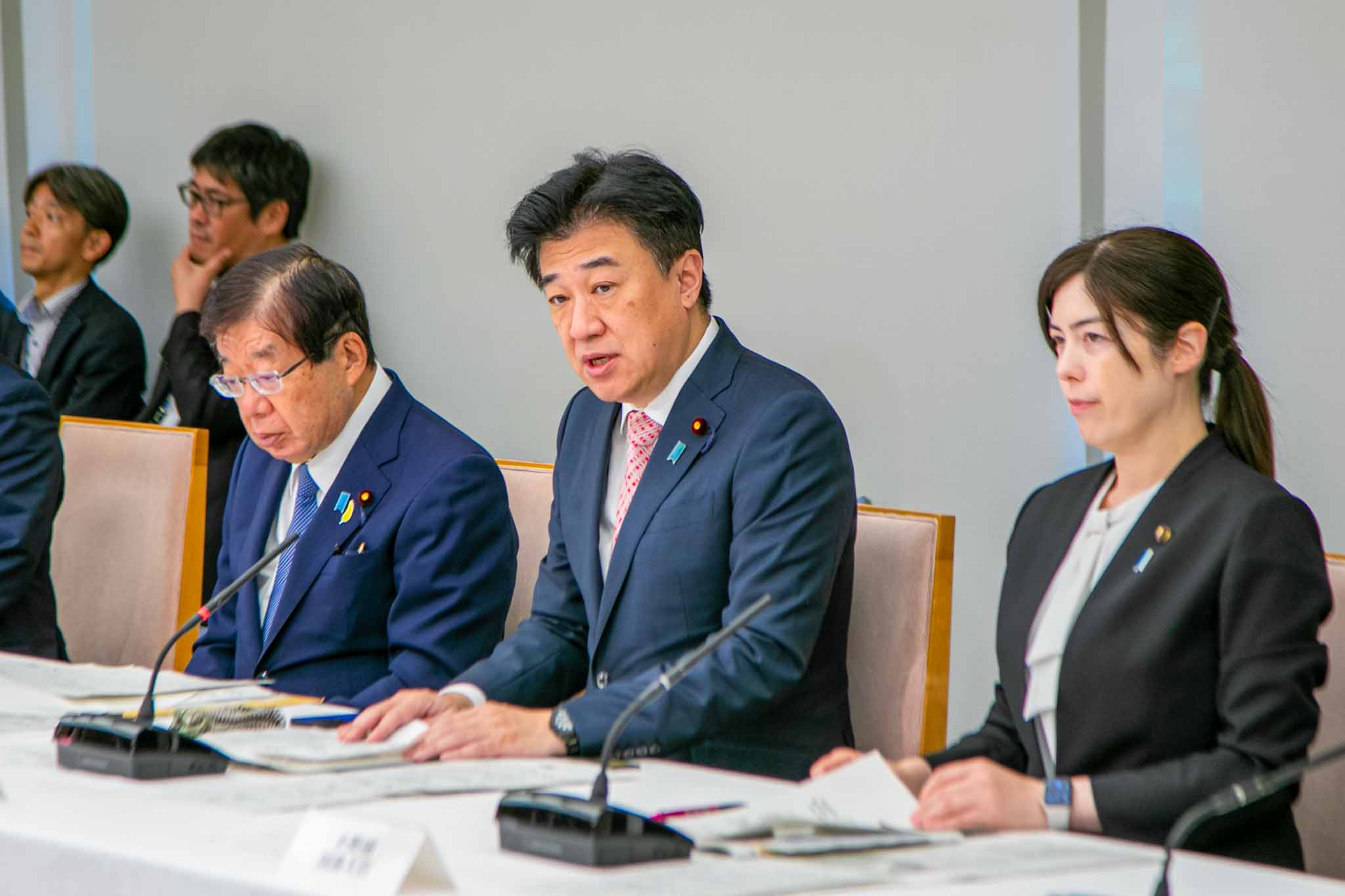
Source: Prime Minister's Office of Japan
The industry that cannot afford to lose the buyer
Tomohiro Makino, a real estate producer whose new book takes on the foreign-property question, argues that developers look healthier than they are. Office vacancy has fallen since the pandemic, hotels are packed with inbound tourists, logistics is riding e-commerce, and the majors keep posting record profits. The reluctance lives underneath all that, in the borrowing left over from the building boom of the Abenomics years. By Makino's account the interest-bearing debt carried by the big developers has risen from the ¥3 trillion range into the ¥4 trillion range, roughly $19 billion to $25 billion at ¥157 to the dollar.
Higher rates squeeze that pile from both ends. Funding costs rise, and mortgage costs push ordinary Japanese households out of the very market the developers were counting on. New apartments put on sale in Tokyo's 23 wards during 2025 averaged ¥136.13 million, about $870,000. Buyers who gave up on new units crowded into resales and pushed those past ¥100 million too.
So who is left holding the wallet? Makino cites a Mitsubishi UFJ Trust survey of developers covering the second half of fiscal 2024: somewhere between 20 and 40 percent of new condominiums sold in Chiyoda, Shibuya and Minato went to foreign buyers. Add the overseas funds that absorb the office towers and shopping centres developers need to sell as they shrink their debt, and the industry's preference writes itself. Nobody in the business wants these buyers frightened off.
The wiring between the industry and the ruling party
A preference only matters once it reaches someone with a vote. The Real Estate Companies Association of Japan, the club of large developers, donated ¥40 million (about $255,000) to Kokumin Seiji Kyokai, the LDP's political funding body, in the 2023 political funds reports. Jiji Press ranked it fifth among industry associations, behind the automakers at ¥78 million, the electrical manufacturers at ¥77 million, steel at ¥70 million and petroleum at ¥50 million. Makino counts 163 companies on the association's roster as of May 2025.
Smaller brokers have their own channel. The All Japan Real Estate Political Federation was founded in 1978 out of the membership of the All Japan Real Estate Association, which dates to 1952 and is the oldest trade body in the sector. The federation is candid about its purpose on its own website, listing the taxes it has helped change and the bank incursions it has helped block. In 2014 it helped launch a Diet league for promoting real estate policy, chaired by lawmaker Seiko Noda, with roughly 260 LDP legislators taking part.
None of this is a scandal. It is ordinary interest representation of the kind that exists in every democracy. But it does explain why a proposal that would deliberately shrink a buyer pool tends to lose momentum somewhere between the campaign speech and the draft bill.
A promise signed in 1995 that nobody can unsign
Even a government that wanted to move fast would hit a wall made of treaty text.
When the World Trade Organization came into force in 1995, its General Agreement on Trade in Services brought with it Article 17, the national treatment rule: in sectors a member commits, foreign suppliers cannot be treated worse than domestic ones. Countries could preserve exceptions by writing reservations into their schedules. According to a research report published by the House of Representatives Research Bureau in February 2026, Japan's schedule carries no such reservation. The report's reading is that the 1995 accession commitments made it difficult to introduce new property-acquisition restrictions aimed at foreigners. In 2002 Japan went further in the other direction, asking fellow members to remove and relax their own restrictions on foreign property acquisition.
From there the design follows almost automatically. In December 2020 a Cabinet Secretariat expert panel recommended that any regime start from equal treatment regardless of nationality. Two reasons: shell companies incorporated in Japan can have foreign controlling owners, so a line drawn on nationality misses the target anyway; and a regime aimed solely at foreign capital would run into GATS. That is why the 2021 law on land near sensitive sites makes no distinction between Japanese and foreign owners, and why the rules the government has been drafting since March 2026 take the same shape. A screening regime around bases and critical facilities catches a Japanese-named paper company in the same net.
There is one law already on the books that does target foreigners. The Alien Land Act of 1925 lets the government restrict foreign acquisition of land in areas needed for national defence. Its enabling ordinance was abolished in 1945, and it has sat dormant ever since, a statute with no switch attached.
The industry drew its own line first
This is not a picture of pure inaction. In November 2025 the transport ministry published numbers on flipping: in the first half of 2024, large new condominiums in Tokyo's 23 wards were resold within a year of purchase 575 times, running at roughly five times the previous year's pace. Days later, on November 25, the developers' association announced three self-imposed measures: caps on how many units one buyer can register for, strict matching between the name on the application and the name on the deed, and a ban on marketing a unit for resale before handover. By March 2026, the Nikkei reported that 41 of 57 member companies planned to adopt them.
The limits are visible in the association's own words. Chairman Junichi Yoshida attributes price growth to construction costs and tight supply and calls the effect of flipping limited. When Chiyoda Ward asked in July 2025 for a five-year resale ban on condominiums built through redevelopment schemes, executive director Masashi Nomura said constitutional property rights made that unworkable between private parties. Rules that bite before handover are acceptable. Rules that follow the deed are not.
What happened to the countries that did regulate
Japan's critics point abroad, and reasonably so. But the abroad they point to has been revising itself over the past year.
Canada banned most non-residents from buying homes in 2023 and extended the ban to January 1, 2027. The measurable effect has been thin: foreign buyers accounted for 1.1 percent of home sales in British Columbia in 2021, and average Canadian prices still rose more than 20 percent between 2021 and 2026. Mark Carney's government is now reviewing what should replace it, with Australia's approach under study.
Australia went the other way. Its ban on foreign purchases of established dwellings took effect on April 1, 2025, was meant to run two years, and was extended in the 2026–27 budget to June 30, 2029. The design point is that new construction stays open, so foreign money adds housing rather than bidding for the existing stock.
New Zealand has partially reversed. Late in 2025 it legislated to let holders of its Active Investor Plus visa buy homes worth NZ$5 million or more from early 2026, trading a slice of the ban for wealthy migrants.
Singapore has not blinked. Foreigners pay a 60 percent additional buyer's stamp duty on any residential purchase, a rate untouched since April 2023.
Four countries, four different answers, and nowhere a consensus that a ban makes housing affordable. Copying someone is less obvious than it looks from a distance.
The thing everyone is still waiting for
The one measure with a firm date is not a restriction. Under the package the cabinet-level council adopted in January 2026, applications to register a property transfer will start recording the applicant's nationality during fiscal 2026, which runs to March 2027, with a consolidated ownership database to follow. Japan is about to find out, for the first time and in detail, who owns what.
Everything else waits on that. Whether the numbers justify the current alarm is still open, and by the time they land the yen, the interest rate and the government may all look different. Japan's answer, for now, is transparency first and restriction maybe. Which came first where you live, the data or the ban? And did the ban do anything?
References
- https://news.yahoo.co.jp/articles/35e022087ab12defea72de6568bea1418f3f149b
- https://www.kantei.go.jp/jp/pages/20260724choukan_gaikokujin.html
- https://www.cas.go.jp/jp/seisaku/symbiotic_society/index.html
- https://www.nikkei.com/article/DGXZQOUA030Z70T00C26A6000000/
- https://www.shugiin.go.jp/internet/itdb_rchome.nsf/html/rchome/shiryo/202602_real_estate_acquisition_by_foreign_nationals.pdf/$File/202602_real_estate_acquisition_by_foreign_nationals.pdf
- https://www.jiji.com/jc/v8?id=20241212kaisetsuiin141
- https://nisseiren-souhonbu.com/about/
- https://www.fdk.or.jp/k_etc/pdf/tankitenbai_2511.pdf
- https://newswitch.jp/p/47661
- https://www.blg.com/en/insights/2026/07/canadas-foreign-buyer-ban-what-the-2027-expiry-signals-for-investors
- https://www.ato.gov.au/about-ato/new-legislation/in-detail/international/banning-foreign-purchases-of-established-dwellings







Global Discussion
4 comments