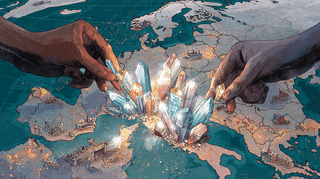
Nine months after the Japan-EU BRT proposal, the rare earth landscape has transformed: 55-nation pricing agreements, an EU center modeled on Japan's JOGMEC, and $1.3B US funding. But can the West truly break China's grip?
China's carrier Liaoning conducted flight operations near Minamitorishima — Japan's remote rare earth island. With Beijing tightening export controls in retaliation for PM Takaichi's Taiwan remarks, and a US-Japan rare earth partnership signed at the March 2026 summit, this is no longer just about minerals. It's a geopolitical power game with South China Sea parallels.
Japan Research Institute proposes an Ocean Industrial Complex combining deep-sea robotics, rare earth mining, and blue carbon. With a successful trial extraction of rare earth mud from 6,000m depth and breakthrough underwater wireless tech, Japan's ocean strategy is becoming reality.
In March 2026, Japan and the US signed an MOC on deep-sea mineral development. But overseas coverage missed the real story: Japan's successful 6,000m rare-earth mud retrieval, China's dual-use export ban, and 14 years of research that made this moment possible.
Itochu Corporation launches a joint venture with America's largest e-recycler ERI to tap Japan's urban mines for rare metals. With Chinese lithium giants also eyeing the market, we break down the business battle over Japan's hidden treasure trove of 6,800 tons of gold and 60,000 tons of silver.
China's Commerce Ministry banned dual-use exports to 20 Japanese defense entities including Mitsubishi Shipbuilding, Kawasaki Heavy's aerospace arm, IHI Aerospace and JAXA, while adding 20 more firms such as Subaru and TDK to a watch list. Seen as a response to PM Takaichi's Taiwan remarks, the move puts rare earth and semiconductor material supply chains at risk. The list was expanded again in June 2026.
A field-by-field breakdown of the 17 strategic sectors PM Takaichi named in her February 20, 2026 policy speech: AI and semiconductors, fusion, content, defense and the rest, with current standing, plans and key players, plus the public-private investment roadmap released in June 2026 that runs to over 370 trillion yen through fiscal 2040.
Japan and the US have agreed on the first tranche of a massive $550 billion investment plan, including a $600 million lab-grown diamond factory in Georgia. With China controlling over 60% of global production, synthetic diamonds are being called "the next rare earth." But with a controversial profit-sharing deal, is this a smart bet or a high-risk, low-return gamble for Japan?
Japan achieved a world-first by extracting rare earth mud from 6,000m deep near Minamitorishima in January 2026. Explore the latest on Japan's seabed mineral resource development, commercialization roadmap, environmental challenges, and what it means for global critical mineral supply chains.
Yamaguchi University researchers discovered four new rare earth-containing minerals at Gunma Prefecture's Mokurasawa Mine. Amid Japan's push to reduce China dependence, this discovery holds both scientific significance and strategic implications for resource security.
Japan unveils groundbreaking automated rare metal recovery system developed over 30 years by AIST's Dr. Tatsuya Oki. Combining AI detection with air-based sorting technology, this world-first facility in Osaka began testing in September 2025. The system automatically extracts up to 10 types of rare metals from six categories of small electronics including smartphones and tablets, targeting commercial operation by 2028. Learn how this innovation could transform Japan's resource security and reduce dependence on Chinese imports.
Prime Minister Takaichi asked Keidanren to diversify supply sources for critical materials. With China tightening export controls on Japan, Tokyo is pushing seabed rare earth mining trials at Minamitorishima alongside international partnerships. In July 2026 the recovered mud was reported to be about 54% medium and heavy rare earths.
A new mineral called Takanawaite discovered in Mt. Takanawa, Ehime Prefecture contains rare earth elements. However, commercial development faces three major barriers: mining volume, stable supply, and radioactive waste processing. This article explores Japan's path to becoming a "resource power" alongside the Minamitorishima seabed development project.
China threatens rare earth export bans following PM Takaichi's Taiwan comments. After 15 years since the 2010 Senkaku crisis, Japan's preparedness through supply chain diversification is now the model for the US, Europe, and Australia accelerating their "de-risking" from China.
Japan's JAMSTEC will conduct the world's first rare earth mud mining test from 6,000m deep ocean off Minamitorishima in January 2026. A historic project key to Japan's economic security strategy to reduce dependence on China for critical minerals.