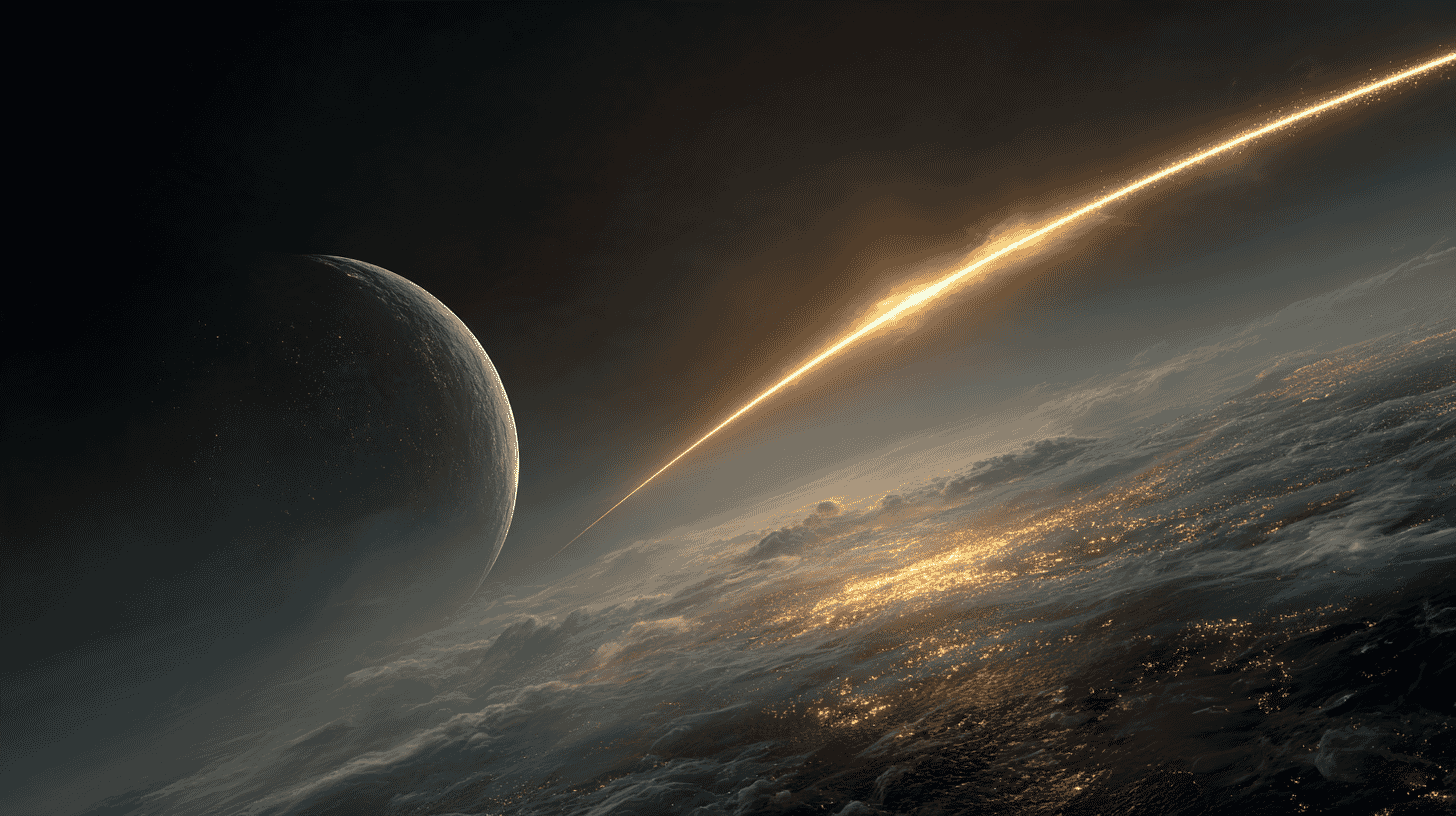
🛰️ In October 2018, a Japanese spacecraft and a European one left French Guiana stacked on top of each other. Since then they have brushed past Earth, Venus and Mercury nine times, shedding speed a little at a time over about eight years and about 10 billion kilometers. That stack is scheduled to enter orbit around Mercury on November 21, 2026. In December, Japan's Mio will be released, and it will start circling the planet alongside Europe's MPO. Their target is a puzzle half a century old: why the smallest planet in the solar system has a magnetic field at all.
The closer you get to the Sun, the harder it is to stop
Mercury looks like a neighbor from Earth, yet before BepiColombo only two spacecraft had ever gone there, both American. A probe falling toward the Sun keeps speeding up as the Sun's gravity pulls on it. To actually arrive at Mercury, you have to keep killing that speed.
The European Space Agency (ESA) and the Japan Aerospace Exploration Agency (JAXA) run BepiColombo together. Fuel alone could never slow it down enough, so it borrowed gravity from planets instead, in a series of flybys: Earth once in 2020, Venus twice, Mercury six times. Nine in total. According to Science Portal, run by the Japan Science and Technology Agency (JST), that is the most ever planned for a planetary probe.
The mission is named after the man who pioneered the long way around: Giuseppe "Bepi" Colombo (1920-1984), a mathematician at the University of Padua in Italy. NASA's Mariner 10 was able to pass Mercury three times in 1974-75 thanks to his orbit calculations.
On April 26, 2024, the European transfer module (MTM) that does the pushing could no longer send enough electrical power to its ion thrusters. Thrust came back to only about 90% of its previous level, and ESA redesigned the route. Arrival slipped from the original December 2025 to November 2026, almost a full year.
Two spacecraft, one stack
For eight years the two orbiters have flown as a single vehicle. The transfer module sat at the bottom, ESA's Mercury Planetary Orbiter (MPO) in the middle, and JAXA's Mercury Magnetospheric Orbiter, Mio, on top, wrapped in a sunshield called MOSIF. The transfer module was released on September 3, 2026. Since then, MPO has been doing the driving for both.
MPO studies the surface and the interior. Mio, which weighs 255 kilograms and is an octagonal prism that fits inside a 1.8-meter circle, is built to spin once every 4 seconds while it measures what surrounds Mercury: magnetic fields, plasma, dust and the planet's wisp of an atmosphere. While bolted to MPO, though, it cannot spin. That is why it needed a sunshield to survive the heat.
Under ESA's plan as of November 2026, the stack enters orbit on November 21, and MPO and Mio separate on December 9-10. The separation itself sets Mio spinning. It then unrolls four 15-meter wire antennas and two 5-meter magnetometer masts and finally takes its working shape.
The name Mio was picked in June 2018 from about 6,500 public entries. Written 澪 in Japanese, it means the trail a ship leaves behind it, or the channel it travels through. The old channel markers that guided boats were called miotsukushi, a word that classical Japanese poets used as a pun on "giving one's all." JAXA says the name carries both the long road of development and a wish for a safe voyage.
A small planet with a strange magnetic field
Earth's magnetic field comes from molten metal churning in its core, and keeping that engine, or dynamo, running requires heat to escape from the core. Mercury is only about 40% of Earth's diameter and its surface is old, so before any spacecraft arrived, the expectation was that its core had either frozen solid or was losing too little heat to keep a dynamo going. Then, in 1974, Mariner 10 found that Mercury has a magnetic field anyway.
It is about one-hundredth as strong as Earth's, and its shape is odd. NASA's MESSENGER spacecraft found that the field's center sits about 480 kilometers north of the planet's center, roughly 20% of Mercury's radius. Relative to the planet's size, that offset is larger than on any other planet, and the MESSENGER team said explaining it would challenge theory.
A field that weak gets shoved around by the solar wind, the stream of charged particles pouring off the Sun. When MESSENGER flew past in 2009, the magnetic tail stretching away on the night side was loading up with energy and releasing it in just 2-3 minutes. On Earth, the same kind of event, called a substorm, plays out over 1-3 hours.
MESSENGER, which orbited Mercury from March 18, 2011 to April 30, 2015, was the only probe ever to do so. But one spacecraft has a hard time telling whether the field it measures at a given spot comes from inside the planet or from the solar wind shaking things up.
BepiColombo is designed to solve that with two. If MPO and Mio, on different orbits, measure the field at the same moment, the outside disturbance can be separated from the internal field. JAXA says that should open a window into Mercury's interior. It is also the first time two spacecraft will orbit Mercury at once. We covered the planet's surface and how much it has shrunk in "Mercury Shrank 11.6 km".
Mio's one and only camera
Of Mio's five instrument suites, only one takes pictures: the Mercury Sodium Atmosphere Spectral Imager, or MSASI.
Mercury has nothing you could call air. Still, sodium atoms knocked off the surface drift around it in a very thin haze. First spotted from ground-based telescopes in 1985, this sodium glows brightly in sunlight, which makes it a handy tracer for what is happening around the planet. When Mercury is closest to the Sun, the pressure of sunlight pushes the sodium out into a long, comet-like tail.
According to ESA, the camera combines a swiveling mirror with the spacecraft's spin to image the whole planet and the sodium tail. So for eight years, unable to spin and hidden behind MPO, it could not be used.
Kyodo News reported on November 4, citing people involved in the project, that Mio will start using the camera after separation and that a first image as early as March 2027 is being arranged. The terrain is also expected to show alongside the sodium, according to the report. As of November 6, 2026, JAXA has made no official announcement.
It would not be BepiColombo's first picture of Mercury, though. At each of its six Mercury passes, from 2021 to January 2025, the transfer module's monitoring cameras photographed the planet. What would be new is Mio imaging the sodium atmosphere with its own camera. Under ESA's plan, full science operations begin in April 2027.
Which unanswered question in the solar system would you be willing to wait eight years for?
References
- https://www.toonippo.co.jp/articles/-/2396169
- https://www.esa.int/Science_Exploration/Space_Science/BepiColombo/Latest_updates_BepiColombo_s_arrival_at_Mercury
- https://www.esa.int/Enabling_Support/Operations/BepiColombo_begins_Mercury_arrival_with_MTM_separation_success
- https://www.esa.int/Science_Exploration/Space_Science/BepiColombo/Fourth_Mercury_flyby_begins_BepiColombo_s_new_trajectory
- https://www.esa.int/ESA_Multimedia/Images/2024/12/Mercury_during_BepiColombo_s_fifth_flyby
- https://www.esa.int/Enabling_Support/Operations/Glitch_on_BepiColombo_work_ongoing_to_restore_spacecraft_to_full_thrust
- https://sci.esa.int/web/bepicolombo/-/11813-pr-40-1999-esa-s-mercury-mission-named-bepicolombo-in-honour-of-a-space-pioneer
- https://sci.esa.int/web/bepicolombo/-/60072-sunshield-ejection
- https://sci.esa.int/web/bepicolombo/-/60068-separation-of-mercury-magnetospheric-orbiter
- https://cosmos.esa.int/web/bepicolombo/msasi
- https://mio.isas.jaxa.jp/mission/
- https://mio.isas.jaxa.jp/topics/isas-news/000067.html
- https://scienceportal.jst.go.jp/newsflash/20181018_01
- https://scienceportal.jst.go.jp/explore/review/20200423_01/index.html
- https://gendai.media/articles/-/72839
- https://mio.isas.jaxa.jp/topics/news/000009.html
- https://sci.news/space/bepicolombo-mercury-arrival-15044.html
- https://arxiv.org/abs/1701.05060
- https://europlanet-society.org/?p=2407
- https://www.jhuapl.edu/news/news-releases/100715-messenger-mercury-exosphere-volcanism-magnetic-substorms
- https://www.astronomy.com/science/messenger-spacecraft-reveals-new-information-about-mercury/
- https://science.nasa.gov/resource/from-the-first-to-the-last/
- https://pparc.gp.tohoku.ac.jp/thesisfile/takamizawa-m.pdf
- https://meetingorganizer.copernicus.org/EPSC2010/EPSC2010-700.pdf




Global Discussion
4 comments