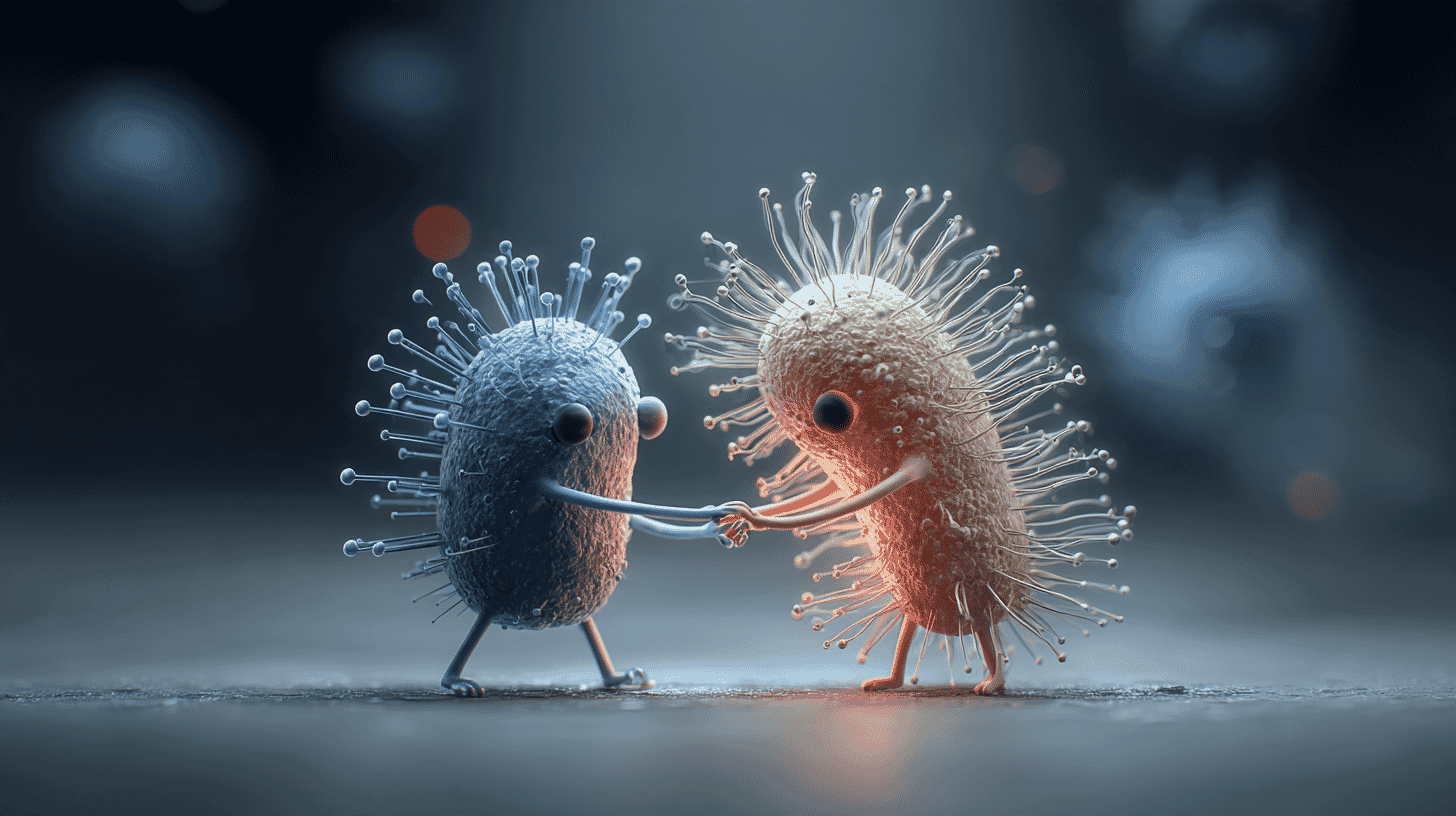
🔬 The cells in your body are thought to have begun about 2 billion years ago, when two microbes merged. A Japanese-led team has now isolated and grown, for the first time, members of the archaeal group considered closest to one side of that merger. The microbes were living on the wall of a natural gas well in Chiba, east of Tokyo.
The group is called Heimdallarchaeia. A team of 26 researchers led by the Japan Agency for Marine-Earth Science and Technology (JAMSTEC) reported the work in Nature on October 28, 2026 (London time). The results bear on two open arguments: whether our cells became complex inside before or after the merger, and whether oxygen was around at the time.
Our cells began as a merger
Life splits into three great branches. Bacteria and archaea are single-celled microbes without a nucleus. Eukaryotes, the branch that includes plants, animals and fungi, have cells divided into membrane-bound compartments, including a nucleus that holds the DNA and mitochondria that make energy.
The leading explanation for how eukaryotes arose is that an archaeon teamed up with a bacterium and eventually took it inside. That bacterium became the mitochondrion.
The bacterial partner is fairly well understood. The archaeal one is the mystery. Genome surveys over the past decade pointed to a group named after the Norse gods, the Asgard archaea, now formally the phylum Promethearchaeota, and within it to Heimdallarchaeia, named for the gods' watchman Heimdall, as the closest match to eukaryotes. Nobody had isolated one. In 2022, a California Institute of Technology team read complete Heimdallarchaeia genomes from enrichment cultures of hydrothermal vent microbes, but the cells were still mixed in with many others. Working from DNA alone, some researchers predicted complex internal structures, or even the ability to breathe oxygen, like eukaryotes.
A gas well in Chiba, and three years of patience
In January 2020, a JAMSTEC group led by Hiroyuki Imachi, the same team behind the new work, reported the world's first cultured Asgard archaeon, known as strain MK-D1. It came from mud collected in May 2006 by the crewed submersible Shinkai 6500 from a methane seep in the Nankai Trough, 2,533 meters deep. Getting it into a stable culture took 12 years.
This time the sample was a biofilm on the wall of a gas production well in the Minami-Kanto gas field, Boso Peninsula, Chiba Prefecture. At this well, methane-rich, oxygen-free ancient seawater gushes out intermittently, so the wall is periodically exposed to air. DNA showed a small number of Heimdallarchaeia living there.
After about three months on filtered groundwater and methane, Asgard archaea, Heimdallarchaeia included, made up about 0.3 percent of the cells.
The team then switched the food to protein and added antibiotics to hold back bacteria. Instead of removing all oxygen, they left a few hundred nanomolar of dissolved oxygen in the medium. Oxygen-loving bacteria bloomed too, but the share of Heimdallarchaeia rose to 1.8 percent.
About three years after sampling, strain HC1 was isolated in a pure co-culture with a single partner, a methane-producing archaeon of the genus Methanocalculus. A second strain, SC1, a separate species, lives in a pure three-member culture with methanogenic partners. Neither grows alone.
HC1 received the proposed name Margulisarchaeum peptidiphilum. The genus honors Lynn Margulis, the American biologist who championed endosymbiotic theory, the idea that parts of our cells were once free-living microbes. The species name means "protein-loving."
Simple inside, busy outside
Both strains are round. HC1 is about 1.3 micrometers across, SC1 about 0.9 micrometers. Both grow long, branching protrusions and release small membrane bubbles called vesicles. In HC1, the protrusions add up to about 1.7 cubic micrometers per cell, about 1.4 times the volume of the cell body. The team saw those protrusions reach out and attach to the methane-producing partners.
Cryo-electron microscopy cross-sections, rebuilt in 3D, showed actin filaments and ferritin-like iron-storage granules inside, but no membrane-bound organelles. There is no nucleus.
The two Asgard archaea grown before, MK-D1 from Japan and Lokiarchaeum ossiferum strain B35, cultured in Vienna, look the same. Those two were only distant relatives of eukaryotes. Now the closest relatives turn out to be simple inside as well.
JAMSTEC says the results strongly support the view that the archaeal ancestor built its nucleus and other compartments only after the merger. These are living relatives, though, not the ancestor itself.
The protrusions are also used for moving. In a separate Nature paper published on September 30, 2026, a University of Vienna team filmed live cells reshaping within minutes and crawling across surfaces with their protrusions. The cells studied included the HC1 strain grown in Japan. According to Vienna, this kind of crawling had previously been known only in more complex cells, human immune cells among them.
Both strains grow on protein alone and pass the hydrogen or formate they release to their methanogen partner. Genome analysis suggests these archaea cannot make about half of the amino acids they need, and the missing set resembles the essential amino acids humans must get from food. The team describes this only as an interesting feature.
Is oxygen friend or foe?
Most eukaryotes need oxygen, and the mitochondrial ancestor used it. So how did an oxygen-hating archaeon end up living with an oxygen-breathing bacterium?
In February 2026, Brett Baker, an associate professor at the University of Texas at Austin, and colleagues had offered a different answer in Nature. Analyzing 404 genomes, 136 of them new Heimdallarchaeia, they reported that many Heimdallarchaeia live in coastal sediments with shifting oxygen and carry hallmark proteins of an oxygen-using lifestyle. The shared ancestor, they argued, may have breathed oxygen.
HC1 does carry genes for oxygen-using oxidase enzymes. But JAMSTEC found it lacks the full electron transport chain needed to breathe oxygen, so the enzymes likely mop up oxygen instead. It also has a broad kit of enzymes such as catalase and superoxide dismutase that neutralize reactive oxygen.
In culture, HC1 did not grow at all with a few hundred nanomolar of dissolved oxygen, or with a gas containing 1 percent oxygen. Alongside oxygen-consuming bacteria, it grew even when a little oxygen was present at the start. A new genome-based test also found every member of Promethearchaeota is fundamentally anaerobic, including those with oxygen-related genes.
From this, JAMSTEC concludes that the first partnership with the mitochondrial ancestor began in low-oxygen surroundings, held together in part by oxygen detox.
Masaru K. Nobu, a principal researcher at JAMSTEC who shares first authorship with Imachi, told Jiji Press the microbe dislikes oxygen but copes when oxygen-eating bacteria are around. He suggested it may put up with oxygen because sunlit shallow seafloors, where photosynthesis releases oxygen, are richer in protein to eat.
Even "closest relative" is still argued over
In 2023, a phylogenetic study in Nature placed eukaryotes as the sister group of Hodarchaeales, a branch inside Heimdallarchaeia. Both HC1 and SC1 belong to Hodarchaeales. If that tree is right, they are among the closest living microbes to our cells' archaeal side.
That tree has challengers. In 2025, a team from East China Normal University and Shenzhen University reported in Nature that eukaryotes split off before all sampled Heimdallarchaeia diversified, and the ancestor was probably an anaerobe that depended on hydrogen. On that reading, Heimdallarchaeia are cousins, not siblings.
Either way, JAMSTEC says the new strains are easier to work with than earlier isolates and expects them to become model organisms. We have written before about an archaeon with the smallest known archaeal genome whose cell nobody has seen. These cells have been filmed crawling.
What did the ancestral archaeon look like, and where did the two microbes meet? Which of those questions would you most like answered?
References
- https://www.jamstec.go.jp/j/about/press_release/20261029/
- https://www.jamstec.go.jp/e/about/press_release/20261029/
- https://doi.org/10.1038/s41586-026-11170-7
- https://www.jiji.com/jc/article?k=2026102900034&g=soc
- https://www.jamstec.go.jp/j/about/press_release/20200116/
- https://www.univie.ac.at/en/news/press-room/press-releases/detail/unexpected-dynamics-of-ancient-microbes-discovered
- https://doi.org/10.1038/s41586-026-11063-9
- https://cns.utexas.edu/news/research/break-longstanding-mystery-about-origin-complex-life
- https://doi.org/10.1038/s41586-026-10128-z
- https://doi.org/10.1038/s41586-023-06186-2
- https://pmc.ncbi.nlm.nih.gov/articles/PMC12222021/
- https://doi.org/10.1038/s41564-021-01039-y




Global Discussion
4 comments