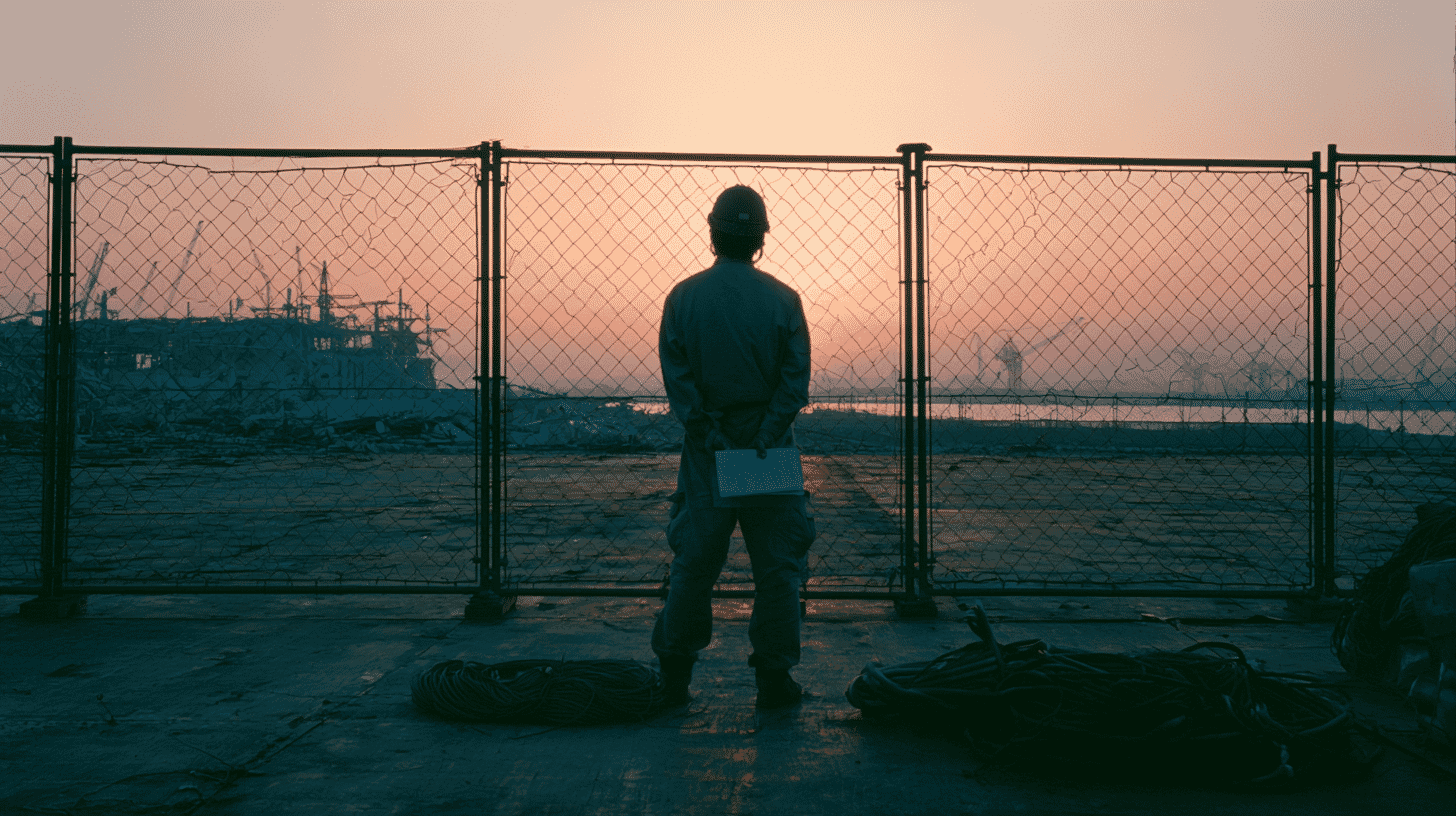
A year after the Osaka-Kansai Expo closed, one of the few contractors to recover any of his unpaid bill got the money from a government that owed him nothing: Angola. Japan's own Expo hosts welcomed the news, then repeated that they have no legal basis to pay. Between them sits a chain of subcontractors that Japanese law barely protects.
A payment nobody had to make
The contractor is a 43-year-old employee of an equipment firm in Kagawa Prefecture, on the island of Shikoku. His company worked on the Angola Pavilion's electrical and interior systems as a fourth-tier subcontractor. Three layers of companies stood between his crew and the Angolan government that commissioned the building.
According to MBS, Angola had paid its main contractor in full. The money simply stopped somewhere above him. The third-tier firm that hired his company never paid about ¥43 million ($272,000), and he is suing it for the full amount.
He kept appealing to Angolan officials during and after the Expo. In April 2026, MBS reports, the Angolan side told him it had no legal responsibility but would pay 40% on humanitarian grounds. About ¥17 million ($108,000) arrived in July 2026. Kyodo News, which broke the story on October 13, the first anniversary of the Expo's closing, called it the first known case of a foreign government covering a debt it was not party to.
During construction he had given technical advice to a Spanish company working on the pavilion's electrical systems, and later told them about his unpaid bill. That Spanish company asked Angolan officials to help him. Angola told MBS it would not make a public statement.
The money was enough to repay his own suppliers and pay his consumption tax, he told MBS. If the lawsuit recovers the full amount, he plans to return Angola's money.
"A good thing," said the host
On October 14, Osaka Governor Hirofumi Yoshimura, who is also vice president of the Japan Association for the 2025 World Exposition that ran the event, called Angola's payment a good thing, Kyodo reported. In the same remarks he said a bailout by the prefecture would be extremely difficult and that the Expo Association has no legal basis to pay either. Speaking to MBS, he described Angola's move as a judgment that country made as the client, and explained that neither the prefecture nor the association ordered the pavilions, so there is simply no basis for advancing the money.
That argument has weight: foreign pavilions were commissioned by participating countries under private contracts.
A victims' group of unpaid Expo contractors had already filed requests with Yoshimura on June 23, 2025, and again on July 22, 2025, asking for emergency advance payments and, failing that, long-term interest-free loans. In his account to the weekly Josei Jishin, the prefecture pointed them to existing loan programs and help desks, the same channels that had already turned them away.
If another country stepped in to fix a problem at Japan's own event, he argued, the governor should first have thanked Angola.
Where Japanese law runs out
Japan's Ministry of Economy, Trade and Industry has received complaints from more than 30 companies working on 11 pavilions, MBS reports. At a press conference in Tokyo in November 2025, affected business owners put the total at about ¥2 billion ($12.7 million).
Japan's legal safety valve is narrow. Article 41 of the Construction Business Act lets the authority that licensed a prime contractor recommend it cover workers' wages left unpaid further down the chain, but not invoices between companies. A small firm that paid its crew out of its own pocket, as this one did, falls through.
Opposition lawmakers tried to close that gap. On December 15, 2025, eight members from the Constitutional Democratic Party, Reiwa Shinsengumi, the Japanese Communist Party and a small caucus called Genzei Hoshu Kodomo submitted an amendment to the Expo special measures law letting the Expo Association buy up contractors' payment claims. In effect, the association would pay first and chase the debtors itself. The bill was carried over, then lapsed without a vote on January 23, 2026, when the lower house was dissolved.
The subcontractor told Josei Jishin he went public partly to push for the bill to be reintroduced in the autumn extraordinary Diet session.
A promise on paper
In April 2024, the Expo Association adopted a human rights policy that pledges to respect the human rights of everyone involved in the Expo project and to work on remedy where its activities cause or contribute to harm. It is a voluntary pledge, not a legal duty to settle anyone's invoices, but the contractors who built the pavilions are among the people it promises to respect.
The subcontractor also pointed to May 2025, when swarms of non-biting midges became a headline at the Expo site. The association responded with a midge task force headed by its secretary general. Nothing comparable was set up for unpaid contractors, he told Josei Jishin, and asked whether the victims counted for less than insects.
In December 2025, the association projected an operating surplus of ¥32 billion to ¥37 billion ($202 million to $234 million). In April 2026 a government review panel's draft report proposed spending it on Expo legacy projects. The victims' own estimate of their losses comes to a little over 5% of the top of that range. That does not make the surplus legally available for debts the association never incurred.
How other countries handle the chain
On US federal construction contracts above $150,000, contractors must post a payment bond, a guarantee backed by a surety company that pays subcontractors and suppliers if the contractor doesn't. But protection generally reaches only two tiers below the prime contractor. A fourth-tier firm like this one could still be left out.
Spain went at the problem from the other end. Its construction subcontracting law (Law 32/2006) bars a third-tier subcontractor from subcontracting further, with a narrow exception for one extra level. Under that rule, a fourth-tier position like his would exist only by exception.
Neither system would apply neatly to a foreign government's pavilion.
When a big public event in your country leaves small contractors unpaid, who is expected to step in: the organizer, the government, or nobody?
References
- https://jisin.jp/domestic/2604757/
- https://topics.smt.docomo.ne.jp/article/mbs_news/region/mbs_news-3009397
- https://topics.smt.docomo.ne.jp/article/kyodo_nor/life/kyodo_nor-2026101301001067
- https://news.infoseek.co.jp/article/kyodo_1483046806438740743/
- https://www.pref.osaka.lg.jp/o070050/koho/07-dantaial/250623_banpakumibaraii_yobo.html
- https://www.pref.osaka.lg.jp/o070050/koho/07-dantaial/250722_banpakumibaraii_yobo.html
- https://www.arabnews.jp/en/business/construction-companies-seek-restitution-from-government-over-unpaid-osaka-expo-costs-158358
- https://laws.e-gov.go.jp/law/324AC0000000100
- https://www.shugiin.go.jp/internet/itdb_gian.nsf/html/gian/keika/1DE0A86.htm
- https://www.sangiin.go.jp/japanese/joho1/kousei/gian/220/meisai/m220090219018.htm
- https://www.shugiin.go.jp/Internet/itdb_kaigiroku.nsf/html/kaigiroku/000122020260123001.htm
- https://www.expo2025.or.jp/wp/wp-content/uploads/JP_Human-Rights-Policy-.pdf
- https://www.j-cast.com/2025/05/27504723.html
- https://dempa-digital.com/?p=703834
- https://www.sakigake.jp/news/article/20260427CO0096/
- https://www.govinfo.gov/content/pkg/USCODE-2023-title40/html/USCODE-2023-title40-subtitleII-partA-chap31-subchapIII.htm
- https://www.acquisition.gov/far/28.102-1
- https://www.boe.es/eli/es/l/2006/10/18/32





Global Discussion
3 comments