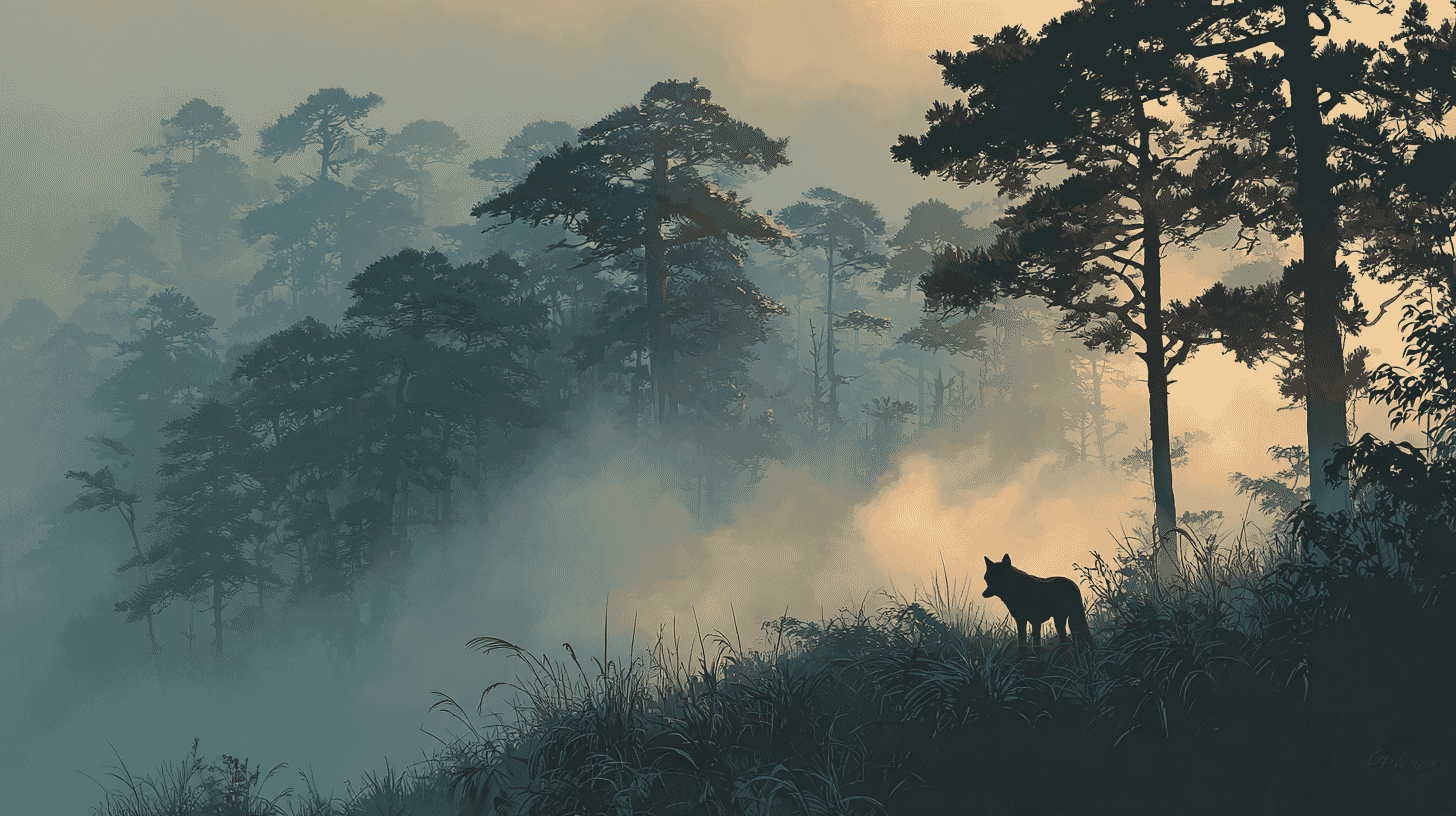
🐕 Call a Shiba Inu by name and you may get a glance, and nothing more. Reach down to pick one up and it slips away. In Japan, owners trade these stories like a running joke.
A new book by two Japanese researchers, excerpted by PRESIDENT Online on October 24, 2026, offers one explanation. The Shiba belongs to a group of "ancient breeds" that sit genetically close to wolves, and dogs in that group tend to ask for less attention from their people. Separately, Japanese dogs carry a small share of DNA from the Japanese wolf, which disappeared more than a century ago. It makes a tidy headline: wolf genes, therefore a cool dog. The research doesn't go that far.
The dog that won't come when called
Japanese owners even have a word for one Shiba habit: kyohi-shiba, the refusing Shiba, a dog that plants its feet mid-walk and will not move. Not every Shiba fits the type. In April 2026, one became a police dog in Gifu Prefecture (our story on Tsubu).
Most people outside Japan met the breed through Kabosu. Her 2010 photo became the Doge meme, and in 2013 her face became the mascot of Dogecoin. As Global News retold the story, the picture was taken when Kabosu was called over to play and answered by turning only her head, with that famous side-eye.
A trace of an extinct wolf
The Japanese wolf was a small subspecies of the gray wolf that lived on Honshu, Shikoku and Kyushu. The last confirmed animal was caught in 1905, in Nara Prefecture.
In February 2024, a team from SOKENDAI (the Graduate University for Advanced Studies), Gifu University and Anicom published a genome study in Nature Communications. They sequenced 9 Japanese wolves and 11 Japanese dogs (Shiba, Kishu and Akita). The Japanese wolf turned out to be the wolf most closely related to dogs, which led the team to suggest that dogs likely arose in East Asia. The genomes of Japanese dogs also carry 2 to 4 percent from the Japanese wolf's ancestors. Among the dogs compared, dingoes and New Guinea singing dogs carry the most. The press release adds that genome data cannot show how domestication happened.
A breed that nearly disappeared
The Shiba was named a Natural Monument in 1936, then nearly wiped out by the Second World War and a distemper outbreak that followed. Today's Shiba descends from three regional lines that survived: Shinshu, San'in and Mino.
"Ancient breeds" ask for less attention
Genome studies since 2010 split breeds into wolf-like ancient breeds (Akita, Shiba, Chow Chow, Siberian Husky, Basenji and others) and modern, mostly European ones. Several Japanese teams have tested whether the two groups behave differently.
The biggest of these studies came in 2015 from Azabu University and the University of Pennsylvania. They analyzed owner questionnaires for 2,951 dogs in Japan and 10,389 in the US, more than 13,000 in all. The questions covered everyday clinginess, such as whether a dog follows family members from room to room. The ancient and spitz group (Basenji, Shiba, Akita, Siberian Husky and Samoyed) had the lowest score for attachment and attention-seeking, significantly below every other group. The authors also noted that owner reports can carry bias.
Lab experiments point the same way. In a 2016 study led by Akitsugu Konno, now a lecturer at Azabu University and one of the book's authors, researchers tested 125 purebred dogs from 26 breeds. Faced with a container they could not open, ancient breeds were slower to look at a person, and their glances were shorter. The pattern tracked closeness to wolves rather than working purpose.
In 2022, the Azabu University group behind the 2015 survey tested 624 dogs. The ancient group looked back at people less often. Variants of MC2R, a gene tied to the stress hormone cortisol, were linked to looking back and to reading gestures. Reading pointing gestures did not differ between groups.
The book's authors, Konno and Miho Inoue-Murayama, a professor at Kyoto University's Wildlife Research Center, suggest that ancient breeds may not lack attachment to the people close to them. They may simply show it differently.
Breed explains about 9 percent
In 2022, a team from UMass Chan Medical School and the Broad Institute published a study in Science that surveyed owners of 18,385 dogs and analyzed the DNA of 2,155. Breed explained only about 9 percent of the behavioral differences between individual dogs. A group trend can be real and still tell you little about the dog on your sofa.
And none of these studies connects the two halves of the headline. The wolf genome paper did not look at personality. The personality studies did not measure Japanese wolf DNA. "Wolf DNA makes Shibas aloof" is, for now, a hypothesis.
Does your dog follow you to the bathroom, or greet you with a Shiba-style side-eye? Tell us the breed, or the mix, and where you live.
References
- https://president.jp/articles/-/120322
- https://pmc.ncbi.nlm.nih.gov/articles/PMC10891106
- https://kyodonewsprwire.jp/release/202403017362
- https://www.gifu-u.ac.jp/about/publication/press/20240301_1.pdf
- https://kotobank.jp/word/%E3%81%8A%E3%81%8A%E3%81%8B%E3%81%BF-3146013
- https://pmc.ncbi.nlm.nih.gov/articles/PMC4683527
- https://pmc.ncbi.nlm.nih.gov/articles/PMC5063391
- https://pmc.ncbi.nlm.nih.gov/articles/PMC9184530
- https://pmc.ncbi.nlm.nih.gov/articles/PMC9675396/
- https://globalnews.ca/news/10522139/doge-meme-death-kabosu-shiba-inu
- https://newschannel5.com/entertainment/kabosu-the-shiba-inu-that-inspired-the-doge-meme-behind-dogecoin-cryptocurrency-has-died
- https://togetter.com/li/1956081
- https://www.tokyoweekender.com/?p=207953
- https://kotobank.jp/word/%E6%9F%B4%E7%8A%AC-74684




Global Discussion
4 comments