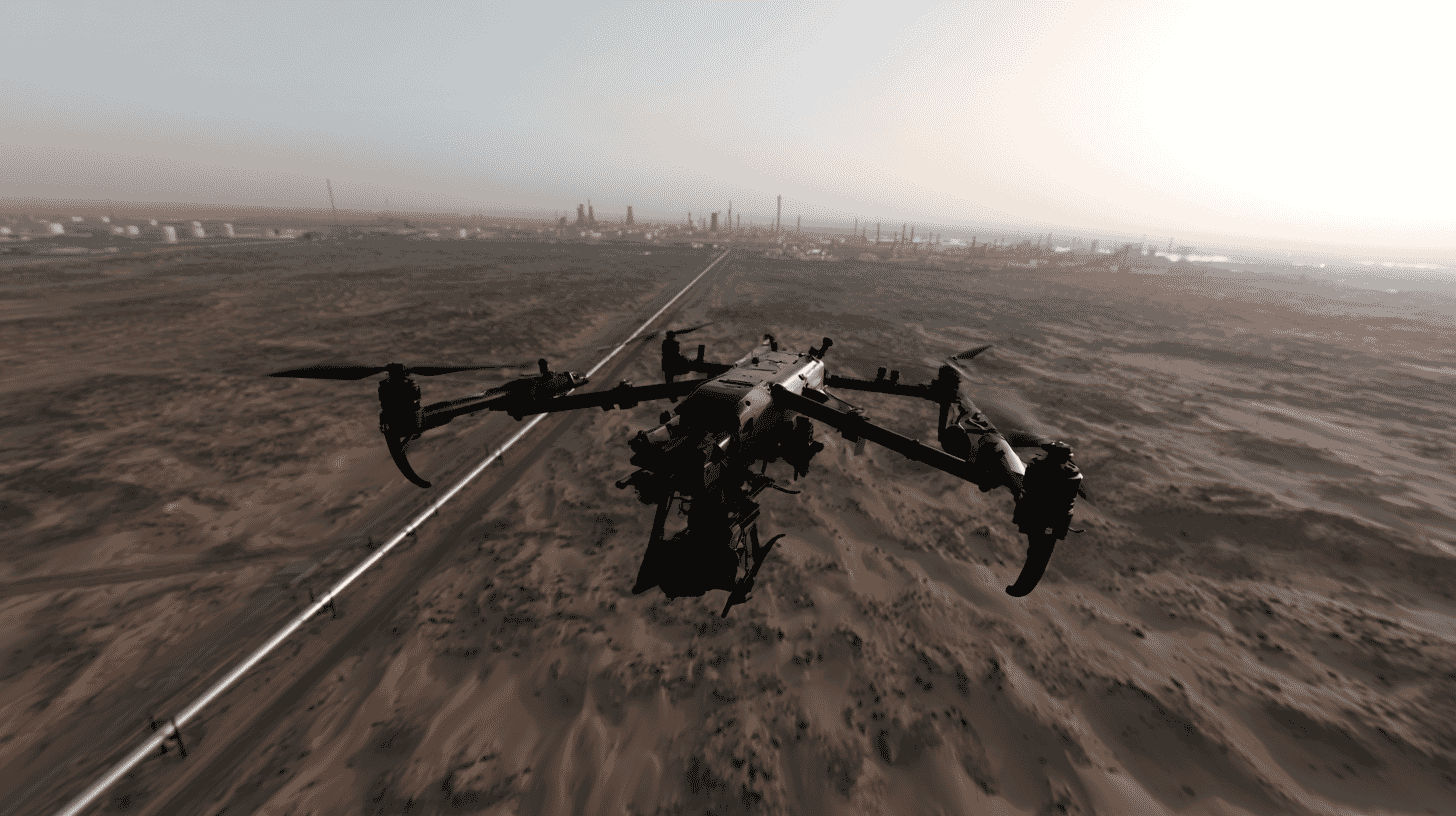
🛢️ A Tokyo-listed drone company has won a solo contract to patrol oil and gas pipelines across a vast stretch of eastern Saudi Arabia, for one of the world's largest integrated energy and chemicals companies. The price tag is about 2.7 million dollars. The job is AI-driven security surveillance, not the inspection work Terra Drone is better known for. And the subtext: while DJI gets walled out of the United States and Skydio raises fresh capital for its NDAA-compliant push, Japan's industrial drone champion is quietly building a third lane, one that runs through the Gulf.
What was actually announced
On May 14, 2026, Terra Drone Corporation said its Saudi subsidiary Terra Drone Arabia had been awarded a solo contract to provide drone-based security surveillance of oil and gas pipelines in eastern Saudi Arabia. The client is described only as "one of the world's largest integrated energy and chemicals companies." The job runs for one year and begins during the fiscal year ending January 2027. The value is 10.15 million Saudi riyals, which the company converts to roughly 406 million yen at its stated assumption of 1 SAR to 40 JPY. Because the riyal is pegged at 3.75 to the dollar, that works out to about 2.71 million dollars. Terra Drone shares jumped on the day of the announcement.
The work itself is more interesting than the headline figure. Long-endurance drones with high-resolution cameras will patrol a wide management area on a routine cadence, with AI flagging "safety violations and suspicious security events" in real time. The pipeline operator gets early detection of trespass, theft, leaks and damage. Terra Drone gets to translate inspection experience, built partly on projects for the Abu Dhabi National Oil Company (ADNOC), into a different, security-oriented service line.
The press release stops short of naming the customer. But the details narrow the field quickly. Eastern Saudi Arabia is the heart of the Kingdom's oil patch. The "world's largest integrated energy and chemicals" framing is the language Saudi Aramco uses about itself. Terra Drone is partly funded by Wa'ed Ventures, Aramco's venture arm, which put 14 million USD into the Japanese company in 2023. And in April 2025, Terra Drone signed a memorandum of understanding directly with Aramco aimed at running inspection trials starting in 2027. The new security contract sits inside that orbit, though the identification remains inference rather than confirmation.
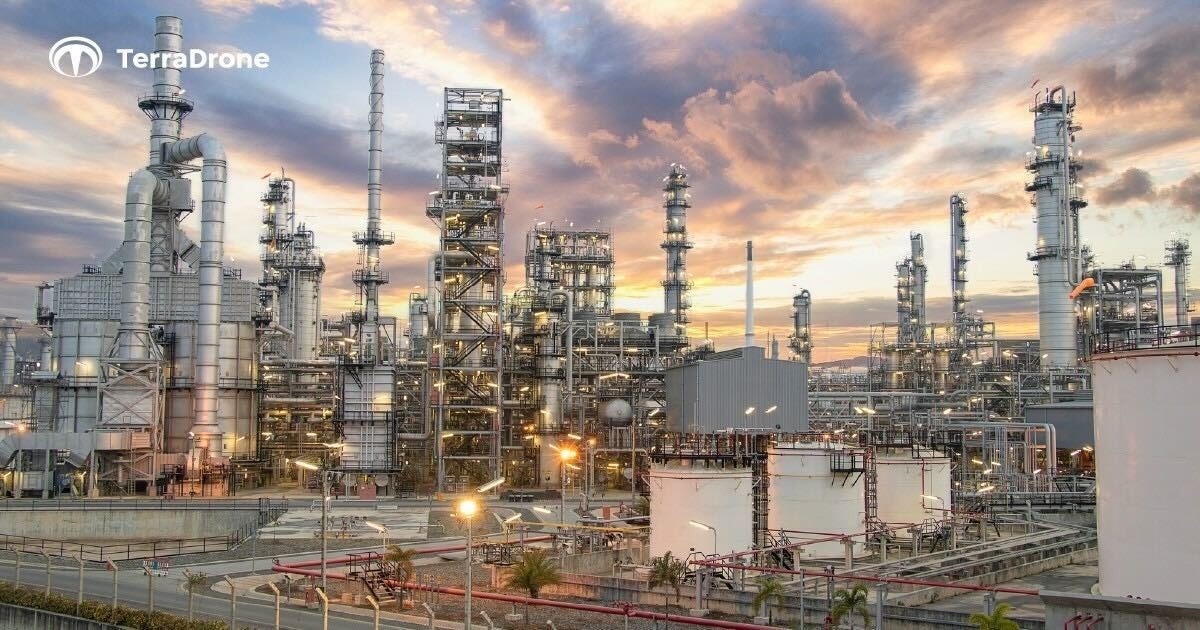
Source: Terra Drone Corporation press release
From inspection to security: a meaningful pivot
To outsiders, "drone for pipeline inspection" and "drone for pipeline security" sound interchangeable. Inside the industry they're different products. Inspection drones fly slow, hover close, and look for corrosion, leaks, structural defects and wall-thickness anomalies. Terra Drone's Dutch subsidiary Terra Inspectioneering claims more than 1,500 inspection projects, including work for Shell's largest European refinery and chemical giant BASF, and in 2023 received what it says was the world's first ABS (American Bureau of Shipping) certification for drone-based ultrasonic thickness measurement on FPSO vessels.
Security surveillance is a different mission profile. You want long endurance, broad coverage, automated patrol routes, and above all AI that can sort a stray camel from a saboteur, and a leak plume from a heat shimmer over baked sand. The new contract leans hard on that last piece. AI-driven anomaly detection is explicitly the value-add Terra Drone says it brings.
This matters because the Gulf has been on the receiving end of an unmistakable lesson in low-cost aerial threats. Drone and missile strikes on Saudi oil infrastructure, most notoriously the 2019 Abqaiq attack that briefly knocked out roughly half of Saudi crude output, taught regional operators that pipelines and processing facilities can no longer rely on perimeter fencing and patrol jeeps alone. Vision 2030, the Kingdom's economic diversification plan, calls for digitizing exactly this kind of critical infrastructure protection. Drones with AI eyes fit the brief.
Where Terra Drone sits between Skydio and DJI
Here's the geopolitical backdrop that makes this contract more than a one-off press release.
On December 23, 2025, the U.S. Federal Communications Commission added DJI, which held roughly 70 percent of the global drone market, to its Covered List. Autel and other foreign manufacturers are covered as well. Existing DJI drones can still be sold and flown, but new platforms can no longer receive FCC equipment authorization for the U.S. market. DJI has warned in court filings that it could lose roughly 1.5 billion dollars in 2026 U.S. sales as a result, with about 25 product launches affected.
That has done two things at once. It has handed America's homegrown enterprise champion, Skydio, a structural tailwind. In April 2026 Skydio closed a 110 million dollar Series F at a 4.4 billion dollar valuation and announced a five-year, 3.5 billion dollar U.S. manufacturing expansion. Its X10 platform runs roughly 16,000 to 25,000 dollars per unit, far above a comparable DJI machine, and is now the default NDAA-compliant choice for U.S. utilities and oil and gas operators that want a non-Chinese drone.
But Skydio's tailwind is regional, not global. The FCC rule applies to the U.S. market. The Gulf, Southeast Asia, Africa, and Latin America are not bound by it. There, the customer's question isn't "is this drone NDAA compliant?" but "can your team operate at scale on my asset for a year, with my licenses, my regulators, and my standards?" That is exactly the question Terra Drone has been building an answer to since establishing Terra Drone Arabia and pulling local GACA and GEOSA licenses and ISO 9001/45001/22301 certifications.
The result is something like a three-way split forming in industrial drone services:
- DJI: still dominant on hardware unit economics where it can sell, but locked out of new U.S. authorizations and increasingly seen as a procurement risk in security-sensitive verticals.
- Skydio: U.S.-made, autonomous, NDAA-aligned and aggressive in domestic enterprise and DFR (Drone as First Responder), but at heart a hardware-and-software product company rather than a global services operator.
- Terra Drone: hardware-agnostic at heart, betting on local subsidiaries, AI software and long-term industrial service contracts, especially in the Gulf, Southeast Asia and South America, where the calculus of where a drone was made looks different than it does from Washington.
It is a quieter strategy than Skydio's funding rounds, and harder to copy quickly. Building Terra Drone Arabia took Gulf investment, a Saudi subsidiary, local hires, regulatory clearances and years of inspection track record. A U.S. drone maker cannot replicate that with a Riyadh sales office.
The market underneath
The dollar size of this single contract is modest. The market underneath it is not.
MarketsandMarkets sizes the global industrial drone market at about 3.56 billion USD in 2024 and projects it to reach roughly 6.01 billion USD by 2029, an 11 percent compound annual growth rate. SNS Insider, looking specifically at the inspection drones slice, puts that segment at about 15.27 billion dollars in 2025 and forecasts 84.56 billion by 2035, close to a 19 percent CAGR. Definitions and figures vary widely between research houses here, so the direction matters more than the level. IDTechEx expects inspection and maintenance to surpass agriculture as the largest commercial drone segment before 2030, driven by drone-in-a-box deployments, AI defect detection, and remote fleet management.
The Saudi piece of that pie is structural, not cyclical. Aramco's own published guidance has flagged drone work for flare stacks, corrosion monitoring of offshore structures, pipeline surveillance, and methane leak detection as part of its sustainability and operational excellence playbook. Wa'ed Ventures putting capital into Terra Drone in 2023 was a tell. The operator wanted to localize a service capability, not just buy hardware once.
What Tokushige is really doing
Terra Drone CEO Toru Tokushige's public framing of the new contract is restrained, the standard language about advancing the company's presence in Saudi Arabia and supporting Vision 2030. Read alongside his recent moves, a pattern emerges.
In March 2026, the company announced full-scale entry into defense equipment, setting up a U.S. subsidiary called Terra Defense. In April, the firm unveiled details of Terra A2, an interceptor drone with about 75 km range pitched at the Shahed-style suicide-drone threat. In May, it secured an order from Japan's Acquisition, Technology and Logistics Agency for 300 modular training UAVs worth 115.43 million yen. Also in May, it landed the 406 million yen civilian security contract in the Gulf.
These aren't separate stories. They are branches of the same trunk: a single Japanese company trying to claim a sliver of every layer of the unmanned-systems stack, from industrial inspection through civilian asset security to defense, while DJI is pushed out of one major market and Skydio is pulled deeper into another. The bet is that drones have stopped being a product category and become a service infrastructure, and that the winners will be the few firms able to run that service across regulators, languages and threat environments.
Whether Terra Drone can hold all those branches up financially is a separate question. Its most recent disclosures show meaningful operating losses as it invests across these fronts, and Tokushige's "world top five" ambition is, candidly, ahead of the numbers. But ambition is not the same as bluff. A solo, AI-driven, year-long security contract on a Gulf energy major's infrastructure is not a press release somebody manufactures.
What to watch next
A few markers will tell us whether this Saudi deal is one-off or template.
First, whether Terra Drone Arabia secures follow-on work from the same customer once the year is up. Security contracts often start as pilots, and the real money is in the renewal at expanded scope. Second, whether the AI anomaly-detection layer, which is doing the heaviest lifting on differentiation, gets standalone product packaging, which would signal a move from services to platform. Third, whether other Japanese drone players fast-follow into the Gulf, or cede the region and stay focused on Japan and the United States.
Reading the early signals from Tokyo and Riyadh, the most likely answer is that Terra Drone is trying to make the Gulf its home market for industrial drone services before anyone else can. The Skydio-versus-DJI story is the one written about in the United States. The story written about in Dhahran may turn out to be a different one entirely.
Industrial drone work used to be measured in inspection hours saved. It is increasingly measured in square kilometers patrolled per year, with AI doing the looking. In your country, are oil and gas operators, utilities or critical infrastructure agencies moving the same way? Or is it still guard trucks and helicopter sweeps? Curious to hear from the field.
Sources
- https://prtimes.jp/main/html/rd/p/000000415.000020194.html
- https://terra-drone.com.sa/
- https://terra-drone.com.sa/safeguarding-the-environment-drone-monitoring-for-industrial-sites-and-pipelines/
- https://jpt.spe.org/aramco-eyes-2027-start-for-drone-inspections-under-mou-with-terra-drone
- https://uavcoach.com/dji-ban/
- https://dronelife.com/2025/12/29/fcc-foreign-drone-rule-market-impact/
- https://dronedj.com/2026/05/06/dji-drone-ban-fcc-comments/
- https://www.skydio.com/solutions/oil-and-gas
- https://www.marketsandmarkets.com/Market-Reports/industrial-drone-market-25621852.html
- https://www.globenewswire.com/news-release/2026/05/07/3290173/0/en/Inspection-Drones-Market-Projected-to-Hit-USD-84-56-Billion-by-2035-SNS-Insider.html



Global Discussion
5 comments