Kioxia and Sandisk have achieved a world-first technological milestone toward 3D NAND flash memory exceeding 1,000 layers. Their multi-stacked cell array CMOS (MSA-CBA) structure with wafer-to-wafer Cu direct bonding successfully demonstrated QLC operation, and will be unveiled at the VLSI Symposium 2026 in Hawaii this June. We break down the technology, the three-way stacking race against Samsung, SK hynix, and Micron, and what soaring AI data center demand means for the NAND market.
SoftBank Group plans to spin off and list 'Roze,' an AI and robotics company, on US markets at a target valuation of $100 billion. We unpack Masayoshi Son's strategy in the context of Stargate, his OpenAI commitments, how Japanese tech compares to US and Chinese giants, and the Middle East risk hanging over the timing.
Submarine cables carry 99% of international data traffic, and roughly 90% of new construction is controlled by just three companies: SubCom (US), Alcatel Submarine Networks (France), and NEC (Japan). Japan now wants 35% of that market by 2030, and NEC's CEO is targeting 40%. We unpack the AI-era infrastructure race, the Taiwan Strait cable cuts, the exclusion of China's HMN, and why undersea cables have become the new front line of geopolitics.
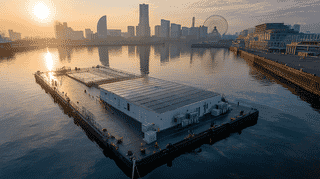
On March 25, 2026, five partners, NYK Line, NTT Facilities, Eurus Energy, MUFG Bank, and the City of Yokohama, launched a world-first floating data center powered entirely by solar panels and batteries at Yokohama Port. How does this off-grid demonstration differ from the MOL-Hitachi used-ship concept, and what does it say about Japan's answer to the AI power crisis?
The shutdown of Qatar's LNG facilities due to Middle East conflict has wiped out 30% of global helium supply. Without helium, dry etching, essential for all advanced chips, physically cannot function. South Korea's memory makers face a 5-month countdown, and the U.S. no longer has a strategic reserve to cushion the blow.
Global chip sales hit $88.8B in Feb 2026, up 61.8% YoY. Yet Japan is the only region with 9 consecutive months of decline. We analyze the structural reasons behind Japan's stagnation amid the AI-driven global boom.
Microsoft announced a $10 billion investment in Japan by 2029 to expand AI data centers, strengthen cybersecurity, and train 1 million engineers. We explore the partnerships with SoftBank and Sakura Internet, Japan's sovereign AI strategy, and why US tech giants are racing to invest across Asia.
Japan's shipping giant MOL and tech conglomerate Hitachi have agreed to jointly develop floating data centers by converting used ships. Using seawater cooling to slash power costs, needing no land, and deployable in just one year, these maritime server farms offer a creative answer to the AI era's insatiable appetite for computing power.
NTT has developed multi-core optical fiber technology that quadruples submarine cable capacity without changing cable structure. Achieving 192 cores (48 fibers × 4 cores) with deployment targeted for 2029, this Japanese innovation addresses the explosive data demands of the AI era. We explore the technology alongside Big Tech's submarine cable investment race.
AT Tokyo and elleThermo successfully demonstrated waste heat power generation using Semiconductor-Sensitized Thermal Cells (STC) in a live data center. This Science Tokyo-born technology generates electricity directly from low-grade heat at just 30-40°C — no temperature differential required. A look at how this could reshape data center energy efficiency amid soaring AI power demands.
Shinko Electric Industries is entering the photonic-electronic convergence manufacturing market as an OSAT, targeting CPO projects that TSMC won't take. With expertise in advanced packaging and optical alignment, this Japanese company aims to become the go-to manufacturer for Co-Packaged Optics — the technology set to slash AI data center power consumption by half. We break down the CPO race, NTT's IOWN initiative, and why NVIDIA, Intel, and AMD are all betting on light.
SoftBank CEO Masayoshi Son has announced a $500 billion AI data center campus at a former uranium enrichment site in Ohio—the largest single-site investment in history. With 21 Japanese and American companies involved and 9.2 GW of gas-fired power, this project reshapes the global AI infrastructure race. Here's what Japan thinks.
Kioxia has developed foundational 3D DRAM technology using IGZO oxide semiconductors, signaling the NAND-only maker's bold entry into the DRAM market. Behind this challenge: exploding AI demand and the physical limits of current memory. We break down the competition with Samsung, SK hynix, and China's CXMT.
Furukawa Electric's Lightera begins mass production of the world's highest-class 13,824-core ultra-high-density fiber optic cable. Learn how this Japanese innovation doubles transmission capacity for hyperscale AI data centers.
Australian data center giant AirTrunk has expanded its Japan investment to over $8 billion. We analyze the paradox of how Japan's population decline is creating prime opportunities for AI infrastructure, examine the 'Data Center Ginza' cluster in Inzai, and compare Japan's position with Singapore and Southeast Asia.
Kioxia's Q4 net profit surged 17x year-over-year as NAND flash prices skyrocket. AI-driven demand for HBM is squeezing memory supply for smartphones, PCs, and automobiles — creating a global shortage that may last until 2028. We analyze the competitive landscape with Samsung, SK Hynix, and Micron, and Kioxia's post-IPO growth strategy including its NVIDIA partnership for next-gen AI SSDs.
The NTT-led IOWN Global Forum has signed a comprehensive partnership with ETSI, Europe's telecom standards body, revealed at MWC Barcelona 2026 and following a February tie-up with the Open Compute Project. Where does a photonics-electronics technology promising one hundredth the power and one two-hundredth the latency stand in a 6G standards race between the US, China and Europe? A look at the forum's 170-plus members and its roadmap.
Japan's Ministry of Internal Affairs and Communications has joined the AI-RAN Alliance, an international consortium turning cell towers into AI processing hubs. With SoftBank, NVIDIA, Samsung, and other tech giants on board, this move signals Japan's commitment to distributed AI infrastructure and its strategic positioning in the US-China tech race heading into the 6G era.
Japan's Fair Trade Commission raided Microsoft Japan over suspected antitrust violations in cloud computing. The investigation targets licensing practices that may have hindered competitors to Azure. We explore how this fits into the global wave of Big Tech regulation, from the EU's Digital Markets Act to the US FTC probe and UK CMA scrutiny.
The explosive growth of AI data centers is creating a golden age for power electronics. With tens of thousands of GPUs fluctuating power equivalent to a nuclear plant by over 50%, Japanese makers like Mitsubishi Electric, Fuji Electric, and Toshiba see a massive opportunity. Includes US and Europe comparisons.