💡 Shine blue light on a cell-sized bubble of fat, and the genetic machinery inside starts making mRNA. Switch to ultraviolet, and it stops, then starts cutting up what it already made. Most earlier systems used light only to switch production on and off. A team led by Tohoku University has now added a brake that light can press.
A bubble that behaves a little like a cell
The "artificial cell" in this study is not alive. It's a giant unilamellar vesicle, or GUV: a capsule about the size of a real cell, wrapped in the same kind of double layer of fatty molecules that surrounds our own cells. Researchers load it with DNA, enzymes and other parts, then check whether the mix can do something cell-like on its own. It doesn't grow or divide like a living cell. It's a test bench for one function at a time.
The function under test here is gene expression, the process every cell uses to turn instructions into products. DNA is copied into mRNA (messenger RNA) in a step called transcription, and the mRNA then serves as the template for building a protein. Researchers in Japan call systems of this kind "molecular robots": groups of molecules designed to receive a signal and respond, rather than machines with motors and arms.
For the bigger picture, a group of Asian labs laid out a 10-year plan this year to build a synthetic cell that can sustain itself. We covered that roadmap here.
Why "off" was the hard part
According to the research team, most earlier light-based control amounted to an on-off switch for making mRNA. The catch is that switching transcription off does nothing about the mRNA already sitting in the capsule. It keeps being read, and protein keeps being made. It's a car with an accelerator and no brake. Lifting your foot doesn't stop you.
Living cells get around this by clearing out mRNA constantly. In a large study of mouse fibroblast cells, the median mRNA half-life was about 9 hours (Schwanhäusser et al., Nature, 2011). That steady turnover is what lets a cell turn a protein down once it's no longer needed.
One molecule, two colors, two jobs
The new system, published in the journal ChemSystemsChem on September 17, 2026, gets both pedals out of a single light-sensitive piece of DNA. The eight authors are from Tohoku University, Nagoya University and JAMSTEC, the Japan Agency for Marine-Earth Science and Technology.
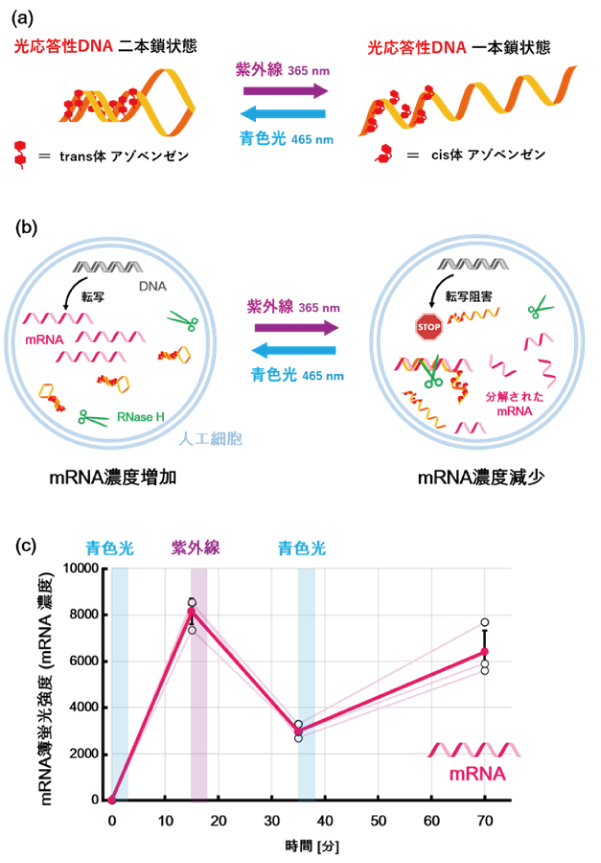
The key ingredient is azobenzene, a small organic molecule that changes shape depending on the color of light that hits it. Under blue light (465 nm) it lies flat; under ultraviolet light (365 nm) it bends. The team attached azobenzene to a strand of DNA. When the azobenzene is flat, it slips between the DNA's bases and holds the strand folded into a stable hairpin. When it bends, the hairpin loosens and more of the strand hangs open as a single strand.
That open form does two things at once. It gets in the way of T7 RNA polymerase, the enzyme that copies DNA into mRNA, so transcription is held back. And it latches onto mRNA already present, which brings in RNase H, an enzyme that cuts RNA only where it is paired with DNA. Blue light folds the DNA back up and lets transcription resume.
Source: Tohoku University (figure labels in Japanese)
In test-tube experiments, mRNA fell to 36.5% of its level 20 minutes after UV exposure, then rose again once blue light was applied. The team also showed that controlling mRNA this way controlled how much protein got made. Finally, they sealed the system inside GUVs, illuminated them, collected the capsules and measured what was inside. The mRNA had gone up or down as instructed.
The published figure shows only one round: blue, then UV, then blue again. The release doesn't say how many times the switch can be repeated. And the measurements inside the capsules were taken after collecting them, not watched in real time.
A lab that has been working with light for years
In 2017, the same Tohoku group, led by associate professor Shin-ichiro M. Nomura, reported an "amoeba-like" molecular robot in Science Robotics. It was a capsule tens of micrometers across whose shape-shifting could be started and stopped by DNA signals released with light. In 2019, Nomura's group published a study with Ken Komiya, then at the Tokyo Institute of Technology and now a researcher at JAMSTEC, that used light to start a DNA-amplifying reaction inside artificial cells.
Japan's molecular robotics community says it was the first in the world to propose the idea of a "molecular robot," and it moved early on ethics as well. Researchers in the field, working with bioethicists, drafted an ethics code for molecular robotics in 2018, and the community approved a revised version in March 2019. Komiya co-authored a 2022 study looking at how that code was written and taken up by the research community. So the marine-science agency's name on this paper reflects a collaborator on DNA reactions who has worked with Nomura's group since at least 2019. Nothing in the paper involves the deep sea.
Optogenetics, the light-control technique many readers may already know, works differently. It inserts genes for light-sensitive proteins into living neurons, which then switch on or off within milliseconds when light hits them. It was shown with a protein called channelrhodopsin in 2005, and its pioneers received the Japan Prize in 2023. The Tohoku system works on a different layer: no living cells and no engineered proteins, just chemistry that raises or lowers the amount of one mRNA over tens of minutes.
The distance between this and "pinpoint therapy"
The university's press release closes on a hopeful note: molecular robots that make medicine "when needed, where needed, in the amount needed," with fewer side effects. That's a fair description of the goal. It's not what has been shown.
The first problem is the light itself. Ultraviolet barely penetrates tissue, and blue light only about 1 mm. One modeling study found the deepest penetration, about 5.4 mm, at 750 nm in the near-infrared (Ash et al., Lasers in Medical Science, 2017). UV can also damage biomolecules, and the researchers acknowledge the problem. As of October 2026, their stated next step is to move to molecules that respond to visible or near-infrared light.
There's a size problem as well. Long mRNAs, the kind needed for large proteins, fold into complex shapes that resist cutting, so the brake can't yet bring them down far enough. The team expects that designing the DNA to grab the mRNA at more points will help. And so far, everything has happened in test tubes and lipid capsules, not in animals or people.
What the study does establish is that a capsule can be told both to make a message and to get rid of it, using only two colors of light. Living cells do that without thinking. Synthetic ones mostly couldn't.
Most talk about futuristic medicine is about getting a drug to the right place. This study is about knowing when to stop. Where you live, when people get excited about "smart" medicines, does anyone ask how the treatment gets switched off?
References
- https://www.tohoku.ac.jp/japanese/2026/10/press20261007-03-photocontrol.html
- https://www.tohoku.ac.jp/japanese/newimg/pressimg/tohokuuniv_press20261007_web03_photocontrol.pdf
- https://doi.org/10.1002/syst.70057
- https://www.tohoku.ac.jp/japanese/newimg/pressimg/tohokuuniv-press20170228_02web.pdf
- https://www.titech.ac.jp/news/2019/045032
- https://www.jamstec.go.jp/j/about/press_release/20221021/
- https://pmc.ncbi.nlm.nih.gov/articles/PMC5653719/
- https://www.japanprize.jp/data/prize/2023/e_2_achievements.pdf
- https://bionumbers.hms.harvard.edu/bionumber.aspx?id=106378








Global Discussion
4 comments