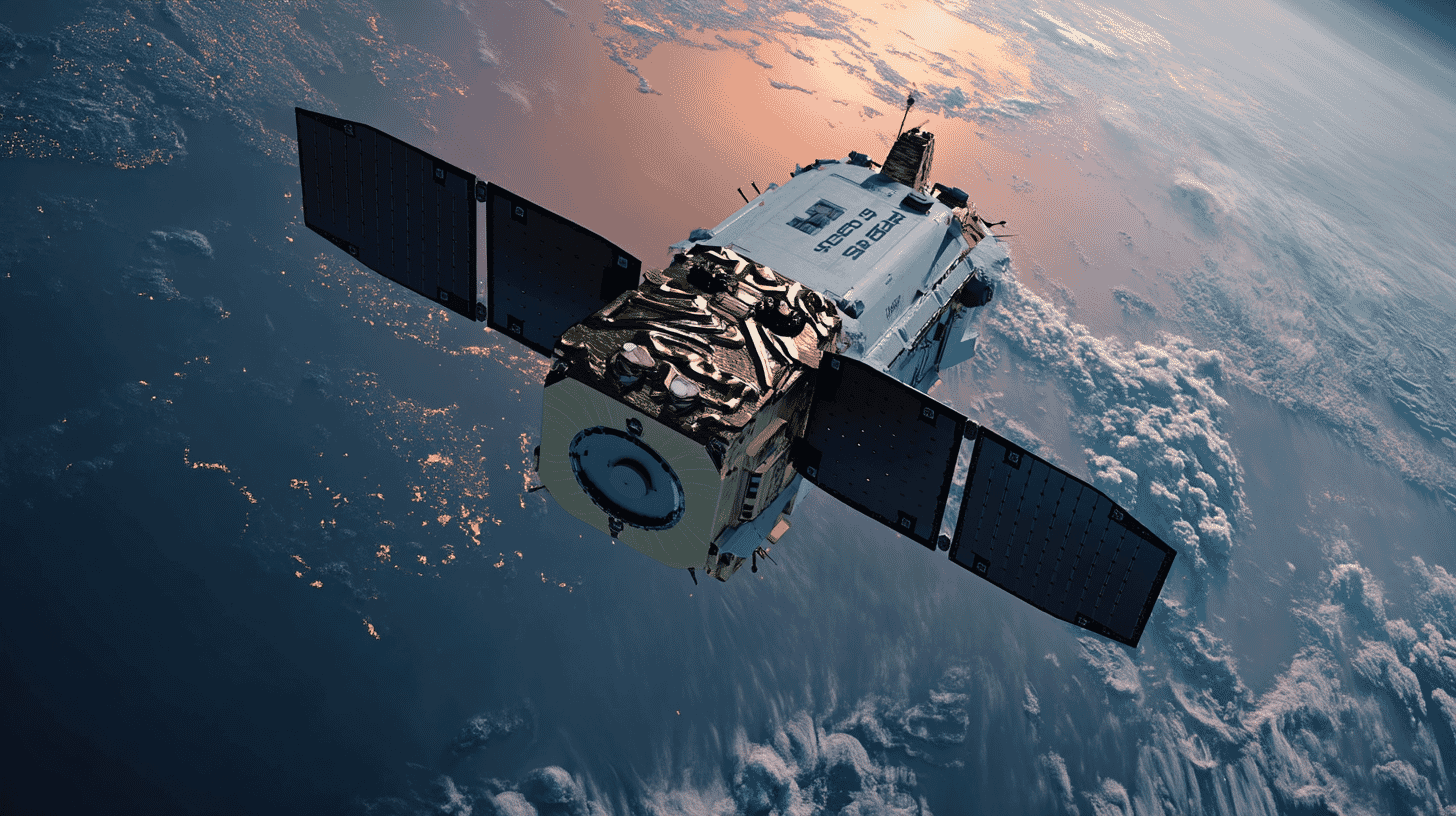
The invisible junk orbiting Earth could knock out your GPS, your weather forecast, and your internet, all at once. That scenario is closer than it sounds. About 130 million pieces of space debris are hurtling around our planet at speeds of 17,000 mph, threatening the satellites that underpin modern life. A Japanese startup called Astroscale wants to become the world's first "space safety patrol."
The company just announced its ISSA-J1 mission, which will approach and inspect two separate pieces of satellite debris in different orbits during a single flight. No private company has attempted this before. Here is why it matters, and how Japan is positioning itself at the front of a new space economy.
The Space Junk Crisis: Why It's Everyone's Problem
Space debris, defunct satellites, spent rocket stages, and collision fragments, has been accumulating since the dawn of the space age. According to ESA's 2025 Space Environment Report, over 39,000 objects are now tracked in Earth's orbit, and that number jumped by more than 7,400 in 2024 alone. But the tracked objects are just the tip of the iceberg: ESA estimates there are roughly 1.2 million pieces between 1 and 10 cm, and about 130 million fragments between 1 mm and 1 cm.
The most alarming concept in this field is the "Kessler Syndrome," named after NASA scientist Donald Kessler, who warned in 1978 that cascading collisions could eventually make certain orbits unusable. In simple terms: one collision creates thousands of fragments, each of which can cause another collision, creating an exponential chain reaction.
This isn't hypothetical anymore. SpaceX has reported that its Starlink satellites performed over 144,000 collision avoidance maneuvers in a recent six-month window, roughly one every two minutes, around the clock. In 2024 alone, several major fragmentation events added over 3,000 newly tracked objects. Scientists now believe debris levels in key orbital zones between 520 and 1,000 km altitude are already at or near the point where they could sustain runaway growth.
For those of us on the ground, this matters because satellites are the invisible backbone of daily life, GPS navigation, weather prediction, internet service, financial transactions, even agriculture and disaster response all depend on functioning satellite networks.
Astroscale: The "Roadside Assistance" Company for Space
Astroscale was founded in 2013 by Japanese entrepreneur Nobu Okada. After attending an academic conference in Germany where experts discussed the space debris problem but offered no concrete plans of action, Okada founded the company just ten days later. It was a remarkably decisive response to a problem that had been largely stuck in the academic realm.
Headquartered in Sumida, Tokyo, with operations in the UK, US, France, and Israel, Astroscale is the world's first private company dedicated exclusively to on-orbit servicing. The company went public on the Tokyo Stock Exchange Growth Market in June 2024 (ticker: 186A), and as of March 2026 its market capitalization stands at roughly ¥139 billion.
Astroscale's service offering covers four key areas:
ISSA (Inspection): Approaching orbital objects to diagnose their condition up close, essentially a patrol car that drives to the scene of an incident in space.
ADR (Active Debris Removal): Capturing defunct objects and guiding them into atmospheric reentry for safe disposal.
EOL (End-of-Life Services): Removing satellites from orbit before they become debris, preventing the problem at its source.
LEX (Life Extension): Refueling and repairing satellites to extend their operational lifespan, reducing the need to launch replacements.
Think of it as comprehensive "roadside assistance" for space, the kind of service infrastructure that exists for cars on highways but has never existed for the increasingly crowded orbital highways around Earth.
ADRAS-J: Proving the Technology Works
Astroscale's credibility rests on actual missions, not just plans. The most significant is ADRAS-J (Active Debris Removal by Astroscale-Japan), selected by JAXA for Phase I of its Commercial Debris Removal Demonstration program.
Launched in February 2024, ADRAS-J targeted a decommissioned H-IIA rocket upper stage from 2009, a bus-sized piece of space junk roughly 11 meters long, 4 meters in diameter, and weighing about 3 tons. Crucially, this was an "uncooperative" target with no docking mechanisms or guidance systems, making the mission far more challenging than approaching a cooperative satellite.
Over ten months, ADRAS-J achieved a series of groundbreaking milestones. It detected the target from hundreds of kilometers away using onboard cameras, progressively closed the distance to 50 meters, conducted multiple fly-around observations from different angles, and ultimately achieved a closest approach of approximately 15 meters in November 2024, the closest any commercial spacecraft has gotten to a piece of space debris through autonomous rendezvous and proximity operations.
When an unexpected attitude anomaly of the debris was detected during the final approach, the spacecraft's onboard collision avoidance system automatically executed an abort maneuver and safely retreated, demonstrating exactly the kind of safety technology needed for real-world debris removal missions.
The data collected is now informing the design of ADRAS-J2, which will attempt to actually capture and deorbit the same rocket stage.
ISSA-J1: The Space Safety Patrol Takes Shape
In March 2026, Astroscale announced ISSA-J1, a mission that takes the concept further. Rather than approaching just one piece of debris, this spacecraft will visit two different decommissioned Japanese satellites in separate orbits during a single mission. This would be a world first for any private company.
The logic is practical: if on-orbit servicing is going to be commercially viable, a single service vehicle needs to handle multiple jobs per trip, just as a highway patrol car doesn't return to base after every incident. ISSA-J1 is designed to demonstrate this capability.
The mission is backed by Japan's SBIR program, a government initiative supporting startup-led R&D, with Phase II funding of up to ¥6.31 billion. The programme runs through Phase III, scheduled to continue until March 2028 at the latest. The spacecraft is currently in its assembly phase and is scheduled for launch in 2027 aboard an Indian PSLV rocket from the Satish Dhawan Space Centre, the first dedicated PSLV launch ever procured by a Japanese company.
How Astroscale Compares to Global Competitors
Astroscale isn't the only company working on this problem, but it has a distinct edge.
ClearSpace (Switzerland/ESA): The ESA-backed startup secured a contract worth about $121 million for its ClearSpace-1 mission, which aims to capture and deorbit a piece of debris using four robotic arms. Originally planned for 2025, the target was changed to the PROBA-1 satellite and the launch has been pushed to 2028. ClearSpace is also competing with Astroscale for UK Space Agency debris removal contracts.
SpaceX: As the operator of Starlink's massive constellation, SpaceX has built sophisticated autonomous collision avoidance systems. However, SpaceX is not in the debris removal business, and with thousands of satellites in orbit, the company is simultaneously part of the congestion problem it's managing.
TransAstra (US): This American startup is developing a "Capture Bag" concept, a large enclosure that wraps around debris for potential recycling in space. It's an innovative approach but remains in early stages.
Northrop Grumman: Their Mission Extension Vehicles (MEV) have demonstrated satellite life extension through docking with geostationary satellites, but their focus is on high-value GEO assets rather than debris removal.
Astroscale's advantages are clear:
First, proven flight heritage. With ELSA-d (2021) demonstrating magnetic capture docking and ADRAS-J (2024) achieving the closest-ever commercial approach to debris, Astroscale has more hands-on RPO experience than any competitor.
Second, a comprehensive service portfolio. While most competitors focus on one aspect, removal or inspection or life extension, Astroscale covers all four pillars of on-orbit servicing.
Third, commercial traction. In March 2025, Airbus placed an order for over 100 second-generation docking plates from Astroscale UK, marking the first large-scale commercial order for hardware that makes future satellite servicing possible. As of December 2025 the company's order backlog stood at ¥41 billion, made up of ¥27 billion in signed contracts and ¥14 billion in awards not yet contracted, spanning JAXA, the US Space Force, ESA, the UK Space Agency, and Eutelsat OneWeb.
Japan's Evolving Position in the Space Economy
Astroscale's rise reflects a broader shift in Japan's space industry. Traditionally dominated by government-led programs through JAXA, the sector is now seeing a wave of entrepreneurial activity.
Companies like ispace are pursuing lunar exploration, Interstellar Technologies is developing small launch vehicles, and AstroX is working on balloon-launched rockets. Together with Astroscale, these companies represent a new generation of Japanese space ventures that are competing globally in niche but strategically important markets.
Astroscale's specific niche, on-orbit servicing, could prove to be among the most important as the space economy matures. As satellite operators launch ever-larger constellations, they'll need reliable, commercially available services for inspection, maintenance, and end-of-life disposal. Astroscale is building the infrastructure for this future.
CEO Okada has also emphasized the importance of shaping international rules, not just building technology. At the company's IPO, he stated that Astroscale is pursuing both technical development and rule-making for sustainable space use simultaneously, positioning Japan as a leader not only in space technology but in space governance.
In Japan, space development tends to be associated with rocket launches and JAXA missions. But the less glamorous work of keeping orbits clean and functional may matter more for the long-term future of space.
What's happening in your country when it comes to space debris? Should taxpayers fund orbital cleanup, or should the companies that launch satellites bear the cost? We'd love to hear your thoughts.
References
- https://prtimes.jp/main/html/rd/p/000000101.000067481.html
- https://www.astroscale.com/ja/solutions/issa
- https://www.esa.int/Space_Safety/Space_Debris/ESA_Space_Environment_Report_2025
- https://www.astroscale.com/en/news/astroscales-adras-j-achieves-historic-15-meter-approach-to-space-debris
- https://en.wikipedia.org/wiki/Astroscale
- https://clearspace.today/







Global Discussion
15 comments