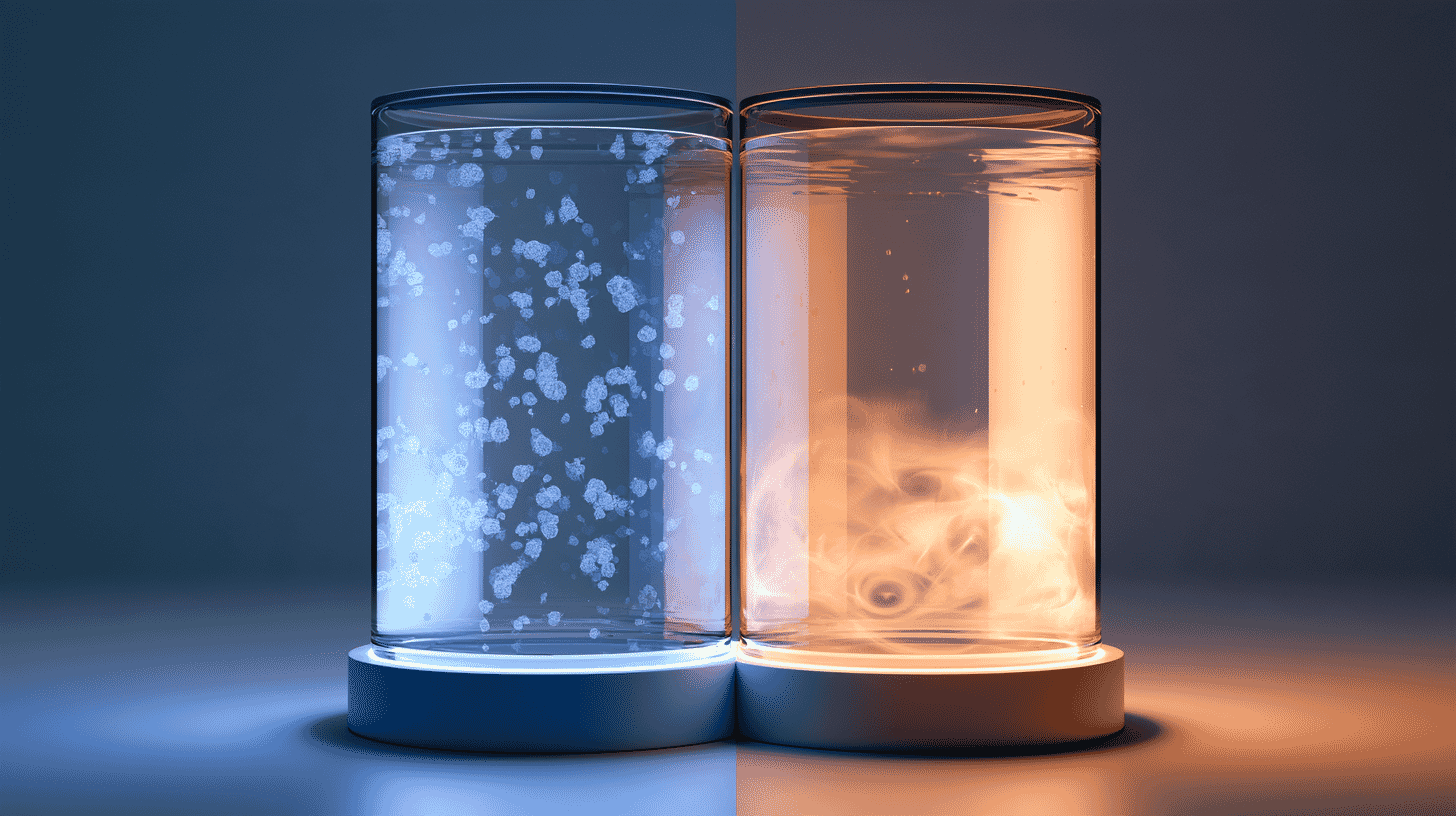
🧪 Japan has started treating patients with products made from iPS cells. The next problem is less glamorous: growing huge numbers of those cells without damaging them. A fluid dynamicist at the University of Osaka wants to throw out the stirring blade and leave half the container empty. NASA, whose rotating bioreactor dates back to the 1980s, did the opposite.
Cells don't like being stirred
The standard way to grow iPS cells in bulk is suspension culture: the cells float in a tank of nutrient broth instead of sticking to a dish. Left alone, they sink and clump, so the broth is stirred, usually by an impeller, a propeller-like blade. As Yomiuri Shimbun noted when it reported the Osaka work, the blade's force can injure the cells and slow their growth. RIKEN describes the bind in engineering terms: stir faster to mix evenly, and the shear stress around the blade rises until some damage is unavoidable.
On March 6, 2026, Japan's health ministry gave conditional, time-limited approval to the world's first two iPS-derived products, RiHEART (Cuorips) and Amchepry (Sumitomo Pharma). In July 2026, the national pricing council approved a reimbursement price of ¥53.2 million (about $338,000) for RiHEART. It was calculated with the cost-accounting method, which builds the price up from what the product costs to make. Under that method, cheaper ways to grow cells can feed straight into what a treatment costs.
Lay the cylinder down, fill it halfway
Daiki Watanabe, a specially appointed researcher (fluid dynamics) in Professor Susumu Goto's lab at the University of Osaka's Graduate School of Engineering Science, fills a cylindrical vessel about halfway with culture medium, lays it on its side and turns it slowly. Swirls form on their own and mix the liquid gently, with no blade. His prototype holds 200 mL.
Watanabe, a computational fluid dynamics specialist who used to be a researcher at a chemical company, explains on his crowdfunding page why the halfway mark matters. Spin a vessel filled to the brim and the liquid just turns along with it. Nothing mixes. Half-fill it, and a vortex appears that turns in a different direction from the vessel and keeps going.
Physicists had seen swirls like these before; a 2017 numerical study showed them, and Watanabe's own paper cites it. What he, Goto and a co-author added, in a 2024 article in the Journal of Fluid Mechanics, was a map of when these "convection cells" appear and persist. The cells spin on axes perpendicular to the cylinder's rotation, and the paper's discussion notes the setup might be useful for cell culture.
NASA kept the air out
Turning a cylinder on its side to grow cells is not new. One well-known version took shape at NASA's Johnson Space Center. After the Challenger disaster on January 28, 1986, grounded the shuttle fleet, engineers David Wolf, Ray Schwarz and Tinh Trinh were stuck with a problem: moving the medium created turbulence that killed delicate cells. Rotating the vessel wall itself, they realized, could keep cells suspended without turbulent flow. The device became a way to mimic microgravity on the ground, and Wolf later used one as an astronaut aboard the Mir space station.

Source: NASA Spinoff
That design depends on zero headspace, meaning no air gap at all. A 2019 paper from Temple University explains why: the rotating wall vessel relies on the fluid turning like a solid body, and a single bubble deflects the flow and adds turbulence and shear.
NASA wanted that solid-body motion so cells could drift gently, as if weightless. Watanabe's 2024 paper notes that a liquid-only rotating cylinder always settles into it, which is why a full vessel won't mix. He wants the liquid to churn, so he keeps the air in.
Japan's race to stir better
In January 2024, RIKEN and Satake MultiMix reported about 10 billion cells at 2-liter scale, using an oval plate that moves up and down instead of a spinning blade. In November 2025, a team from the same university's Graduate School of Engineering and the company ZACROS described a 10-liter system that stirs only now and then, in a thickened medium that holds cell clumps in place between stirs. It reached about 10.9 billion cells (1.09 x 10^10). In April 2026, Panasonic Holdings began testing a machine that automates the step of creating iPS cells, at a CiRA Foundation lab in Osaka.
Beyond 200 milliliters
Watanabe reports on his crowdfunding page that the 200 mL prototype gave roughly six times the yield of conventional shaking culture. That result was in a different cell type, not iPS cells, and we could not find the figure in a published paper. His next design is 1,000 mL. Tubing can't be connected to a vessel that keeps turning, and heating, cooling and oxygen supply get harder. At 200 mL, the whole device sat in a temperature-controlled room, and the vessel material made oxygen bubbling unnecessary.
To pay for the next machine, Watanabe ran the first crowdfunding campaign at Osaka's Graduate School of Engineering Science. It closed on October 23, 2026, with ¥4,029,000 (about $25,600) from 169 donors, above its ¥3 million target.
Yasuyuki Sakai, a professor of biochemical engineering at the University of Tokyo, told Yomiuri that getting rid of the blade is a real plus for delicate iPS cells, but that practical use hinges on whether culture efficiency improves in larger vessels. The rival systems above already run at 2 and 10 liters.
In Japan, the price of these therapies goes through a government pricing council, and public insurance covers it. How are cell therapies paid for where you live, and would you chip in to a lab's crowdfunding to make them cheaper?
References
- https://readyfor.jp/projects/bladeless-bioreactor
- https://doi.org/10.1017/jfm.2024.443
- https://spinoff.nasa.gov/node/10683
- https://www.ncbi.nlm.nih.gov/pmc/articles/PMC6686703/
- https://www.riken.jp/press/2024/20240116_2/index.html
- https://www.frontiersin.org/articles/10.3389/fbioe.2025.1664723/full
- https://sj.jst.go.jp/stories/2026/s0518-01p.html
- https://www.mhlw.go.jp/content/10808000/001726219.pdf
- https://www.ajinomoto.co.jp/company/en/ir/news/news-20261016/main/00/link/20261016_E.pdf
- https://news.panasonic.com/jp/press/jn260420-1






Global Discussion
3 comments