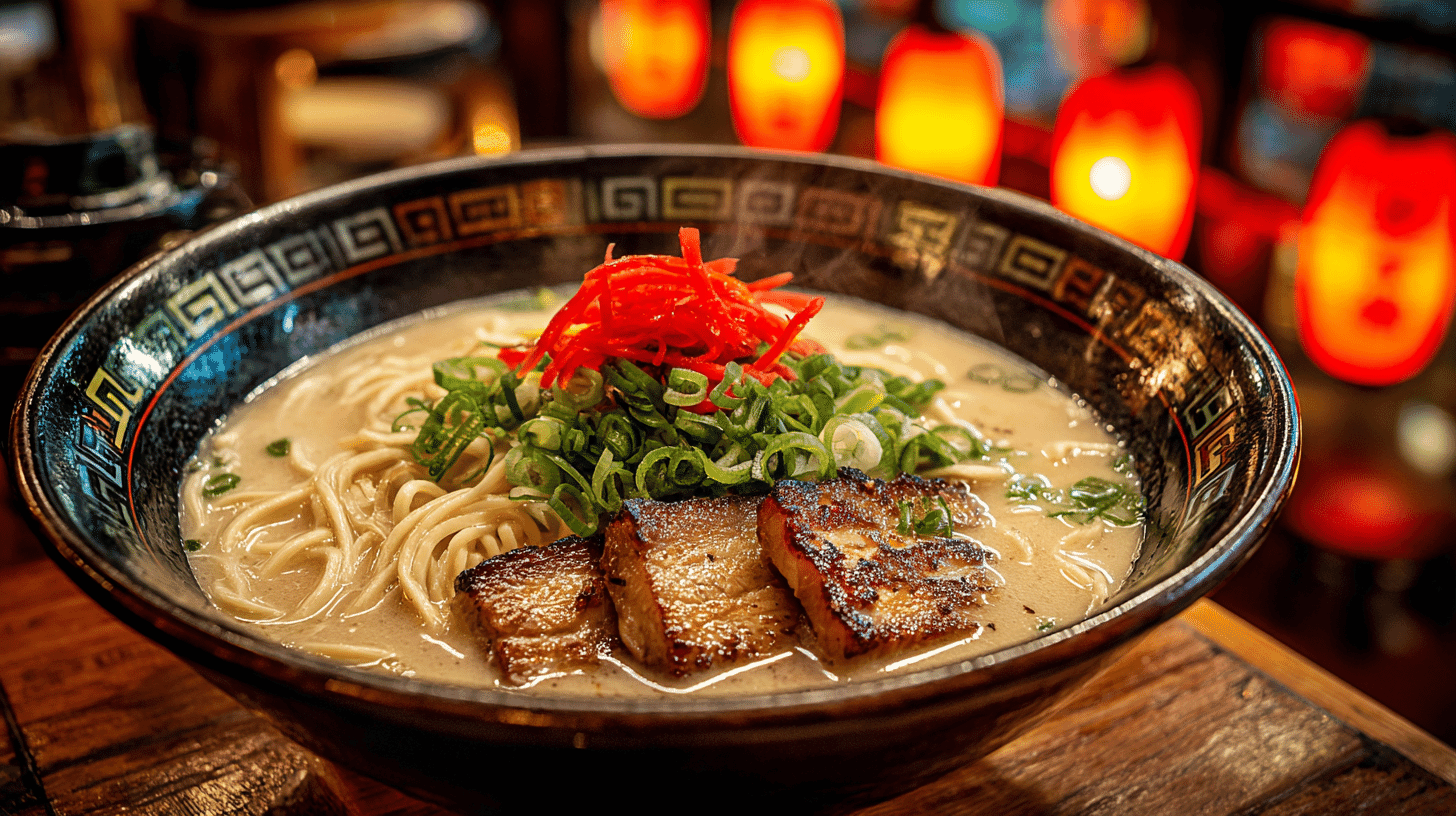
🍜 Order tonkotsu ramen outside Japan and you will probably get the bowl Ichiran and Ippudo made famous: creamy, white, and almost odorless. In Kurume, the city in Fukuoka Prefecture where the style began, the best-known shops serve a thicker, stronger-smelling soup than Hakata's, and one of them says its pot has never been emptied since the day it opened. In autumn 2026 a Japanese ramen critic reported that this stronger kind of tonkotsu is slowly catching on in Tokyo. So what is that smell, and why did the version that went global leave it behind?
A street stall in Kurume, 1937
Tonkotsu means "pork bone." The word describes the stock, not the seasoning. According to the Shin-Yokohama Ramen Museum, the first ramen in Kyushu was served in 1937 at Nankin Senryo, a street stall in Kurume, about 40 km from Fukuoka City. Its soup used pork bones, but it was not white. The founder is said to have trained in Yokohama's Chinatown, and Chinese soup noodles were traditionally made with a clear broth.
The white version came later, and its origin story is a kitchen accident. In 1947, the museum says, the owner of another Kurume shop, Sankyu, went out and left someone else to watch the fire. The pot was boiled too hard and the stock turned milky. The details change depending on who tells it, and Hakata has a claim of its own: the museum also records a tradition that cloudy pork-bone soup first appeared in 1946 at a Hakata shop called Akanoren, and it tells of a Hakata cook who had tasted a cloudy pork soup as a soldier in China and set out to recreate it.
The museum traces the ramen of Kumamoto, Miyazaki, Oita and Kitakyushu back to Sankyu, and passes on a saying that Kagoshima is the only part of Kyushu whose ramen does not descend from Kurume.
5 towns, 5 different bowls
The table follows the museum's descriptions, and every town has exceptions.
| Style | Soup | Noodles and extras |
|---|---|---|
| Kurume | Pork bones boiled hard. The best-known shops are thicker and smellier than Hakata's, though lighter ones exist | Straight, slightly thicker than Hakata's. Nori and wood-ear mushroom on top; grated garlic, red pickled ginger and sesame on the counter. Many shops have no kaedama |
| Hakata | Mostly pork bones and nothing else, boiled hard for hours | Very thin, straight, low-moisture noodles in small portions. Green onion, sesame, red pickled ginger, often spicy pickled mustard greens. Kaedama is standard |
| Nagahama | Now very close to Hakata | Thin noodles. Kaedama is standard |
| Kumamoto | Many shops add chicken bones, so the soup is milder | Thicker noodles. Garlic is cooked before use, as fried chips or as mayu, a garlic oil. No kaedama; order a large instead |
| Kagoshima | Pork bones with chicken and vegetables, simmered gently, so the soup is only half cloudy | Pale, soft noodles made without kansui (alkaline water). Fried green onion and bean sprouts. Pickled daikon and a small pot of tea on the side |
Ganso Nagahamaya opened in the early 1950s in Nagahama, Fukuoka's fish-market district. Market workers were in a hurry, so the noodles got thinner to cook faster. Thin noodles go soft quickly, so portions shrank and the noodle refill, kaedama, was born, or so the story goes.
Outside Kyushu, Yokohama and Wakayama have pork-bone ramen of their own. Yokohama's iekei style, which goes back to a shop called Yoshimuraya in the 1970s, pairs a pork-bone-and-soy-sauce soup with chicken fat and thick noodles. Wakayama's Ide Shoten lineage is also pork bone and soy sauce, and the museum says it too began with a pot that was boiled down by mistake. Kyushu tonkotsu, by contrast, is seasoned with salt or light soy sauce.
Where the smell comes from
The white color is emulsion. When pork bones are boiled hard, gelatin from the bones gets into the liquid and the fat emulsifies, so the stock turns white.
The smell is a separate matter, and it is a choice. Food journalist Rikiya Yamaji, writing on the magazine site @DIME, explains the difference between torikiri and yobimodoshi. In torikiri, the pot is emptied after each day and started fresh the next morning. Soup made this way has little odor. In yobimodoshi, the pot is never emptied. Fresh stock and bones are added to the old soup, which matures and smells stronger. Yamaji calls Kurume ramen the leading example of the method. The technique comes from Taiho Ramen, a Kurume shop that began as a stall in 1953, and the name was given to it by the founder's successor.
In June 2026 a team from Kyushu Sangyo University and the RIKEN BioResource Research Center published a peer-reviewed paper on this in Nippon Shokuhin Kagaku Kogaku Kaishi, the journal of the Japanese Society for Food Science and Technology. The old-style shops with a strong sour, gamey smell all used yobimodoshi. Their soup contained Sulfophobococcus zilligii, an archaeon (a kind of microbe distinct from bacteria) that thrives in extreme heat, and the data suggest it multiplies during boiling and produces isovaleric acid and isobutyric acid, the main components of the aroma. The authors say this may be the first known fermented food to involve such an organism.
None of this means the soup has gone off. Yamaji likens the mechanism to natto and kusaya, a pungent dried fish, and says the smell is deliberate, not a failure of preparation.
Why the tonkotsu you know is milder
Ippudo and Ichiran, the two chains named at the start, were both built on removing that smell. Hakata Ikkousha, by contrast, cooks its soup by adding fresh stock to matured soup, a method much like yobimodoshi, and its website lists more than 60 shops in 10 countries.
Ippudo was founded in 1985 in Fukuoka's Daimyo district. As The Japan Times reported in 2017, tonkotsu shops then were known for the 3 Ks, kusai, kitanai, kowai (smelly, dirty and intimidating), which kept women away. Founder Shigemi Kawahara simmered the soup for many hours to remove the odor, modernized the interior and played jazz. Ippudo's first overseas restaurant opened in New York in 2008, and the company's then-president told the paper in 2017 that the amount of oil, the saltiness and even the length of the noodles were tuned for each country. As of October 2026, Ippudo was in 16 countries and regions, Japan included.
Ichiran, founded in Fukuoka in 1960, lists tonkotsu soup without the smell as one of its 5 originals. The company explains that simply boiling bones produces odor, so it removes the scum slowly. It reached New York in 2016, and as of June 2026 it had 93 restaurants (85 in Japan, 8 overseas).
Even so, the old style is hard to scale. In a book excerpt published by Bunshun Online in June 2026, a Japanese ramen writer put the number of Tokyo shops serving it at only a handful. Yobimodoshi soup changes constantly and depends on experience and feel, so it is hard to teach and hard to turn into a chain. Hours of hard boiling also run up gas and water bills, no small thing in an industry where bankruptcies keep piling up. Yamaji adds that complaints from neighboring shops and homes make it hard to find a location, even in Fukuoka.
Kaedama, firmness and the order sheet
Kaedama is a second helping of noodles dropped into the soup you have left, so do not drink it all first.
Noodle firmness runs from bariyawa (very soft) through yawa, futsu (regular) and katamen (firm) to barikata and harigane, literally "wire." "Bari" is Hakata dialect for "very." Regulars sometimes go further: konaotoshi, where the noodles are dipped just long enough to rinse off the flour, or yugedoshi, where they only pass through the steam and are not boiled at all.
On the counter, red pickled ginger is there to cut the fat and the pork smell. At Ichiran you fill in an order sheet at your seat. It has 7 items (noodles, dashi, richness, chashu, green onion, secret red sauce, garlic) and comes in English, Korean and Chinese.
Is Tokyo really coming around?
Tokyo has picked the milder bowl before. Yamaji writes that when Kyushu tonkotsu first reached the city, in the postwar boom years, the smelly kind did not catch on and the odorless kind did. From the late 1980s, the museum notes, a tonkotsu boom led by Hakata ramen swept the Tokyo area. Yamaji's own article, published on October 31, 2026, runs under a headline about a big boom, but the text says the trend is growing slowly, and it names 9 Tokyo shops. The Bunshun Online excerpt a few months earlier called such shops a handful. Whether 9 counts as a boom or a handful depends on who is counting.
Some dishes smell like a warning and taste like a reward. What is that dish where you live, and would you queue for it?
References
- https://dime.jp/genre/2166718/
- https://bunshun.jp/articles/-/89396
- https://www.jstage.jst.go.jp/article/nskkk/73/6/73_NSKKK-D-25-00049/_article/-char/ja/
- https://www.raumen.co.jp/rapedia/study_japan/study_raumen_kurume.html
- https://www.raumen.co.jp/rapedia/study_japan/study_raumen_hakata.html
- https://www.raumen.co.jp/rapedia/study_japan/study_raumen_kumamoto.html
- https://www.raumen.co.jp/rapedia/study_japan/study_raumen_kagoshima.html
- https://www.raumen.co.jp/rapedia/study_japan/study_raumen_wakayama.html
- https://www.raumen.co.jp/rapedia/study_japan/study_raumen_yokohama.html
- https://newscast.jp/smart/news/3428669
- https://www.gov-online.go.jp/hlj/ja/november_2024/november_2024-00.html
- https://www.gov-online.go.jp/hlj/ja/november_2024/november_2024-04.html
- https://digitalpr.jp/r/144674
- https://www.japantimes.co.jp/news/2017/10/16/business/corporate-business/ippudo-ramen-chain-credits-global-success-localized-tastes
- https://ichiran.com/company/profile.html
- https://ichiran.com/company/history.html
- https://ichiran.com/ganso/
- https://www.gltjp.com/ja/directory/item/13406/
- https://www.ikkousha.com/
- https://livejapan.com/ja/in-tokyo/in-pref-tokyo/in-tokyo_train_station/article-a0003253/


Global Discussion
0 comments