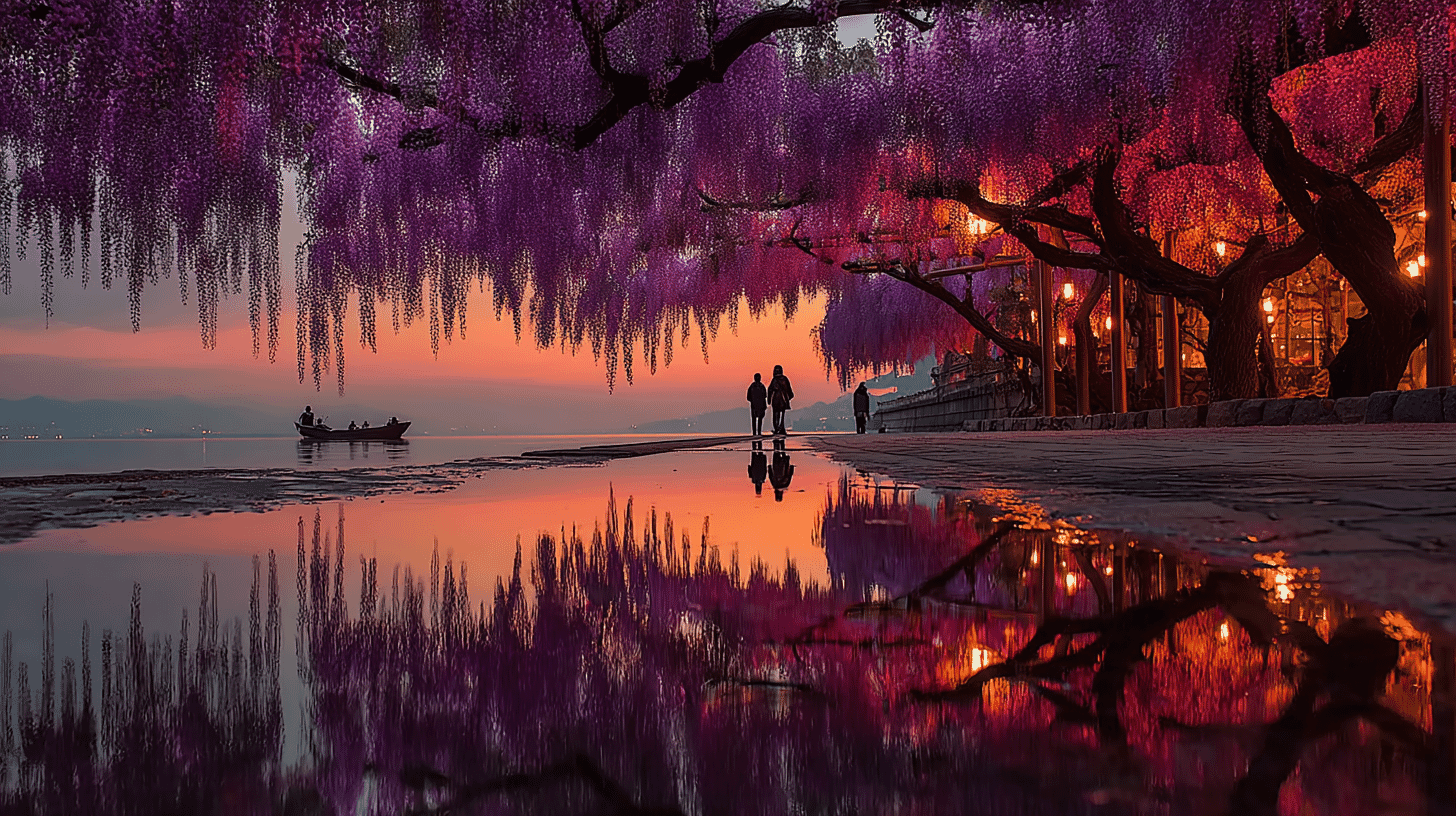
Once the cherry blossoms fall, the sky over Tsushima City in Aichi Prefecture turns purple. A 275-meter wisteria trellis, mirror-like reflections on the water below, nighttime illuminations straight out of a Studio Ghibli film. Tennogawa Park is under half an hour from Nagoya by train, and it hosts the Owari Tsushima Wisteria Festival every year from mid to late April. Here's the spring spectacle worth visiting after sakura season.
The "Village of Wisteria Waves"
Tucked into the western edge of Aichi Prefecture, Tsushima City has long been known as "Fujinami no Sato," the Village of Wisteria Waves. True to the name, cascading wisteria has been part of the city's identity for centuries. Each year from mid to late April, that heritage comes alive at the Owari Tsushima Wisteria Festival, held at Tennogawa Park.
Tennogawa Park was built around Maruike, an oval-shaped pond that formed when the old Tennogawa River was dammed. In spring, cherry blossoms give way to wisteria just before Golden Week (Japan's late April holiday stretch), handing the park from one bloom to the next.
A Purple Canopy by the Numbers
The wisteria trellis at Tennogawa Park ranks among the largest in Japan. Stretching 275 meters (902 feet) long and covering roughly 5,034 square meters (about 1.2 acres), it supports 114 individual wisteria plants across 12 different varieties. When they bloom in unison, it looks as though the sky itself has been swapped for a ceiling of purple flowers.
The star variety is the "kyushaku fuji" (nine-foot wisteria), named for its extraordinarily long flower clusters that hang like purple chandeliers. Walking beneath them as they sway gently in the breeze, filling the air with their sweet jasmine-like fragrance, engages more senses than a photograph can carry.
The "Inverted Wisteria" on the Water
Beneath the trellis runs a narrow canal, and on calm days the wisteria blooms are reflected perfectly on the still water below. This phenomenon, known as "sakasa fuji" (inverted wisteria), is one of the festival's most iconic sights. The purple flowers appear to extend both above and below, and the waterline between them disappears.
For photographers, it's an irresistible subject. Every April, social media fills with images of this reflected wisteria, often going viral both in Japan and abroad.
Nighttime Illuminations
During the festival, the entire trellis is illuminated from 6:30 PM to 9:00 PM each evening. Lit blossoms float against the darkness, their reflections shimmering on the water, and the evening breeze sends ripples through the hanging flowers.
Visitors often compare the scene to a Studio Ghibli film, with the blend of natural beauty and otherworldly quiet that Hayao Miyazaki's animations are known for. The twilight hours, when the sky shifts from sunset orange to deep blue behind the purple canopy, are widely considered the most magical time to visit.
Matcha and Festival Food
The festival is more than just flowers. Tsushima has a long tradition of casual matcha (green tea) culture, and during the festival, outdoor tea ceremonies are held beneath the wisteria trellis. Sipping freshly whisked matcha under a purple canopy is an experience that blends two quintessentially Japanese pleasures.
Near the Maruike pond area, food stalls serve up local specialties and classic festival fare. Look for Tsushima's famous lotus root products, local-style fried chicken, gohei mochi (grilled rice cakes with sweet miso glaze), and mitarashi dango (sweet soy-glazed rice dumplings), all easy to eat while walking. Expect to spend around 500 to 1,000 yen (roughly $3 to $6) per snack.
Getting There from Nagoya
From Meitetsu Nagoya Station, take a Tsushima Line through train to Tsushima Station. Express and semi-express services take roughly 23 to 28 minutes; local trains take about 33 minutes. The one-way IC fare is 460 yen (around $2.90 at mid-2026 rates). From Tsushima Station, it's a 15-minute walk to the park.
By car, take the Higashi-Meihan Expressway to the Yatomi IC, then drive about 15 minutes. Roads around the park get congested during the festival and parking is limited, so both the city and the park urge visitors to come by train. The park lot holds 300 cars and charges 1,000 yen (about $6); the paid period and collection points shift with the bloom.
2026 Festival Information:
- Dates: April 15 (Wed) – April 29 (Wed, holiday), 2026; subject to change with the bloom
- Venue: Tennogawa Park (1-chome Miyagawa-cho, Tsushima, Aichi)
- Illumination: 6:30 PM – 9:00 PM
- Admission: Free
- Official site: https://tennogawa-park.com/
Wisteria in Japanese Culture, from Heian Nobility to Demon Slayer
Wisteria, called "fuji" in Japanese, carries centuries of cultural significance that goes far beyond its visual beauty.
During the Heian period (794–1185), aristocrats prized wisteria for its elegance, and the flower appears in classic literary works like The Tale of Genji and The Pillow Book. The Fujiwara clan, Japan's most influential noble family for centuries, incorporated wisteria into its family crest, cementing the flower's association with nobility and refinement. The word "fuji" also sounds like the Japanese word for "immortality," giving the flower auspicious connotations of longevity and prosperity.
In recent years, wisteria has gained massive international recognition through the global hit anime and manga series Demon Slayer (Kimetsu no Yaiba). In the story, demons cannot tolerate the scent of wisteria; the blossoms work as a natural repellent, much as garlic and crucifixes ward off vampires in Western folklore. The Demon Slayer Corps uses wisteria-covered mountains as natural prisons for captured demons, and wisteria scent sachets are given to vulnerable people for protection.
This fictional connection has real cultural roots. Wisteria belongs to the legume family, and in Japanese tradition beans (mame) are thrown at demons during the Setsubun festival to drive them away (the word "mame" also sounds like "destroying evil"). Wisteria is also a sun-loving plant, connecting it to another demon weakness: sunlight. And the plant does contain mild toxins in its seeds, adding a further layer of plausibility to the Demon Slayer lore.
For anime fans, visiting a wisteria festival during blooming season has become a form of "seichi junrei" (pilgrimage to sacred anime locations). Social media fills with posts declaring this or that wisteria garden "the real Fujikasane Mountain," the peak where Demon Slayer's hero, Tanjiro, takes his entrance exam.
Chasing Flowers After Sakura
Most international visitors plan their Japan trips around cherry blossoms, but sakura's peak lasts only one to two weeks. Miss it, and you might arrive to bare branches.
Wisteria season conveniently follows about two to three weeks after cherry blossoms, making late April through early May an ideal window for travelers who want guaranteed spring beauty. Beyond Tsushima, Japan offers world-class wisteria viewing at Ashikaga Flower Park in Tochigi Prefecture and Kawachi Fuji Garden in Fukuoka Prefecture.
Japan's spring-to-summer flower relay runs roughly like this: cherry blossoms (pink, late March – mid April) → wisteria (purple, mid April – early May) → roses (various, May – June) → hydrangeas (blue and purple, June – July). Following this natural calendar is one of the most rewarding ways to experience "hanami," the Japanese art of appreciating seasonal flowers.
In Japan, wisteria is beloved as the "next flower" after cherry blossoms fade. Does your country have a tradition of chasing seasonal blooms? Is there a favorite flower destination where you live? We'd love to hear about it.





Global Discussion
15 comments