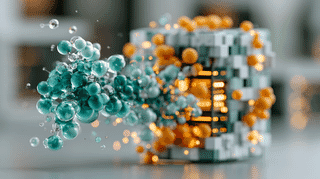
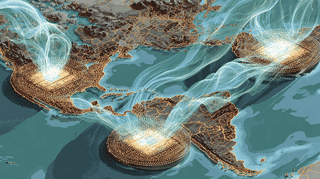
Hoku Energy K.K., the Japanese subsidiary of UK-based Hoku Infrastructure, will build Japan's first new-build 100% hydrogen mono-firing thermal power plant in Aomori Prefecture. The 106.6MW Daiichi Plant, awarded under Japan's 3rd Long-Term Decarbonized Power Source Auction, is scheduled to start operations in the early-to-mid 2030s. We compare it with hydrogen power efforts by Plug Power, MHI in Utah, Linde, Air Liquide, and South Korea's Doosan, and explain what it means for Japan's GX strategy.
On May 19, Japan's ruling LDP unveiled a policy proposal calling for stablecoins and tokenized deposits to be treated as national financial infrastructure — and added to PM Takaichi's Big-Boned Policy in June. We compare Japan's approach with the Web3 hubs of Singapore, Hong Kong and the UAE.
NEC has completed the East Micronesia Cable System (EMCS), a 2,250-kilometer optical submarine cable that gives three Pacific island nations their first-ever fiber connectivity. For Tarawa, Nauru, and Kosrae, roughly 100,000 people who had only known the 600-millisecond delay of satellite internet, the upgrade is transformative. The backstory is equally striking: in 2018, China's HMN Tech (formerly Huawei Marine) underbid NEC and Alcatel Submarine Networks by more than 20%. A 2020 US diplomatic warning to Micronesia, the World Bank's withdrawal, and a 2021 Japan-US-Australia rescue plan rewrote the project. Five years later, the cable is in the water.
Brazilian Foreign Minister Mauro Vieira visited Japan on May 17–19 for the inaugural Japan-Brazil Foreign Ministers' Strategic Dialogue. Here's what oil-dependent Tokyo wants from South America's resource giant amid the Hormuz crisis.
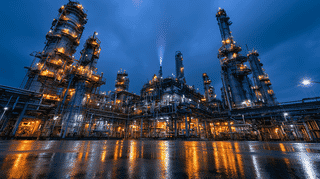
Kawasaki Heavy Industries has begun pitching a technology that produces naphtha, the building block of plastics, from hydrogen instead of crude oil. Built on its commercial gas-to-gasoline plant in Turkmenistan, the proposal lands in the middle of a Japanese petrochemical crisis triggered by the Strait of Hormuz disruption.
TSMC's Japanese subsidiary JASM posted a quarterly profit of NT$951 million (about $30 million / ¥4.78 billion) in Q1 2026, the first time the Kumamoto fab has been in the black since mass production began in December 2024. We unpack what the 14-month turnaround means against the backdrop of Japan's ¥1.23 trillion in subsidies, the Sony-Denso-Toyota partnership, TSMC's Arizona and Dresden expansions, and Rapidus's high-stakes 2nm bet.
Anthropic's Head of Global Affairs Michael Sellitto arrived in Tokyo May 15 and confirmed the company is weighing participation in the cyber defense corporate alliance proposed by Japan's ruling LDP. Modeled on US Project Glasswing, the framework will test Japan's distinctive 'middle path': an AI Promotion Law with no penalties, sitting between the EU AI Act's hard regulation and the deregulatory turn under the Trump administration.
The SI second hasn't changed since 1967. By 2030 it likely will. From Earth's rotation to atomic vibrations to optical transitions: this is the history of how we've defined the second, and a field guide to the candidate atoms and national labs racing to define it next.
PM Sanae Takaichi pledged to effectively double research funding and build a 'new technological nation' targeting AI, semiconductors and quantum, and the Japan Growth Strategy carrying those measures was adopted by cabinet on July 21, 2026. We look at the 17 strategic fields and 62 priority technologies against the reality of Japan's 3.44% R&D-to-GDP ratio and its falling PhD numbers.
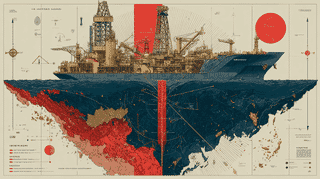
Japan's ruling LDP has asked the government to build a dedicated rare earth mining vessel for ~100 billion yen ($640M) at Minamitorishima, handing the proposal to Prime Minister Takaichi on June 12, 2026. Why JAMSTEC's Chikyu isn't enough, the roadmap from the February 2027 demonstration test to FY2028 industrialization, and how Japan's approach compares with the US, EU and Australia.
About 283,000 barrels of Azerbaijani crude procured by ENEOS arrive at Negishi Refinery in Yokohama on May 12 — the first Central Asian crude ever to reach Japan. We unpack the type of oil, Azerbaijan's production capacity, and the wider patchwork now stitched together from the US, Mexico, Russia (Sakhalin-2), and beyond — plus the paint-thinner shortage that won't go away.
Honda's Zero EV brand launches its first model—the 0 Alpha compact SUV—in India by early 2027, exporting back to Japan. After cancelling three North American EVs and posting record losses, Japan's #2 automaker is betting on Rajasthan over Ohio. We unpack the gamble, the rivals waiting in India, and why this could rewrite Japanese EV strategy.
At a Fireblocks event in Tokyo, SMBC Group CDIO Kazuho Isowa and Mitsui & Co.'s Shinsuke Waka outlined Japan's on-chain finance strategy. January 2028 will bring simultaneous tax and financial-law reforms. ZipangCoin is going cross-border on public chains. And 95% of JPYC trades are now executed by AI. We compare Japan's cooperative model with JPMorgan's $5 billion-a-day Kinexys.
Sony Semiconductor Solutions has signed an MOU with TSMC to form a next-generation image sensor joint venture. Why is the 51% market leader pairing with Taiwan instead of going it alone? We compare it with the US CHIPS Act, EU Chips Act, and Korea's K-Chips Act, and explore the Apple-Samsung tug-of-war shaping the physical-AI era.
Reuters reported that Japan conducted multiple yen-buying interventions during the May Golden Week, exploiting thin holiday liquidity. Market estimates put the total at roughly 10 trillion yen including the April 30 operation; the Ministry of Finance later confirmed 11.7349 trillion yen, a record for a yen-buying episode. Vice Finance Minister Mimura said IMF rules do not constrain intervention frequency. Within a month the effect had faded and the yen was back at 161 to the dollar.
Japan's vacuum equipment leader ULVAC is reshoring production of vacuum melting furnaces for rare earth magnets, with orders from US and European manufacturers projected to roughly triple. With over 70% global share in continuous vacuum furnaces, Japan's equipment dominance becomes a geopolitical asset.
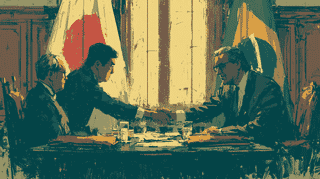
On May 4 in Canberra, PM Takaichi and PM Albanese signed five joint documents including the Economic Security Joint Declaration. Six critical mineral projects backed by $1.2B. How Japan's approach differs from the US IRA and EU CRMA, and what it means for global supply chains.
On May 1, Japan's METI met infrastructure operators from the power and gas sectors, and Economy Minister Akazawa asked electricity companies to run emergency system inspections and report within a month. The order covers 24 critical-infrastructure operators in the power sector. The trigger was Anthropic's Claude Mythos Preview, announced April 7, which surfaced a 27-year-old bug chain in OpenBSD's TCP SACK code among others. The UK's AISI reached a more measured verdict. How Japan's penalty-free approach compares with CISA's OT principles and the EU's NIS2.
Two months into the de facto closure of the Strait of Hormuz, Japan took its first Russian crude cargo since the blockade began. Taiyo Oil bought Sakhalin-2 barrels on a spot contract at the request of Japan's energy agency, and the tanker reached Imabari on May 4. How the "Sakhalin exception" to the G7 and EU price cap works, how Germany, South Korea and India have played the same shock differently, and what it all reveals about Japan's structural exposure.
On May 2, Japanese PM Sanae Takaichi met Vietnam's new PM Le Minh Hung in Hanoi. Amid Middle East instability, Japan agreed to underwrite crude purchases for the Nghi Son refinery through NEXI, the first project under the Power Asia framework, and to work with Hanoi on rare earths and other critical minerals. In a speech at Vietnam National University, Takaichi set out three pillars for an evolved Free and Open Indo-Pacific: supply chains, shared rules, and security. How it differs from US friendshoring and the EU's Global Gateway.