Honda faces its first-ever annual loss since going public in 1957, with up to $15.7 billion in EV-related write-downs. Three flagship EVs cancelled, Sony-Honda AFEELA scrapped, and China sales declining for 25 straight months. We break down the crisis, analyze Honda's hybrid pivot and May 2026 strategy reveal, and share Japanese and global reactions.
An in-depth look at Woven by Toyota, the software subsidiary steering Toyota's transformation. From the Arene platform's debut in the new RAV4 to the $1B Woven City experiment, we analyze how Toyota is fighting Tesla and BYD in the SDV era.
Trump tariffs triggered a massive production shift by Toyota, Honda, Nissan, and Subaru from Japan to the US. With $35 billion in annual tariff costs industry-wide, we explore each maker's strategy, the impact on 5.5 million Japanese jobs, and how this echoes the 1980s trade wars.
DENSO and the University of Tokyo signed a 10-year partnership starting April 2026 centered on Dynamic Wireless Power Transfer (DWPT). Learn how charging EVs while driving could shrink batteries, cut costs, and reshape energy infrastructure — plus how Japan's approach compares to Sweden, Israel, and the US.
With Artemis II home safely, we look at Japan's contributions to lunar exploration: Toyota's Lunar Cruiser, MHI's regenerative fuel cells, Bridgestone's lunar tires, and the rest of the hardware keeping crews alive on the Moon.
Japan's Rohm, Toshiba, and Mitsubishi Electric have announced merger talks for their power semiconductor businesses. If realized, the combined entity would hold ~10% global market share, ranking second only to Germany's Infineon. We analyze the Denso $8.3B counter-bid, EV and renewable energy demand, and what this means for global chip competition.
Toyota Group's ¥5.9 trillion ($39B) tender offer for Toyota Industries — the founding company of the Toyota empire — has been completed, making it Japan's largest-ever domestic acquisition. We explore the Elliott Investment standoff, two price hikes, and what this means for Japanese corporate governance reform.
Fusion power, maglev trains, and hydrogen aircraft are driving a resurgence in Japan's high-temperature superconductor (HTS) technology. Fujikura is investing $750M+ to boost wire production up to 8x, Toshiba partners with Airbus on superconducting motors, and Toyota integrates HTS into hydrogen cars. As competition with U.S. giant CFS intensifies, Japan's deep HTS supply chain emerges as a critical global asset.
Toyota announces mass production of water electrolysis systems by 2029, developed with Chiyoda Corporation. With 5MW domestic and 20MW international units, Toyota bets on hydrogen alongside EVs and hybrids. How Japan's multi-pathway strategy compares to the global EV-first approach.
Asahi Kasei has begun installing its Aqualyzer C3 containerized alkaline water electrolyzer in Jyväskylä, Finland — the country's first commercial hydrogen station. Backed by a Toyota-linked foundation, this marks a significant entry for Japanese electrolyzer technology into the Nordic green hydrogen market dominated by European giants like Siemens Energy and Nel ASA.
Spider silk — five times stronger than steel by weight — is finally becoming a mass-produced reality. U.S.-based Kraig Biocraft targets 10 tons per month while Japan's Spiber partners with 45+ brands. Explore Super Silk's potential in fashion, medicine, and defense, and how this bio-revolution is unfolding.
Honda announces its first-ever net loss since going public, with losses of up to $43 billion from scrapping three North American Honda 0 Series EVs, acquiring LG battery joint venture assets, and writing down Chinese operations. With cumulative losses potentially reaching $157 billion, this signals a seismic shift in Japan's EV strategy. Analysis covers Toyota's hybrid vindication, the failed Nissan merger, executive pay cuts, and what it means for the global auto industry.
Denso proposed a tender offer for Rohm worth up to 1.3 trillion yen (about $8.2 billion), then withdrew it in April 2026 after Rohm's special committee declined to endorse the deal. Consolidation has shifted to a Rohm-Toshiba-Mitsubishi Electric alliance. Here is the competitive picture against Infineon, onsemi, and China's fast-rising players.
Nintendo approved a secondary offering of up to 338.2 billion yen ($2.2 billion) as four major shareholders, the Bank of Kyoto, Nomura Trust, Resona Bank and DeNA, unwound their strategic stakes. What is Japan's cross-shareholding system, and why is it being dismantled now? A look at the governance shift reshaping Japanese corporations, from Toyota's $19 billion unwind to the record 9.77 trillion yen sold in 2025.
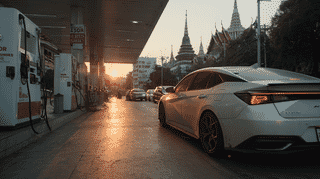
Thailand's BEV sales turned negative in 2024 while hybrid sales surged nearly 50%. Falling resale values, thin charging infrastructure and retreating Chinese brands exposed the limits of the EV boom. As markets from Bangkok to Berlin recalibrate, Toyota and Honda's multi-pathway strategy looks better than it did. A data-led look at the EV slowdown across Thailand, China and Europe.
Trump's auto tariffs have shaken Japan's major automakers to the core. Mazda posts its first loss in 5 years, Honda's car division sees record losses. A deep dive into their earnings, the tariff damage in dollars, and early signs of recovery.
Kyocera, Toyota, Denso and three other major Japanese firms have formed a consortium to promote the deployment of 760MHz ITS roadside communication units. By accelerating V2X technology — enabling vehicles and roads to "talk" to each other wirelessly — the initiative aims to support Japan's 2030 goals of reducing traffic fatalities and scaling Level 4 autonomous driving to 10,000 vehicles.
Japanese automakers are moving beyond the era when ashtrays were the only standardized parts. Facing EV competition and European rivals, Toyota, Honda, Nissan, and others are now pursuing cross-company standardization of steel, semiconductors, and plastics.
Trump tariffs in 2025 caused Japan's top 7 automakers (Toyota, Honda, Nissan, Suzuki, Mazda, Subaru, Mitsubishi) to lose ¥1.5 trillion in just 6 months. Nissan, Mazda, and Mitsubishi fell into the red. Learn how Japan's core industry is adapting to this "new normal."