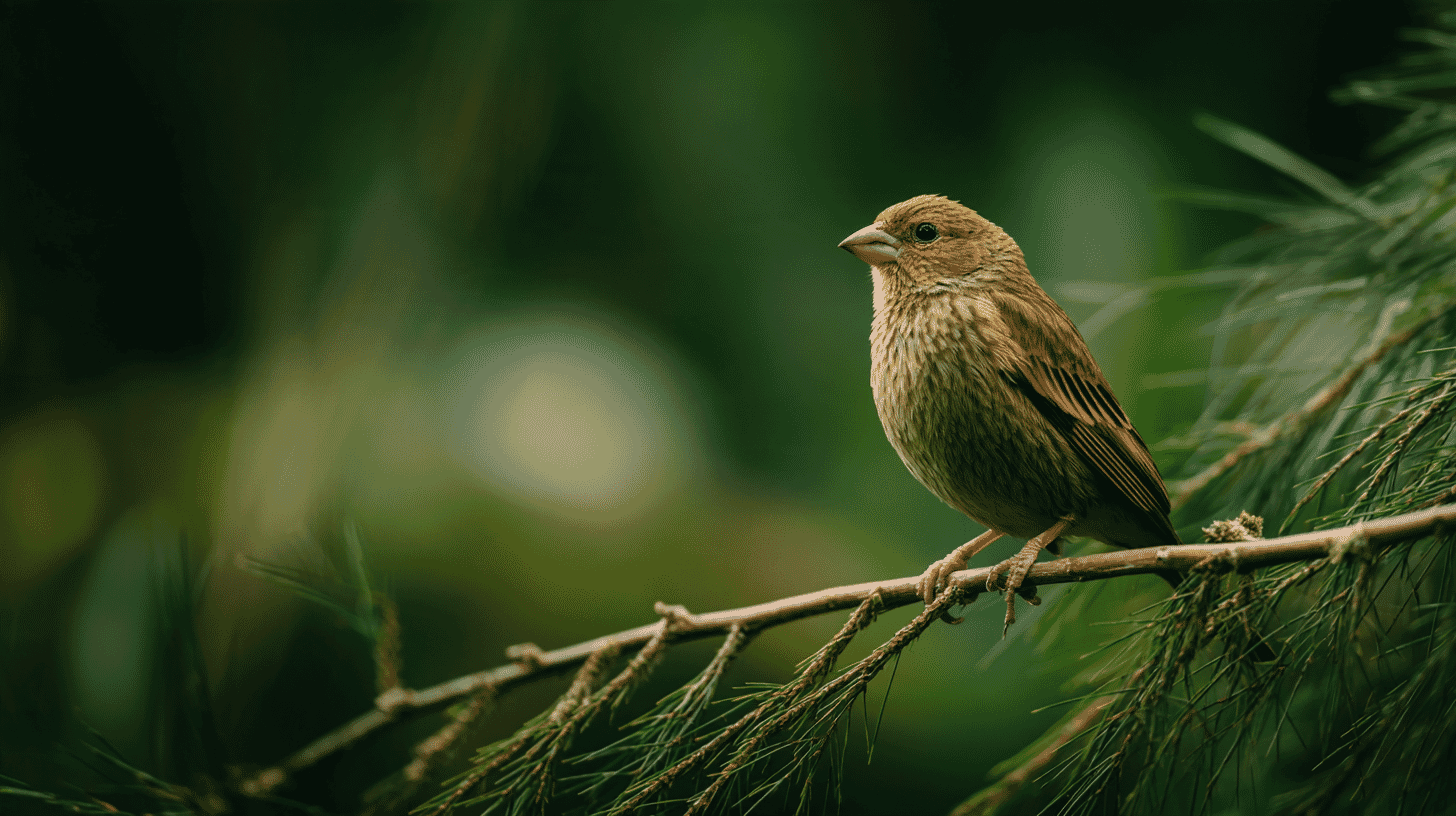
Until 2021, no one had ever kept an Ogasawara greenfinch in captivity, according to the team that started doing it that year. Only about 200 are thought to survive in the wild, on a few small islands far out in the Pacific. In 2026, 16 chicks fledged in captivity, and five of them had parents that were born in captivity too.
Called Japan's closest bird to extinction
The Ogasawara Islands, also called the Bonin Islands, are about 30 volcanic islands roughly 1,000 km south of Tokyo. Isolated far out at sea, they are home to many species found in the wild nowhere else, and UNESCO made them a World Natural Heritage site in 2011. Administratively, they are part of Tokyo.
The Ogasawara greenfinch (Chloris kittlitzi) is a sparrow-sized finch, about 13 cm long, olive green with yellow patches on the wings. For decades it was filed as a subspecies of the Oriental greenfinch, a common garden bird across East Asia. In 2020, a DNA study by the Yamashina Institute for Ornithology and its partners showed the island line had split off about 1.06 million years ago. The institute proposed it as a full species, which took the count of bird species endemic to Japan from 10 to 11.
The bird once bred across the archipelago. In the wild, it now breeds in just two places: a cluster of small islands around Hahajima, and Minami-Iwoto, more than 250 km away. Japan's environment ministry, in a Red Data Book entry published in March 2026, estimates about 100 breeding birds in each and rates the species Critically Endangered. Some specialists call it the Japanese bird closest to extinction, withnews reports. Counts for a bird this scarce carry wide margins; Yamashina's own 2020 estimate was 400 or fewer.
On the islands around Hahajima, population density fell to about a tenth between around 1996 and 2020. Camera-trap sightings fell to 20 to 30 percent of the 2017 level by 2020. Without conservation measures, the Red Data Book says, the Hahajima population could vanish in about 15 years.
Rats, and a tree that does not belong
Every island reached by black rats has lost its breeding population. The islands around Hahajima where the bird hangs on have no black rats but do have brown rats, which raid nests less often yet are considered the main cause of the recent decline. On Hahajima itself, feral cats catch birds feeding on the ground. Goats stripped forests in the past, and in years of typhoons or drought, seed crops can drop sharply.
The greenfinch used to nest in native trees. Now its nests are found almost only in Casuarina equisetifolia, a tree introduced to the islands. According to the Red Data Book, the reason is the trunk: it grows straight, and rats struggle to climb it. Tokyo's government adds that the birds now eat a lot of casuarina seed as well.
In 2021, Japan adopted a recovery program for the species under its endangered species law. It covers rat control on the islands around Hahajima, stronger cat control in southern Hahajima, and a captive population as backup.
Keeping a bird nobody had kept
Captive work began in 2021 on Chichijima, the main inhabited island, at a facility run by the Tokyo government's environment bureau and its Ogasawara branch office. A local nonprofit, the Ogasawara Shizen Bunka Kenkyujo, joined in. According to withnews, the Asahi Shimbun's feature site, the team started with a basic question: could people keep this bird at all? What it ate through the year, and how it bred, were known only in pieces.
For four years, no pairs bred. The team says each failure showed them what the birds needed and what to avoid.
The turn came in 2025. In March, Ueno Zoo in central Tokyo took in two birds from Chichijima. On June 26, a chick fledged at the nonprofit's facility; three others died. Three more fledged at the metropolitan facility in early July, and two at Ueno on July 14, which Tokyo says was a first for any zoo. Six in all, every one from wild-born parents.
Source: Tokyo Metropolitan Government (press release, July 29, 2025)
In 2026, withnews reports, four pairs at three facilities raised 16 fledglings. Tokyo's own releases give only partial counts. Five of the 16 came from parents that had themselves hatched in captivity. At Ueno, the father hatched on Chichijima on June 15, 2025, and the mother hatched at the zoo on June 30, 2025. One year later they had three chicks of their own.
One chick could not get enough food from its mother, so the keepers hand-reared it. It weighed about 2 grams when they started and passed 14 grams in about two weeks. It fledged.
As of August 26, 2026, Tokyo counted 7 birds at Ueno and 23 at the conservation facilities on Chichijima, and said it had no plans to put them on public display. In September, a young male bred at Ueno moved to Inokashira Park Zoo, also in Tokyo. By September 20 there were about 30 birds at four facilities.
Why habitat work alone is not enough
The long-term goal, withnews reports, is to release captive-bred birds and rebuild the wild population. The team's view is that the wild birds are now too few to recover fast enough through habitat work alone, so both have to move at the same time. One typhoon, one drought, a sudden jump in predators or a new disease could be enough to finish them. A member of the keeper team compared the species to a small boat drifting just short of the vortex.
The pigeon next door
The same islands already have one partial recovery. A figure of about 40 red-headed wood pigeons was sometimes cited in the 1990s, though the environment ministry's Red Data Book says that count may have been too low. After feral cats were removed from Chichijima's natural areas, young pigeons began to appear around 2012, and camera traps on Chichijima detected the birds 4.5 to 13.1 times as often in 2013 to 2017 as in 2010. The same entry says the increase has since stopped, and that mature birds still number only a few hundred. The captured cats are not killed: they are neutered and sent to Tokyo for adoption through the Tokyo Veterinary Medical Association, according to Japan's tourism agency. A-HANDS, a group that supports the effort, says more than 1,000 feral cats had been taken in by 2024.
Cats are a sensitive subject in Japan, as the environment ministry's reversal over listing cats as an invasive species showed. But the greenfinch's main enemy is the rat. There is no adoption program for rats. They have to be removed.
What kākāpō and ʻalalā say about the road ahead
When New Zealand's kākāpō recovery program began in 1995, there were 51 of the flightless parrots. On September 1, 2026, the Department of Conservation counted 325, after a season that added 90 chicks. The birds now breed on three islands, and a member of the recovery group says more predator-free habitat is needed.
Hawaiʻi's ʻalalā shows the other half of the problem. The last wild ʻalalā disappeared in 2002. A captive flock grew from about eight founders to more than 100. But birds released on Hawaiʻi Island in 2016 were hunted by the ʻio, a native hawk, and the survivors were taken back into captivity. In November 2024, five were released on Maui, an island without ʻio.
The Ogasawara greenfinch is at an earlier stage. It has shown it can breed in captivity across two generations. Whether those birds will have rat-free islands to go back to is a separate question.
Islands everywhere have lost birds to animals that arrived by ship. Is there a species like this where you live, and what is being done to keep it?
References
- https://www.asahi.com/articles/ASVBG2FWDVBGDIFI00GM.html
- https://www.env.go.jp/nature/kisho/5th-rl-2026/BI0036_RDB5th.pdf
- https://www.yamashina.or.jp/hp/p_release/images/20200527_prelease.pdf
- https://www.metro.tokyo.lg.jp/information/press/2025/07/2025072906
- https://www.metro.tokyo.lg.jp/information/press/2026/06/2026062410
- https://www.metro.tokyo.lg.jp/information/press/2026/08/2026082603
- https://www.vill.ogasawara.tokyo.jp/sightseeing/designmanhole/photoplate/photo07/
- https://www.mlit.go.jp/tagengo-db/common/001555283.pdf
- https://ikilog.biodic.go.jp/rl_rdb/a/777.html
- https://www.mlit.go.jp/tagengo-db/common/001555289.pdf
- https://www.a-hands.org/20250929-nekopurojekuto-reports/
- https://www.doc.govt.nz/news/media-releases/2026-media-releases/kakapo-population-reaches-new-milestone/
- https://www.npr.org/2025/02/18/nx-s1-5232008/hawaii-crow-species-maui-rare
- https://mauinow.com/2024/12/04/historic-first-release-of-%ca%bbalala-on-maui/






Global Discussion
4 comments