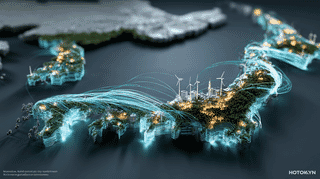
Chinese G.657.A2 optical fiber went from 32 yuan to 240 yuan per fiber-kilometer in a year, a 650% jump. The visible driver is AI data centers; the hidden one is disposable fiber-optic drones on the Ukraine front. China holds 60% of preform capacity, Japan leads on 13,824-core cables, and the US holds the hyperscaler demand.
By fiscal 2034, new data centers and semiconductor fabs will add peak electricity demand equal to seven nuclear reactors in Japan, with roughly 60 percent of capacity clustered around Tokyo and the connection queue backed up. The government's answer is Watt-Bit Integration. Set against Virginia's pricing fix, Ireland's renewables mandate, and Singapore's hard area cap, Japan's regional-distribution-plus-decarbonization bet comes into focus.
Kioxia and Sandisk have achieved a world-first technological milestone toward 3D NAND flash memory exceeding 1,000 layers. Their multi-stacked cell array CMOS (MSA-CBA) structure with wafer-to-wafer Cu direct bonding successfully demonstrated QLC operation, and will be unveiled at the VLSI Symposium 2026 in Hawaii this June. We break down the technology, the three-way stacking race against Samsung, SK hynix, and Micron, and what soaring AI data center demand means for the NAND market.
SoftBank Group plans to spin off and list 'Roze,' an AI and robotics company, on US markets at a target valuation of $100 billion. We unpack Masayoshi Son's strategy in the context of Stargate, his OpenAI commitments, how Japanese tech compares to US and Chinese giants, and the Middle East risk hanging over the timing.
Kao, famous for Biore and Attack, has brought its first overseas semiconductor cleaning center online in Hsinchu, Taiwan. Ajinomoto, the MSG maker, is putting over 25 billion yen into ABF insulation films that hold nearly 100% global share, and has bought land in Gifu for a third plant. How Japanese consumer goods companies, alongside Shin-Etsu, SUMCO, JSR and TOK, became indispensable to the AI chip supply chain, and how they compete with US, European, Korean, Taiwanese and Chinese rivals.
Fujitsu is doubling down on its sovereign AI strategy with the FUJITSU-MONAKA CPU series, choosing Rapidus as a manufacturing partner and 'coexisting' with NVIDIA's GPUs rather than competing. We compare Japan's hybrid approach to China's fully autonomous Loongson (LoongArch) and Europe's Arm-based SiPearl, revealing how Japan's pragmatic balance defines a third path in global chip sovereignty.
JAL launches Japan's first humanoid robot trial at Haneda Airport in May 2026. Chinese-made Unitree G1 and UBTECH Walker E will handle cargo loading and cabin cleaning, Japan's bipedal answer to its aging workforce and aviation labor crisis.
Submarine cables carry 99% of international data traffic, and roughly 90% of new construction is controlled by just three companies: SubCom (US), Alcatel Submarine Networks (France), and NEC (Japan). Japan now wants 35% of that market by 2030, and NEC's CEO is targeting 40%. We unpack the AI-era infrastructure race, the Taiwan Strait cable cuts, the exclusion of China's HMN, and why undersea cables have become the new front line of geopolitics.
Japan's Digital Agency open-sourced 'Gennai', its in-house government generative AI environment, under commercial-use licenses. With a 180,000-employee rollout planned for FY2026, we compare Japan's build-then-open approach with the US GSA's USAi platform, the UK's Humphrey suite, and the EU AI Act framework.
Resonac, the world's top supplier of back-end semiconductor materials, has fully launched US-JOINT, a 12-company Japan-US consortium R&D center in Union City, California. The goal: cut proof-of-concept cycles from six months to one, and plug directly into the custom AI chip development of GAFAM-class hyperscalers.
NEC has begun a strategic partnership with Anthropic, becoming the first Japanese company named as a global partner. The deal embeds Claude Opus 4.7 and Claude Cowork into NEC's BluStellar DX platform for banks, manufacturers, and local governments, and deploys Claude across roughly 30,000 employees. We break down NEC's three-layered AI strategy spanning its own cotomi LLM, the national Physical AI initiative, and now Anthropic, and examine why Tokyo's IT giants are hedging toward Claude over ChatGPT.
ZETA DIVISION's longtime VALORANT analyst gya9 gives his first major interview to eSports World, revealing how a LINE data scientist took an esports side gig that grew into a 5.5-year career behind Japan's historic Reykjavík 2022 bronze run. A deep look at the invisible role that powers competitive VALORANT, written for international fans who only see the players.
On March 25, 2026, five partners, NYK Line, NTT Facilities, Eurus Energy, MUFG Bank, and the City of Yokohama, launched a world-first floating data center powered entirely by solar panels and batteries at Yokohama Port. How does this off-grid demonstration differ from the MOL-Hitachi used-ship concept, and what does it say about Japan's answer to the AI power crisis?
On April 23, 2026, the Nikkei 225 crossed 60,000 intraday for the first time in history. We compare this milestone with the 1989 bubble peak at 38,915 yen, examining USD-based performance, the foreign ownership shift from 5% to 32.4%, the PER drop from 60x to 16x, and the heavy concentration in just a handful of AI and semiconductor stocks like SoftBank Group, which surged 9.6%.
Japan's METI announced a $377M subsidy for Sony's new image sensor factory in Kumamoto on April 17. With $1.13B total investment and production starting May 2029, this is Japan's counter-strike against Samsung's bid to break Sony's iPhone monopoly and capture the booming AI-camera and self-driving car sensor markets.
BlackRock, managing $14 trillion in assets, has taken a 5.28% stake in Komeda Holdings, the Nagoya-born coffee chain. Even in the AI era, people don't stop drinking coffee. We unpack why the world's largest asset manager is betting on Japan's food industry, looking at Komeda's unique franchise model and its global expansion story.
On April 16, 2026, the Nikkei 225 closed at an all-time high of 59,518, up 1,384 points. We break down the structural drivers: US-Iran peace hopes, S&P 500 crossing 7,000, BOJ April rate-hike odds collapsing from 55% to 30% after Finance Minister Katayama's rebuke, USD/JPY at 158, and a 16.5% surge from end-March. Plus the simultaneous rally in tech and regional bank stocks, DAX comparison, and the April foreign-flow anomaly.
Kyoto University's AI-powered robot monk Buddharoid now offers spiritual guidance at a Kyoto temple, trained on ancient Buddhist scriptures. With 30% of Japan's 77,000 temples projected to vanish by 2040, can artificial intelligence save Buddhism? From the $1M Mindar android to BuddhaBot chatbots reaching Bhutan, we explore where faith meets technology.
SoftBank, NEC, Honda, and Sony have established a new company to develop Japan's own AI foundation model, backed by $6.3 billion in government support over five years. Instead of competing head-on with US and Chinese tech giants in general-purpose AI, Japan is betting on 'Physical AI', AI that controls robots and factory equipment using the country's deep manufacturing expertise.
Japan's March 2026 startup funding ranking saw Startale Japan ($530M) and AI & AND ($500M) lead. With Pharos Network's $44M raise backed by Sumitomo and only ~9 unicorns vs. a 100-company target, we examine where Japan's ecosystem stands globally.