Japan's Business-Value-Based Financing Promotion Act took effect on May 25, 2026, creating an enterprise value charge that lets companies pledge their whole business, including intangibles and future cash flow. We compare it with US venture debt and Korean and Singaporean IP finance, and ask whether banks have the skills to use it.
Yokohama National University spinoff LQUOM has closed a 1.23 billion yen ($7.7M) Series B to build quantum repeaters, the missing piece of the quantum internet. Here is what that means, and how it stacks up against Aliro in the US, USTC in China, and Japan's planned Tokyo-Osaka quantum backbone.
Kyoto University spinout Toregem Biopharma will begin Phase 2 trials of TRG035, the world's first tooth-regeneration drug, in summer 2026, dosing 24 children with congenital tooth agenesis. A pre-Series C round of ¥850 million brings cumulative funding, grants included, past ¥4.6 billion. A look at how Japan's university-biotech funding stack works, and why a super-aged society may produce this kind of innovation first.
A black, sponge-like slab that floats with just lamp light has racked up 1.8 million views in a week. Developed at Nagoya University by Tomonaga Ueno, the carbon-nanotube aerogel is lighter than air and could quietly reshape EVs, eVTOL aircraft, drones and spacecraft. Here's how it actually works, and why the startup Sora Material thinks it's an industrial workhorse, not just a viral trick.
In spring 2026, Honda wrote off roughly $10 billion in EV development. That same season, US ITER closed out the supply of ITER's 1,000-tonne central solenoid, the UK's Pulsar Fusion ignited the first plasma inside a fusion rocket engine, and Kyoto Fusioneering pushed on with its integrated fusion fuel cycle test facility in Canada. Stack the candidates in watt-hours per kilo and the picture is brutal: nothing beats gasoline in a form you can put in a car, except one category up, where fusion sits at 7.8 million times the density. Win the bet and you unlock effectively free electricity, working climate reversal, Mars in two months, lunar helium-3, and the solar system as a shipping route. Honda's mistake alone covers nearly 40 percent of ITER's budget. Maybe it's time to stop arguing about EVs and just go build the sun.
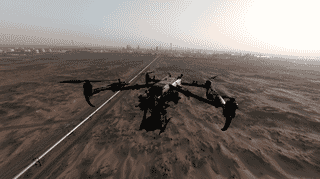
Terra Drone has solo-won a contract worth 10.15 million Saudi riyals, about 2.7 million dollars, for pipeline security surveillance in eastern Saudi Arabia. Here is how Japan's industrial drone champion is moving from inspection into AI-driven security patrols, and how it is threading between Skydio's NDAA-compliant U.S. push and DJI's exclusion from new U.S. approvals.
Terra Drone has unveiled flight footage of its fixed-wing interceptor drone Terra A2 — 75km range, 312km/h top speed, 40-minute endurance. CEO Toru Tokushige outlined the layered air defense vision in a United24 Media interview. Inside the modern methods of stopping Shahed-type kamikaze drones and the new air defense economics being shaped by a Japanese startup.
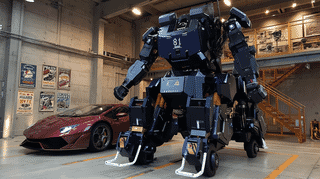
Tsubame Industries' Archax is a 4.5-meter, 3.5-ton piloted robot that transforms between robot and vehicle modes, priced at 400 million yen. What that buys, the CTO who engineered Yokohama's moving life-size Gundam, the Shoji Kawamori special edition, and how Unitree's $650,000 GD01 changed the competitive picture in May 2026.
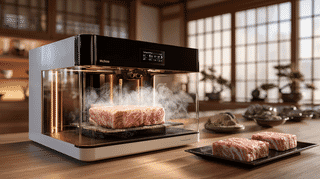
TOPPAN, a 120-year-old Japanese printing company, is applying the thin-film layering know-how it built in semiconductors to 3D-printed cultured meat, targeting revenue from 2031. The plan: a countertop 'Meat Maker' that prints marbled wagyu from data and a recipe. We cover the NEDO consortium with Shimadzu and Itoham Yonekyu, Integriculture's rival cellular agriculture platform, where cultivated meat is legal today, and the cost wall still in the way.
On April 23, PM Sanae Takaichi met five foodtech CEOs at the PM's Office: Oishii Farm, PlantX, FRD Japan, Regional Fish, and Toko Tekko. Why these five? This article decodes how each company's technology answers one of the world's four shared food crises, climate-driven farmland collapse, ocean depletion, population growth, and shrinking farmer populations, and the strategic logic behind Japan choosing to win in specific categories rather than competing across the board.
PETOKOTO and three partner organizations launched the Pet Guardianship Lab to tackle Japan's emerging 'pet refugee' crisis. As single households hit 40% and the population ages rapidly, a uniquely Japanese law-insurance-NGO consortium is building a safety net for pets whose owners die, are hospitalized, or develop dementia.
Japan has reduced dog and cat euthanasia by 99% over 50 years, yet 6,830 animals are still put down annually. Tokyo-based Signal Talk has launched 'Paw Me,' a service that lets users feed shelter animals remotely via smartphone. A new model of social participation for those who cannot keep pets due to allergies, age, or living situation.
JISDA (Japan Integrated Security Design Agency) has launched the Shiraha, a wooden fixed-wing drone costing just 70,000 yen (about 440 USD). Built on three years of field research within 20 km of Ukraine's front line, it targets Japan's training-attrition gap. How it differs from AirKamuy's cardboard drone and why Japan's defense mindset is finally shifting.
Food tech is one of 17 pillars in Japan's new national growth strategy under the Takaichi administration, with a 30% global market share target by 2040. Beyond the obvious giants like Maruha Nichiro, Nissin, and Kikkoman, this deep dive spotlights 5 lesser-known but high-potential players: Regional Fish (gene-edited seafood), FRD Japan (closed-loop salmon), Chitose Bio Evolution (algae unicorn), UMITRON (aquaculture AI), and Oishii Farm (NY strawberry factory).
Alpaca, founded by two Japanese entrepreneurs in Silicon Valley, hit a $1.15 billion valuation in its Series D round, becoming the first Japanese-founded US unicorn. Serving SBI Securities, Kraken, and 300+ institutions across 40 countries, it aims to be the 'AWS of finance', alongside Plaid and Stripe. Why did they build this in America, not Japan?
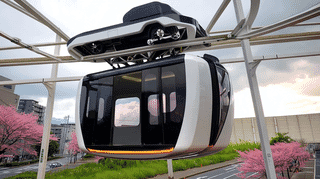
Zippar, a self-propelled urban ropeway developed by Fukushima-based startup Zip Infrastructure, can run every 12 seconds and navigate curves. At 1/20 the cost of subway and 1/5 of monorail construction, it could rescue Japanese cities facing a bus driver shortage.
Japan's FSA plans to let ordinary companies set up simplified insurance subsidiaries that co-insure with major carriers. Born from post-scandal industry reform, the move could reshape a market long dominated by three mega-insurers, and open the door to embedded insurance and fintech innovation.
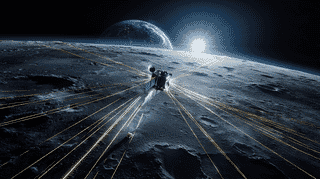
Japanese lunar startup ispace has unveiled 'Lunar Connect,' a communication and positioning service using lunar orbiting satellites. Partnering with KDDI for ground stations and planning 5 satellites by 2030, ispace is pivoting from a transport company to a space infrastructure provider. The new unified ULTRA lander marks another strategic shift.
Tokyo deep-tech startup H.I.Council has performed the world's first 108-qubit FeMoCo calculation on IBM's Heron r2 processor. While achieving chemical accuracy via classical methods, the team discovered a quantitative hardware limit they call the 'coherence wall' — a constructive finding for quantum hardware development.
Japan's METI officially approved an additional $4 billion for Rapidus, bringing total government support to $15 billion. We analyze Japan's 2nm chip ambitions alongside the US CHIPS Act, EU Chips Act, TSMC's Kumamoto expansion, and the critical challenge of finding customers.