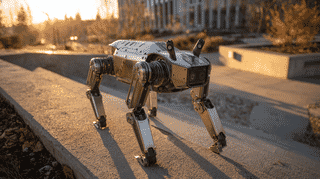
University of Tokyo's MEVIUS2 is a Spot-sized open-source quadruped robot built from sheet metal and e-commerce parts. With full hardware and software on GitHub, LiDAR and HDR camera perception, and reinforcement learning locomotion, it aims to democratize advanced robotics, at a fraction of Spot's $74,500 price tag.
Ritsumeikan University startup Patentix raised $1M in Series A1 funding to accelerate germanium dioxide (GeO2) power semiconductor development, a next-gen material that could outperform SiC and GaN.
AIST developed a voltage-induced static magnetization switching method using artificial antiferromagnets, enabling stable writing across a wide pulse-width range for voltage-driven MRAM. Published in Nature Materials, this breakthrough could lead to ultra-low-power memory for AI and IoT devices.
A Japanese research team has achieved what was considered impossible for over a century: creating a transparent, millimeter-sized bulk piece of amorphous alumina. With a dielectric constant of 11.3, surpassing sapphire, and a novel pentahedral pyramid structure, this JACS-published breakthrough could reshape semiconductor and capacitor materials.
Researchers at Kobe University have achieved the world's first inkjet printing using structural color nanoparticle ink — no dyes, no pigments, just silicon nanoparticles that produce color through light resonance. The result: vivid prints that never fade, with applications from eco-friendly packaging to anti-counterfeit security.
Nobel laureate Shinya Yamanaka explained iPS Cell 2.0 on NTV's Bankisha. From next-gen stem cell tech overcoming current limitations to universal blood platelets that bypass blood-type matching, plus Japan's historic first-ever iPSC drug approvals in 2026 — a comprehensive look at where iPS cells stand 20 years after their discovery.
Japan's METI raises the subsidy cap for quantum technology business demonstrations to ¥2 billion ($13M) per project, a tenfold increase. With ¥15 billion earmarked for business applications out of a quantum budget exceeding ¥100 billion, Japan pushes to industrialize quantum computing in logistics, drug discovery, and beyond.
Japan's AIST has established ASiST, a new consortium bridging chip design, front-end, mid-process, back-end, and packaging. Learn how it fits into Japan's semiconductor revival alongside Rapidus and competes with U.S. and EU chip strategies.
DENSO and the University of Tokyo signed a 10-year partnership starting April 2026 centered on Dynamic Wireless Power Transfer (DWPT). Learn how charging EVs while driving could shrink batteries, cut costs, and reshape energy infrastructure — plus how Japan's approach compares to Sweden, Israel, and the US.
The University of Tokyo's Graduate School of Engineering launches a new Blockchain Applied Practice Program in 2026, featuring cross-disciplinary study groups in finance, cryptography, contemporary art, and mobility. Eight major blockchain platforms including Ethereum Foundation and Avalanche participate in a chain-neutral design.
Fujitsu and Osaka University developed STAR Architecture ver. 3 and molecular model optimization to cut quantum computing resources to between 1/15 and 1/80 of conventional FTQC needs. Calculations for drug-critical Cytochrome P450 fall from 740,000 to 40,000 qubits and complete in 9 days. Comparison with IBM, Google, and IonQ's quantum drug discovery efforts included.
Osaka University startup QuEL has demonstrated 24-hour stable operation of its quantum bit control device QuEL-1 SE, achieving amplitude standard deviation of 0.15% and phase standard deviation of 0.39°. Published in Review of Scientific Instruments, this breakthrough in device-level temperature control clears fault-tolerant thresholds crucial for scaling quantum computers toward the million-qubit era.
Researchers at Osaka and Yamagata Universities have created a 'smart plastic' whose degradation can be toggled on and off with light. Using movable molecular rings, the material balances durability with biodegradability — and can even encode QR codes revealed by enzyme digestion. Published in ACS Nano.
Researchers at the University of Tokyo developed an AI model that integrates cine MRI imagery of uterine peristalsis with clinical data, significantly improving pregnancy prediction for patients with recurrent implantation failure. The novel approach condenses 18 seconds of uterine movement into a single image for deep learning analysis.
AT Tokyo and elleThermo successfully demonstrated waste heat power generation using Semiconductor-Sensitized Thermal Cells (STC) in a live data center. This Science Tokyo-born technology generates electricity directly from low-grade heat at just 30-40°C — no temperature differential required. A look at how this could reshape data center energy efficiency amid soaring AI power demands.
Not the iPS cells themselves, but the liquid they're grown in, injected into arthritic knees. A Japanese team's world-first study showed 71.4% improvement by international criteria with no serious adverse events. We look at what a seven-patient uncontrolled pilot can and cannot tell us, and where conditioned medium sits in Japan's regulations.
Japanese fusion startup Helical Fusion announces the construction site for its demonstration device 'Helix HARUKA' Phase 1, while completing critical coil case components with precision manufacturer Ryoki Tool. Explore how Japan's unique helical stellarator approach and the HTS superconductor boom are reshaping the global fusion race.
Osaka University's QIQB and Fixstars achieved the world's largest quantum chemistry circuit simulation using 1,024 NVIDIA H100 GPUs on Japan's ABCI-Q supercomputer. Breaking the previous 40-qubit barrier, they simulated H₂O with 42 spin orbitals and Fe₂S₂ with 41 qubits — accelerating quantum algorithm development before fault-tolerant quantum computers arrive.
Tohoku University spinoff Space Quarters has successfully demonstrated electron beam welding in simulated zero-gravity and lunar gravity environments aboard an aircraft. The company achieved a world-first by welding sintered lunar regolith — the sandy material covering the Moon's surface. With its ultra-compact 7 kg welding system and JAXA partnership, this breakthrough brings humanity one step closer to building infrastructure in space.
Power Diamond Systems demonstrated the world's first actual power conversion using a diamond MOSFET in a DC-DC converter circuit. Following their recent 200V/1A switching milestone, this breakthrough advances diamond semiconductors from device-level testing to real circuit operation.