SoftBank Group plans to spin off and list 'Roze,' an AI and robotics company, on US markets at a target valuation of $100 billion. We unpack Masayoshi Son's strategy in the context of Stargate, his OpenAI commitments, how Japanese tech compares to US and Chinese giants, and the Middle East risk hanging over the timing.
JAL launches Japan's first humanoid robot trial at Haneda Airport in May 2026. Chinese-made Unitree G1 and UBTECH Walker E will handle cargo loading and cabin cleaning, Japan's bipedal answer to its aging workforce and aviation labor crisis.
Kyoto University's AI-powered robot monk Buddharoid now offers spiritual guidance at a Kyoto temple, trained on ancient Buddhist scriptures. With 30% of Japan's 77,000 temples projected to vanish by 2040, can artificial intelligence save Buddhism? From the $1M Mindar android to BuddhaBot chatbots reaching Bhutan, we explore where faith meets technology.
SoftBank, NEC, Honda, and Sony have established a new company to develop Japan's own AI foundation model, backed by $6.3 billion in government support over five years. Instead of competing head-on with US and Chinese tech giants in general-purpose AI, Japan is betting on 'Physical AI', AI that controls robots and factory equipment using the country's deep manufacturing expertise.
Japan Research Institute proposes an Ocean Industrial Complex combining deep-sea robotics, rare earth mining, and blue carbon. With a successful trial extraction of rare earth mud from 6,000m depth and breakthrough underwater wireless tech, Japan's ocean strategy is becoming reality.
SoftBank Group is betting big on Physical AI, merging telecom infrastructure with robotics. From its $5.4B ABB acquisition to AI-RAN partnerships with NVIDIA, Arm, and Yaskawa, here's how Japan's tech giant plans to make robots think and move in real time.
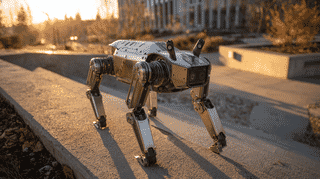
University of Tokyo's MEVIUS2 is a Spot-sized open-source quadruped robot built from sheet metal and e-commerce parts. With full hardware and software on GitHub, LiDAR and HDR camera perception, and reinforcement learning locomotion, it aims to democratize advanced robotics, at a fraction of Spot's $74,500 price tag.
FANUC, the world's largest industrial robot maker, partners with NVIDIA for Physical AI while deliberately avoiding humanoid robots. We break down its historic open-platform shift, the NVIDIA Isaac integration, and how it plans to compete against ABB, KUKA, and China's robot surge.
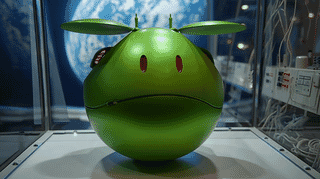
Space Entry Inc. launches 'Minna no Haro,' an autonomous space robot inspired by Gundam's iconic Haro, bound for the ISS Kibo module. Designed by legendary mecha designer Kunio Okawara and running Zephyr RTOS, the project achieves three world firsts and invites public participation through crowdfunding.
As drone warfare extends to the seas, Japan leads the world in autonomous ship technology. From the MEGURI 2040 project to combat-support USV development and lessons from Ukraine, explore the future of maritime security.
Japanese robotics startup Jinki Ittai unveils its Bilateral Arm — a collaborative robot that transmits force feedback to operators — at Japan IT Week 2026. Also on display: a transformable humanoid heavy machine designed by Macross anime creator Shoji Kawamori. Partnering with Advantech (42.5% global IPC share), the company pursues a distinctly Japanese approach to robotics: human-operated force control rather than full autonomy, setting it apart from Boston Dynamics and Tesla Optimus.
Omron announced it will sell its founding electronic components business — relays, sensors, and connectors dating back to 1933 — to U.S. private equity firm Carlyle Group at an enterprise value of ¥81 billion ($540M). A deep dive into Omron's strategic pivot to industrial automation and healthcare, and what this means for Japan's electronics industry restructuring.
Casio and JAXA have demonstrated ±5cm positioning accuracy using LED-based visible light communication technology 'picalico' in a simulated lunar environment. With no GPS available on the Moon, this warehouse-born technology could become essential infrastructure for future lunar bases and rover operations.
Four Japanese companies formed J-HRTI, a consortium to accelerate humanoid robot deployment in factories. With Japan's first private data collection center opening in July 2026, the initiative takes a unique approach focused on industrial data and real-world implementation amid fierce US-China competition.
Japan's Ministry of Economy, Trade and Industry (METI) has formulated a roadmap for deploying AI-powered autonomous robots in security, waste management, and other labor-short sectors by 2030. While Japan commands ~70% of the industrial robot market, it lags behind the US and China in service robotics. The government now targets 30%+ global market share and $130 billion in the AI robot market by 2040. Here's what this national strategy means for Japan and the world.
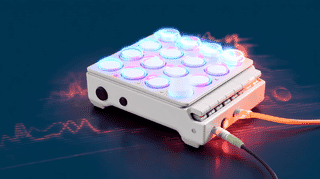
Japanese startup DOT P unveiled PONKEY, a solenoid-powered instrument robot, at SXSW 2026 in Austin, Texas. Featuring 16 custom-designed keys that light up, produce sound, and physically pop out, PONKEY functions as a drum machine, digital synthesizer, and AI communication device. Backed by Tokyo's TOKYO SUTEAM program, it's set for public release in 2027.
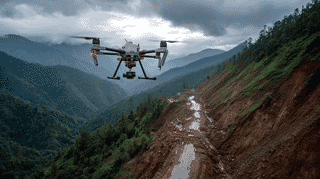
Aizawa Concrete's F3DP is a gasoline-powered drone with a robotic arm and nozzle that extrudes concrete in flight. It is aimed at printing formwork for floating offshore wind platforms by the end of 2028. A machine born from Japan's construction math: 4.77 million workers, 36.6% of them over 55.
Yaskawa's June 2026 plan puts 120 billion yen into Physical AI. FANUC published a ROS 2 driver on GitHub and partnered with both NVIDIA and Google. Mujin raised 36.4 billion. Japan still owns 35% of an industrial robot's cost through precision reducers, but the killer app hasn't shown up.
Citizen Electronics has built the first pressure sensor switch that also gives a physical click, reading 0.35 mm of travel across roughly 6,000 steps. Its metal spring tames hysteresis, the chronic flaw in pressure sensors, opening the door to analog game buttons and robot fingertips.
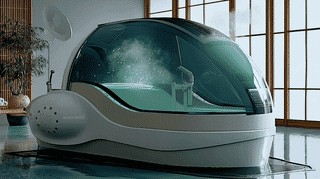
The Mirai Human Washing Machine, tried by 1,277 people at the 2025 Osaka Expo with 98.3% satisfaction, is now sold at Yamada Denki. The 60-million-yen ($370,000) flagship is limited to 40-50 hand-built units, alongside a 1.45-million-yen ($9,000) model aimed at care homes.