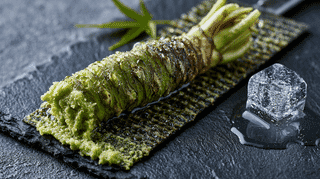
Sensitive teeth affect roughly a third of adults in some surveys, and the usual fix is to seal the surface over. A Tokyo Dental College team has shown that 6-MSITC, a compound in Japanese wasabi, pushes dentin-building cells to lay down new tissue instead. It began with a question asked at a sushi counter in Kanda.
The first commercial transplant of AMCHEPRY, the world's first approved iPS cell-derived medicine, is set for October in Kyoto. Why proving it takes 35 patients and six years, and why the US and EU have no equivalent product.
A team at the Institute of Science Tokyo found resistance genes running harder inside hospital drain biofilm than in the wastewater itself. Why new pipes can backfire.
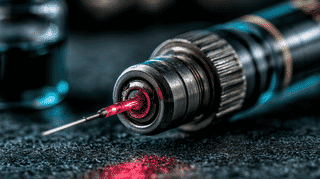
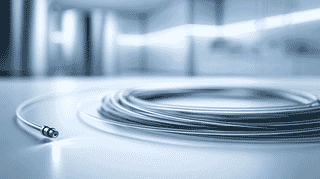
Tohoku University and Air Water went after the two bottlenecks that have kept photothermal cancer therapy in the lab for twenty years. IDP1, an artificial protein designed with AlphaFold, kept nanoparticles circulating for 150.5 minutes against 17.8 for PEG, and a 0.5 mm endoscope that fits inside a 16-gauge needle fired an 808 nm laser from inside the tumor at 28 percent less power. In mice, the tumors were gone within 14 days. How that compares with US trials already running in humans.
Rubbing a sore spot really does help. Kyushu University researchers have identified the touch neurons behind it in mice, a subpopulation called Npy2r-Cre that dampens pain signals in the spinal cord. The PNAS study puts specific cells behind the 1965 gate control theory.
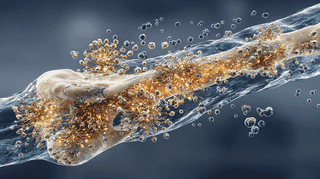
Why does osteosarcoma cluster in the knees of growing teenagers? A University of Tokyo team, working from an accidental clue in aging research, has pieced together how the cancer starts: an accelerator gene (c-Myc), a brake gene (p53), and a signal from the bone's growth plate. It could reshape drug discovery for a rare cancer.
Researchers at Showa and Kansai Medical Universities grew mesothelial-like cells from human iPS cells to repair the peritoneum, the membrane that wears out and ends peritoneal dialysis. A look at the mouse proof-of-concept and why Japan's PD rate is so unusually low.
Japan's iPS cell therapy already treated fresh spinal injuries. Now a Keio University team is preparing a trial for the far harder chronic phase, where more than 100,000 patients have long been told regeneration simply isn't possible.
Toho University stroked infants on the head, back and belly. Only the back calmed them, at about 10.5 cm/s. In mouse pups raised without a mother, the response never appeared at all.
An Osaka University startup, Endoluminal Solutions, has built a 4mm single-use endoscope aimed at replacing barium gastric-cancer screening. A look at the miniaturization behind it and where it fits in an endoscope industry Japan's Olympus dominates.
Nagasaki University and Shionogi have found FPSA, a compound that targets plasmepsin X, the enzyme malaria parasites use to burst out of red blood cells. As artemisinin resistance spreads across Africa, a fresh mechanism of action matters. A look at Japan's global-health drug discovery and where this actually stands.
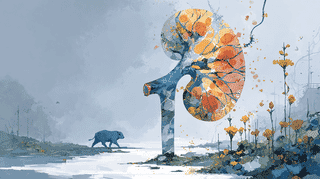
Japanese startup PorMedTec will run the country's first pig-to-human kidney transplant trial at Hokkaido University Hospital and Shonan Kamakura General Hospital in early 2028. Against a backdrop of 340,000 dialysis patients and 15-year transplant waits, we look at the plan, the gene-edited eGenesis pigs, and how it compares with US clinical cases.
A Hirosaki University team made a hydrogel that is 70% water yet bounces like a superball. Swapping one end group from methoxy to hydroxyl raised its stiffness about twentyfold, pointing toward artificial cartilage and underwater cushioning.
Two nearly identical proteins, one sees red and one sees green, separated by just 30 nanometers. A Japan-led international team determined the dark-state atomic structures of the red and green cone pigments for the first time, revealing that three amino acids decide how we tell red from green. The story behind a long-standing mystery in color vision.
Damaged neurons were thought to be beyond repair. A University of Tokyo team led by Noboru Mizushima just challenged that in mice: switch the cell's cleanup system, autophagy, back on, and the protein junk clears, motor skills and memory return. A new angle on neurodegeneration from a disciple of Nobel laureate Yoshinori Ohsumi.
Japan's heart-transplant society is studying transplants from cardiac-death donors. Why now, in a country that donates at one-fortieth the US rate? Inside the 1968 scandal, the death-view gap, and the ethics of restarting a stopped heart.
A Kyushu University team showed for the first time that RPS19, long known as an anemia gene, also suppresses cancer by keeping p53 working. The finding hints at repurposing existing MDM2-inhibitor drugs.
Japan's Koroyawa floor stays hard when you walk and softens only when you fall. Science Tokyo proved it prevents elderly hip fractures using a world-first simulation built from a real patient's CT data.
A Japanese biotech threaded a catheter into a failing heart and delivered iPS-derived muscle without opening the chest. Inside the world's first trial of its kind.
Medicines available in the US and Europe that Japanese patients cannot get. We unpack Japan's drug loss problem: the count falling from 86 to 78, a new fiscal-2026 budget, and the fresh risk posed by Trump's drug-pricing executive order.