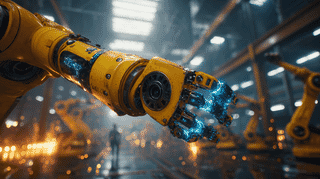
FANUC, the world's largest industrial robot maker, partners with NVIDIA for Physical AI while deliberately avoiding humanoid robots. We break down its historic open-platform shift, the NVIDIA Isaac integration, and how it plans to compete against ABB, KUKA, and China's robot surge.
Ritsumeikan University startup Patentix raised $1M in Series A1 funding to accelerate germanium dioxide (GeO2) power semiconductor development, a next-gen material that could outperform SiC and GaN.
AIST developed a voltage-induced static magnetization switching method using artificial antiferromagnets, enabling stable writing across a wide pulse-width range for voltage-driven MRAM. Published in Nature Materials, this breakthrough could lead to ultra-low-power memory for AI and IoT devices.
Global chip sales hit $88.8B in Feb 2026, up 61.8% YoY. Yet Japan is the only region with 9 consecutive months of decline. We analyze the structural reasons behind Japan's stagnation amid the AI-driven global boom.
Japan's two biggest music labels, Universal Music and Sony Music, have formed NINE BY NINE, a joint venture to produce Japanese music festivals across Asia starting 2027. Here's what this means for J-pop's global push.
A Japanese research team has achieved what was considered impossible for over a century: creating a transparent, millimeter-sized bulk piece of amorphous alumina. With a dielectric constant of 11.3, surpassing sapphire, and a novel pentahedral pyramid structure, this JACS-published breakthrough could reshape semiconductor and capacitor materials.
Japan's yen-pegged stablecoin JPYC reaches approximately $136M in cumulative transaction volume. Osaka's legendary okonomiyaki chain Chibo becomes the first restaurant chain to accept JPYC payments. Over two-thirds of transactions run on Polygon. We explore the currency sovereignty debate in the AI agent era.
Japan's natto exports hit a record 5,248 tons in 2025, up 44% year-over-year. Driven by global health trends and fermented food hype, natto is conquering new markets. But packaging regulations and Korean competitors pose challenges. Plus: how the world eats natto.
Saudi investment firm EGDC has increased its Capcom stake from 5.03% to 6.04%, just three weeks after its initial filing. Combined with PIF's existing holdings, Saudi-linked capital now controls roughly 11% of the Monster Hunter maker amid record-breaking earnings.
Yuri Okina takes the helm of the world's largest pension fund GPIF ($1.7 trillion). Despite Middle East-driven market volatility, she affirms the current 25-25-25-25 portfolio can meet the 1.9% real return target. We compare GPIF's strategy with Norway's GPFG and Canada's CPP.
Renesas Electronics' Intersil-brand radiation-hardened ICs are aboard NASA's Artemis 2 crewed lunar mission, powering critical subsystems in the Orion spacecraft and SLS rocket. Discover the 60+ year heritage behind these space-grade chips and what Japan's role in the $1.8 billion rad-hard semiconductor market means for the future of space exploration.